Today’s guest blogger is my wife Kim, who discusses how the words “Christmas” and “Arabia” could once be used in the same sentence when she lived in the Middle East more than 40 years ago. Ah, the magic and romance of the desert …
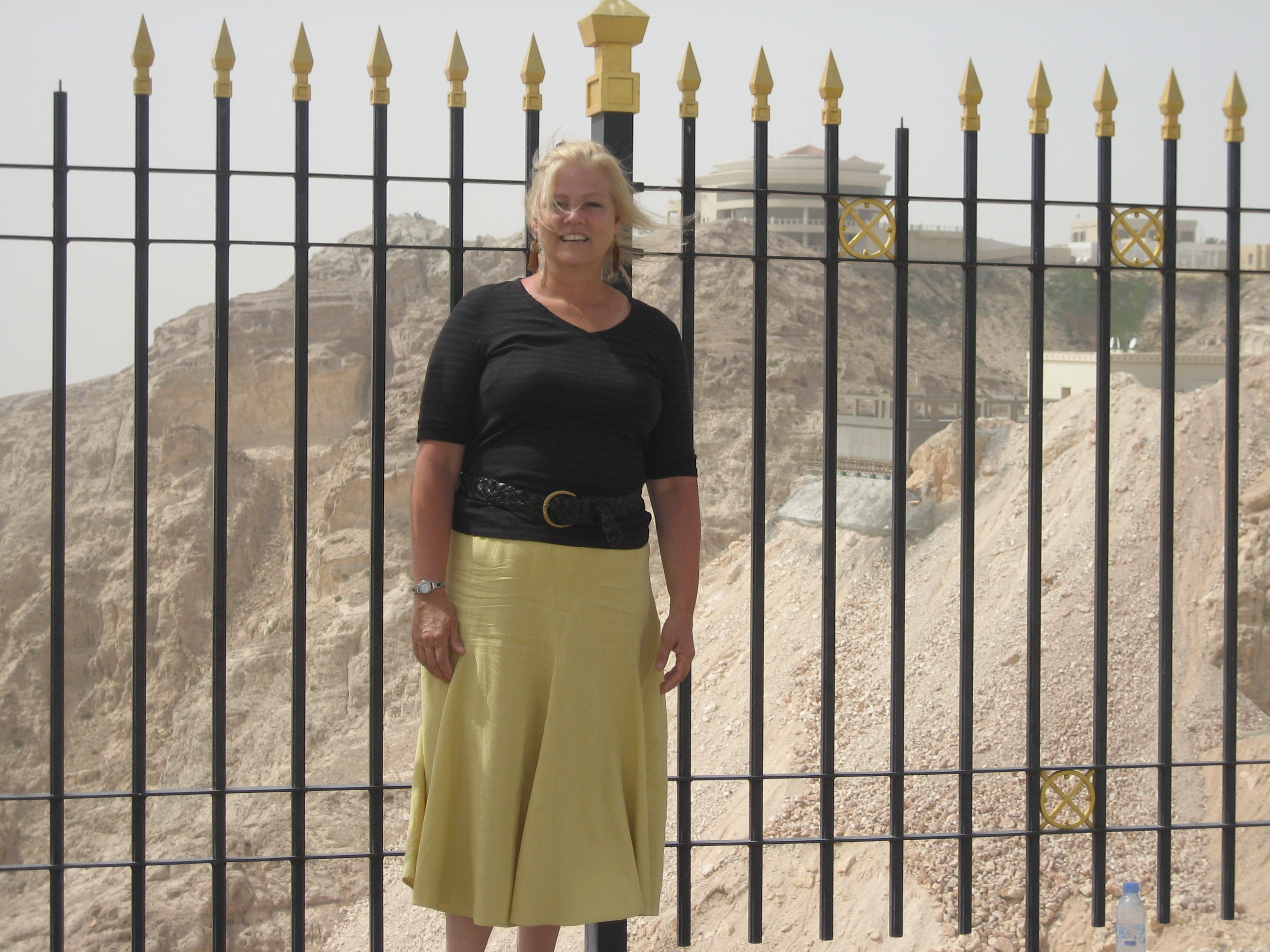
Kim in Arabia, May 2011
It seems so long ago. The years were 1965-1970. It was Christmas in Saudi Arabia, where my parents were missionaries to the Bedouin people in the desert.
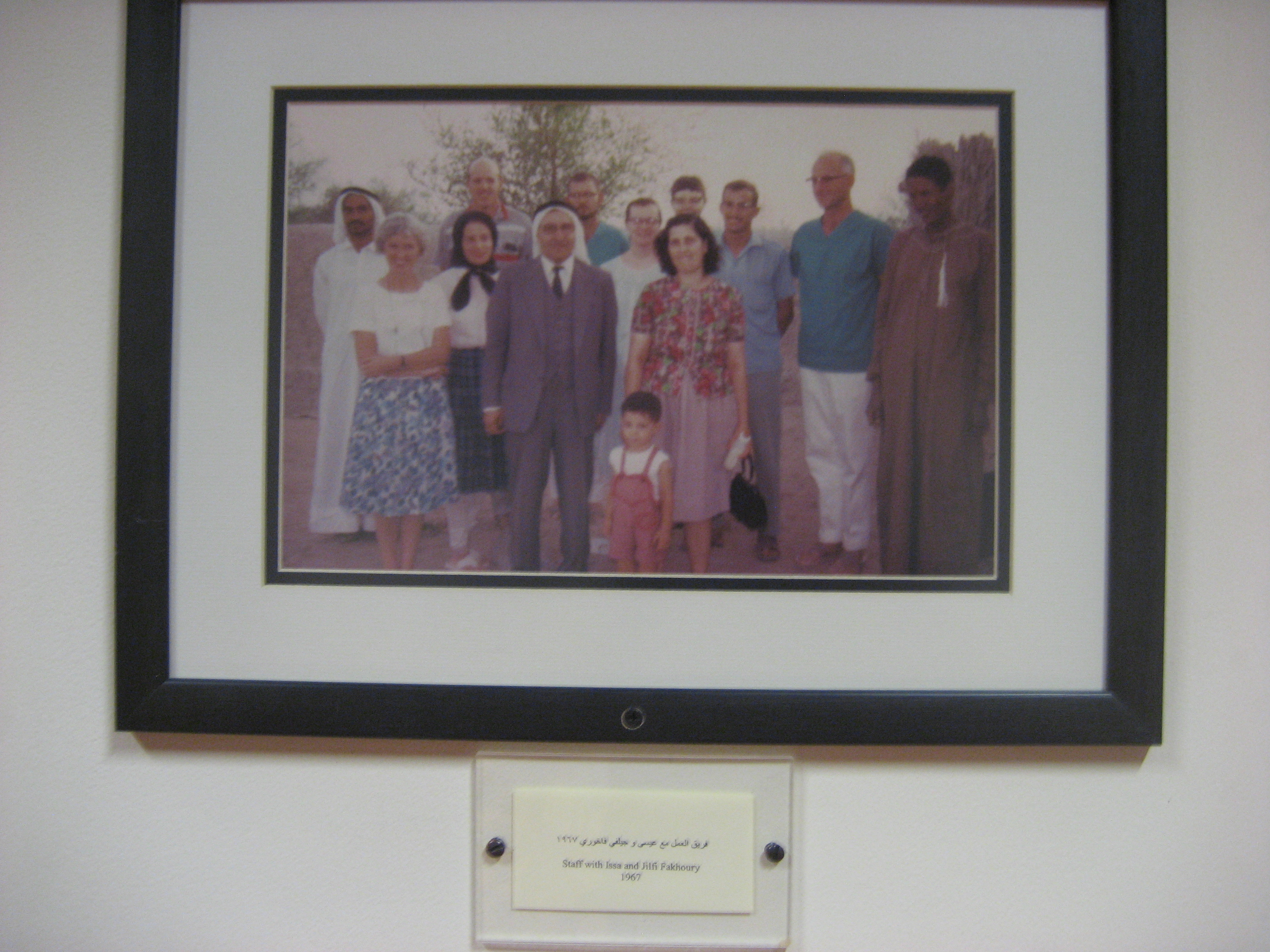
Photo at Oasis Hospital with Kim's father in back row, 3rd from left, 1967
We lived about 100 miles from the now beautiful, modern city of Dubai.

46 years ago, we traveled by open land rover on non-existing roads surrounded by sand dunes. It took about 10 hours to travel 100 miles.
19 months ago, I went back to visit where I lived. I took a taxi to the hospital where we used to work and it only took 1 hour and 15 minutes. What a difference!

Kim with Taxi in Arabia, May 2010
When the Arabs asked me why I was visiting, I told them, “I lived here 46 years ago.” With amazement, they said, “There was nothing here.” I said, “You are exactly right.”

Kim in Front of Oasis Hospital, May 2011
Every year at Christmas time, my brothers, sisters and I came home from boarding school, either in Pakistan or India. It was only at Christmas time that I saw my parents each year. I counted every day for months when it was time to go home. Home was where we had no homework and no strict schedules for two months.
We would get together with friends on the compound. We hiked, cooked, played games, played tricks on each other, and saw our pets (cats, dogs, gazelles, goats, a donkey, a fox, and a hedgehog).
Sometimes we slept outside up on high beds to keep snakes and scorpions away. We would wake up in the morning hearing camels eating our dried palm leaf fence.
Life was simple. We would run around without shoes, help in the hospital, read books, listen to good music, and sit around and just talk. I loved the simplicity.

Saudi Arabian Desert
When it came to getting a Christmas tree, we were creative. We chose a thorn bush and brought it home to decorate. We had fun adorning the tree with popcorn. We wanted more decorations so we took Kotex and tore it apart to make snow with cotton. I wasn’t sure my mom was very happy with us.
We learned to make taffy, pulling and pulling until we had a sweet, sticky treat.
But my best memory was camping in the desert. I remember always having a sinus infection but I was determined to go – so I bundled up and went camping. Being in the desert at night under a clear sky, you could see every star. You could see the campfire for miles. You were surrounded by sand dunes and the sound of nothing. It was peaceful and quiet.
It must have been how the shepherds, Joseph, and Mary felt when Jesus was born.
Our Christmas service was held outside at night. The glowing of candles and far off lights made the desert romantic and magical. I was asked to play the organ and everyone from the compound came and sang Christmas carols. This was my gift to Jesus.
Oh, the simplicity of Christmas!




















 Restoring Kingdom Builders
Forgiving Offenders … Jesus’ Way
Posted in Church Conflict, Church Health and Conflict, Conflict with Church Antagonists, Forgiveness and Reconciliation among Christians, Personal Stories, Please Comment! on December 28, 2011| 3 Comments »
His words still reverberate in my ears.
25 years ago, I served as pastor of a small church in Silicon Valley.
People attend small churches for various reasons. Near the top of the list is significance.
Many churchgoers want to have a say in decision-making, so leaders schedule lots of “business meetings.”
We had such a meeting one Sunday night after the evening service.
A woman made a statement in the meeting. While I cannot recall her precise wording, she mentioned something positive about her Bible teacher, who was also a board member.
The board member interpreted her comment in a negative manner. He quickly yelled out a response in front of the entire church, mentioning her indirectly.
The meeting was spinning out of control – and the moderator stood there in silence.
A few days after the meeting, I contacted the shouting board member and told him that he needed to apologize to the entire congregation for his behavior.
(If you sin in the presence of one person, you need to apologize to that one person. Sin in front of a group, apologize to that group. Sin in front of the congregation, apologize to the congregation.)
It took courage for me to speak with him.
He was twice my age.
He had been a pastor and a missionary in the past.
He was an intimidating individual.
He had vented his wrath on me at times, too.
But he had crossed a line, and he needed to acknowledge his mistake in front of his church family.
Sometimes we had guests on Sunday mornings, so that wasn’t the optimal time for his apology.
I invited him instead to make his apology during our next Sunday evening service when only our church family was present.
It was a so-so apology – maybe good for him, although not as sincere as I would have liked.
If the board member hadn’t apologized, I would have asked him to step down from the board. Yes, leaders mess up, just like everyone else, but when we do, we need to make things right by admiting our sins and requesting forgiveness – especially when we sin in a public setting.
In this case, we forgave him, and that was that.
If this incident happened in your church, how would it have been handled?
Some Christians prefer to deny that anything happened.
Others excuse such misbehavior.
A few believers choose to avoid the sinner in the future.
Some decide to ostracize the offender instead.
And some believers quickly forgive the person without waiting for any type of confession on the offender’s part.
The church as a whole tends to ignore Jesus’ instructions in Luke 17:3-4:
“If your brother sins, rebuke him, and if he repents, forgive him. If he sins against you seven times in a day, and seven times comes back to you and says, ‘I repent,’ forgive him.”
Notice the sequence: Your brother sins. You rebuke him. He repents. You forgive him.
But we tend to ignore the rebuking and the repenting steps. It’s too much work … and, truth be told, we often lack the courage to rebuke anyone … even our kids or friends.
So when our brother sins, we take a shortcut. We instantly forgive him … but we really choose to overlook his sin instead.
That doesn’t help him at all. He’s more susceptible to repeating his behavior.
And some people will choose to tiptoe around the offender from then on.
In the process, we teach our church that when you sin, nothing happens.
I seek to practice these words of Jesus in my own life and ministry.
They deal with sin realistically.
They heal relationships.
They provide true reconciliation.
This week, when a Christian brother or sister sins, gently rebuke him or her so they will repent. In essence, Jesus says, “No repentance, no forgiveness.” (Re-read the second half of verse 4 above.)
And when they repent, let them know you forgive them.
That’s Jesus’ way.
If Christians obeyed Luke 17:3-4, we’d have far less conflict and broken relationships in our churches.
And that’s the biblical way of dealing with sinning Christians.
So why don’t we do it? I’d love to hear your thoughts.
Share this:
Read Full Post »