Feeds:
Posts
Comments

Archive for the ‘Personal Stories’ Category

A Justly Proud Father

Tomorrow will be one of the most joyous and blessed days of my life.

My son Ryan is getting married to a fantastic Christian girl named Vanessa.

Ryan and Vanessa on the Day of Their Engagement

My wife and I have been praying for this day for years – but for a long time, it didn’t look like it was going to happen.

Ryan was born in Orange, California, on Labor Day.  Although we did not know the gender of our first child before birth, I was giddy as I was putting on my gown before he greeted the world.  The California Angels were playing at nearby Anaheim Stadium that day and Nolan Ryan, my favorite player, pitched and won against the White Sox.  Many people assume that I named Ryan after Nolan Ryan, but I actually saw the name Ryan Andrew in the sports section of the LA Times, and we chose to go with it.

When Ryan was growing up, he loved to collect baseball cards (he would talk to the players directly), build forts in our living room out of blankets and pillows, and lead neighborhood kids in endeavors like Spy Camp.  He played Little League and went with me to spring training in Arizona and countless Giants games at Candlestick Park.

But his whole world changed the Christmas we bought a family computer – a Mac IIsi, to be exact.  That was 20 years ago.  I can still see his eyeballs bulging out of their sockets when he saw it.

One summer, Ryan worked hard to earn enough money to buy his own computer.  I was very proud of him for doing that.

When he turned 16, I took Ryan to the East Coast for a 10-day trip.  We had a marvelous time seeing the sights, but most of all, we understood each other a lot more after that excursion.

While I taught Ryan how to play sports and drive, he taught me about The Simpsons, Seinfeld, Star Trek: The Next Generation and Hootie and the Blowfish.  Seems like a good deal to me.

Ryan eventually learned how to run the sound board at our church and later become a drummer.  Many nights, he assembled a band that played outside in the church parking lot very late at night – with the approval of security.

After graduating with a computer science degree from UC Irvine, Ryan chose to live in southern Orange County, where he has worked for several companies.

Somewhere along the line, he started attending a wonderful church in Irvine.  We thank God for Pastor Terry’s leadership and teaching and for the many friends Ryan has made there.

Ryan has also been mountain biking for years, training diligently and competing in races all over Southern California.

Ryan Mountain Biking

Even though he led a full life, something (or someone) was missing.  After dating numerous young women, Ryan finally met Vanessa via eharmony in the summer of 2010.  (Thank you, Neil Clark Warren!)  My wife and I have prayed for many years that Ryan would marry a mature Christian woman from a healthy Christian family and that they would serve the Lord together.  Vanessa is the answer to our prayers – and those of our son as well.

Tomorrow they become man and wife.  I’m privileged to be conducting their ceremony.

Tonight I’ll think back to the joy I felt the day he was born, the times we played catch together, three vacations where it was just the two of us – and a time two years ago when he wasn’t sure he would ever meet the right woman.

At Great Smoky Mountains National Park

It’s now the right time.  Vanessa is the right woman.  And, as usual, God orchestrated the whole thing.

May the Lord be high and lifted up!

And may the Lord bless Ryan and Vanessa with a few little Meyers – eventually!

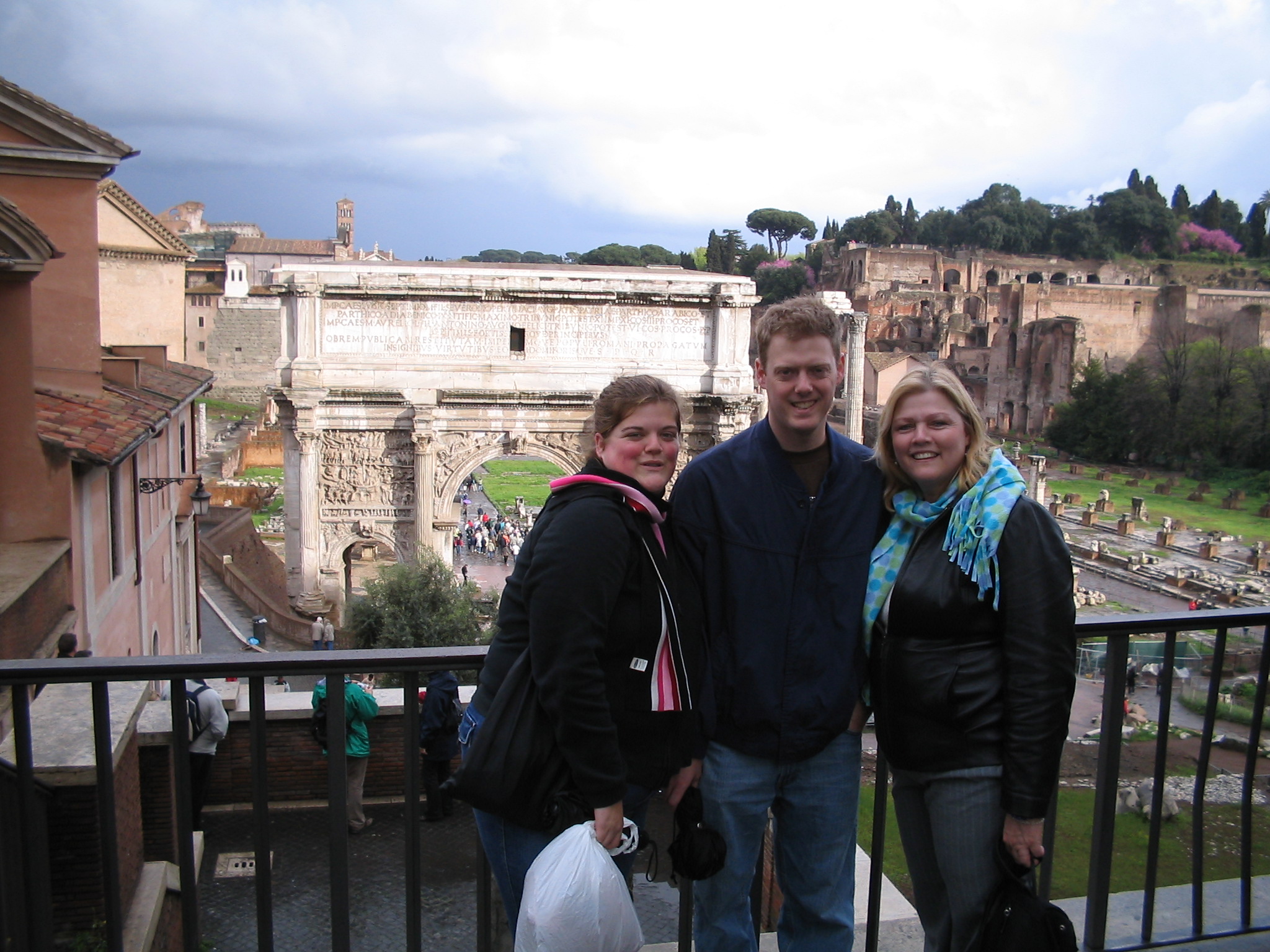
With Sarah and Kim Overlooking The Forum in Rome

Read Full Post »

36 Years

Today is the anniversary of the day that my wife Kim and I were married.

You know, it doesn’t seem that long ago.

Kim’s father became the pastor of my church in the summer of 1973.  I had just been hired by the elders to be the youth pastor for the summer.  I told a good friend that I hoped the new pastor’s two oldest daughters were ugly so I could focus on my ministry.

One day, just after I started work, a large blue Suburban pulled up in front of the church office.  All eight members of the new pastor’s family had driven together from Chicago to Garden Grove, and they wanted to know the location of their temporary home.  While telling them, I hardly noticed who was in the vehicle.

Over the next few weeks, I don’t remember talking to Kim, even though I was the new youth guy.  One of my best friends, though, saddled up to me and asked, “How can I get to know Kim?”

But I wasn’t interested – in anybody.

Yet one night, after talking with her a little, I asked Kim if she’d like to go to the San Diego Zoo the following Saturday.  She said yes.  My brother John had asked a girl to go with him, too.

Every week in a discipleship group I led, I assigned a spiritual exercise called a “discipline.”  The discipline for that week was that no one in the group was supposed to listen to the radio.  (Hey, music in 1973 wasn’t all that great anyway.)  So instead of listening to tunes while I drove to San Diego, Kim and I talked.  (I don’t know what my brother was doing in the back seat.)

And we talked as we walked around the zoo.  And we talked when I drove home.

While I liked Kim, I didn’t really know what to do after that.  But one guy in the group definitely did.  He invited her out the following Friday night to a car race.  She went.  I heard about it and wasn’t happy.  (I was thinking about asking the Lord to revoke his salvation.)

One night, Kim shared that she was having a hard time with the boy friend she left back in Chicago.  I offered to listen.  We ended up driving to the beach.

I came home and told my mother that I knew I had met the girl I was going to marry.

A few nights later, I was at home when I heard a noise outside.  There was toilet paper hanging from our mailbox –  at 7:30 in the evening.  I looked around for the culprit, and found Kim, hiding under a car.

That was a good sign.

I asked her out again the following weekend, and then took her to Disneyland.  When you took a girl to Disneyland back then, it represented a sizeable investment.

Another night, some people from our church went to the Los Angeles Rescue Mission to put on a service.  When I heard that Kim was going, my interest in Skid Row skyrocketed.  She gave a testimony that night, and I sensed how much she cared about people who hurt.

Another time, we went to the Griffith Park Observatory and stayed out late.  Kim’s dad didn’t know where we were, and he had the cops combing Griffith Park looking for us.  (Kim sauntered in around 4:30 am., but that was the last time we ever tried that move!)

Honestly, we were just talking.

After dating Kim for only two months, Kim’s dad had a meeting with my brother and me one night.  (My brother was dating her sister.)  Her father told us that he blessed both of our relationships.  That was cool.

Kim and I stayed up all night before the Rose Parade in Pasadena the following New Year’s Day, and for the first time, we started talking about getting married.  We were young but in love.

We went together for two years before tying the knot.  The ceremony was held at our home church.

I had taken a full-time job as church custodian (I prefer the term ecclesiastical engineer) so we could get married before I started seminary.  The morning of the ceremony, I came to church to spend my normal 5 hours cleaning up the place before Sunday – and promptly locked my keys in the car.  Only my mother had an extra key, and she laughed uproariously when she arrived to let me in.

Later on, the deacons told me they had voted that I didn’t have to clean up the church on my wedding day – but they forgot to tell me.  (If I hadn’t done it, who would have?)

The church was packed even though it was a scorching hot afternoon.  Kim’s dad preached a l-o-n-g sermon while we both knelt on stage.

We went to Yosemite for our honeymoon.  We were so financially challenged that our friends rifled through the wedding cards and gave us any cash they found.

That was 36 years ago!

When we first started dating, Kim and I had a serious discussion about the future.  I believed that God had called me to be a pastor.  She preferred to be a missionary.  I couldn’t envision myself living overseas in another culture.  But because we couldn’t envision living apart, either, she gave up her dreams for me.

There are so many things I love about Kim.  She is kind, sweet, compassionate, energetic, feisty, EC – and a lot of fun.

But most of all, I love her heart.

2 children, 3 apartments, 9 houses, 9 churches, and 10 surgeries later, we’re still madly in love – and truth be told, just plain mad.

Right before we started dating, Gordon Lightfoot came out with a song called Beautiful.  The song begins:

At times, I just don’t know

How you could be anything but beautiful

To think that I was made for you

And you were made for me

That’s how I still feel, more than three decades after marrying my bride.

Happy anniversary, Kimbelina!  I love you now more than ever.

Read Full Post »

John Stott died two days ago in London.  He was ninety years old.

More than any single person, he shaped the way I approached, interpreted, and taught Scripture.

Although Protestants don’t have a Pope, the British leader, author, theologian, and teacher was the next best thing for many of us.

A lifelong bachelor, Stott was the rector for many years at All Soul’s Church in Langham Place in London – right across from the BBC.  Although I’ve been inside the church, I’ve never attended a service there.  (If you look across the photo, you can see an exterior balcony at the BBC building.  U2 did a brief concert there not too long ago.)

After his tenure at All Soul’s, Stott undertook a worldwide teaching ministry.  I had the privilege of hearing him one time – at the Congress of Biblical Exposition in Anaheim in 1986.  Although the conference featured such great preachers as Chuck Colson, Chuck Swindoll, J. I, Packer, Howard Hendricks, Stuart Briscoe, and many more preaching all-stars, Stott was invited to give the first message.  During his talk, he referred to the perspicuity of Scripture, a term I had never heard before.  It was the genius of Stott that he could use a word like that and help us to understand both its meaning and application for our ministries.  (The word refers to the fact that the Bible is clear in its teaching.  If a passage seems unclear in one place, it will be made clear in another place.)

Although he was a great teacher, for me, Stott was primarily an author.  In the series The Bible Speaks Today, Stott wrote books on The Sermon on the Mount, Acts, Romans, Galatians, Ephesians, 1 and 2 Thessalonians, and 1 and 2 Timothy and Titus.  Stott’s analysis of each Bible book is accurate, clear, succinct and practical – and he can turn a phrase like nobody else.  And while some popular Bible teachers skip the problems in Scripture, Stott fearlessly plows right into each one, a trait I greatly admire and have tried to emulate.

For some reason, I have always been attracted to British thinkers and theologians, like Stott, Packer, F. F. Bruce, D. Martyn Lloyd-Jones, Alister McGrath, and the incomporable Charles Spurgeon, to name a few.  Their scholarship, thinking, and writing styles have always resonated with me.

Let me recommend three books by John Stott to you.  They are relatively inexpensive volumes:

First, Baptism & Fullness: The Work of the Holy Spirit Today.  While I’ve owned as many as 30 books on the Holy Spirit, Stott’s 119-page paperback volume has long been my favorite.  He deals biblically and sensibly with four topics: the baptism, fullness, fruit, and gifts of the Holy Spirit.  When I first encountered this book 35 years ago, it challenged and then changed my thinking on the Holy Spirit.

For example, he writes “a word to those who may have been given some unusual visitation of the Spirit.”  He goes on:

“It is understandable that you should want to bear witness to what God has done for you.  But I beg you not to seek to stereotype everybody’s spiritual experience, or even to imagine that the Holy Spirit necessarily purposes to give others what he has given to you.  It is spiritual graces which should be common to all Christians, not spiritual gifts or spiritual experiences.  In a word, let your experience lead you to worship and praise; but let your exhortation to others be grounded not upon your experiences but upon Scripture.”  Wow, that’s good!

Second, Decisive Issues Facing Christians Today.  Although the book is now 21 years old, Stott goes where most Christian teachers won’t go: headlong into controversies about social issues like the environment, human rights, racisim, feminism, abortion, and homosexual marriage.  Stott interacts with secular authorities first (many of them British) so we can understand their positions, and then lets Scripture clarify and arbitrate.  For example, here’s what he writes about gay sex:

“Christians should not therefore single out homosexual intercourse for special condemnation.  The fact is that every kind of sexual relationship and activity which deviates from God’s revealed intention is ipso facto displeasing to him and under his judgment.  This includes polygamy and polyandry … clandestine unions … casual encounters and temporary liaisons, adultery and many divorces … and homosexual partnerships…. In sum, the only ‘one flesh’ experience which God intends and Scripture contemplates is the sexual union of a man with his wife, whom he recognizes as ‘flesh of his flesh.'”

Finally, The Cross of Christ.  Published in 1986, it may be Stott’s greatest book.  It’s certainly my own favorite.  I have turned to it over and over again over the past 25 years, always with great profit.  Because Stott is always well-read, the book is penned with some theological depth, but is always richly rewarding.  This passage about Pilate protesting his innocence before Jesus’ crucifixion makes us think:

“It is easy to condemn Pilate and overlook our own equally devious behavior.  Anxious to avoid the pain of a whole-hearted commitment to Christ, we too search for convenient subterfuges.  We either leave the decision to somebody else, or opt for a half-hearted compromise, or seek to honour Jesus for the wrong reason (e.g. as teacher instead of Lord), or even make a public affirmation of loyalty while at the same time denying him in our hearts.”  Makes you think, doesn’t it?

Stott’s hobby was bird-watching, and I’ve read that he loved James Bond movies as well, so he wasn’t just a pie-in-the-sky leader.  He was transparently human.

But even though the man’s body his left our planet, his writings live on.  While he certainly wasn’t infallible, Stott was always gracious, willing to dialogue with his enemies and even chide his friends in the pursuit of truth.

Heaven is richer because of his departure from our planet.  But I am eternally grateful to God that I not only own most of his books (some are about two feet behind my left shoulder), but that the truth of God as taught in those books has worked its way into my own heart and soul.

Long live John Stott!

Read Full Post »

Ever work alongside someone with whom you just didn’t get along?

How did things end for you?

The first church that I served as pastor met in a school cafeteria.  The district gave us advance warning that they had sold the property to a developer and that we would have to move by a certain date.

A sister church nearby invited us to merge with them, so after a brief period of negotation, we did just that.

One of the board members from the other church was a man I’ll call Bob.  When the two boards initially met, Bob stood out because he was outspoken and opinionated, even though some of his views didn’t make much sense to me.

I liked Bob personally.  He seemed to be a good husband and father and was warm and kind to our family.  In fact, after I’d been at the church only 18 months, he arranged for me to attend an event at a midwestern seminary and to stay with his son and his family.  Bob even leant me his heavy coat for the meetings.  (The wind chill that week got down to -35 degrees.)

While I was very grateful to Bob for his kindness, I wondered if he had ulterior motives.  Was he trying to buy my favor in some way?

As our church slowly made changes designed to reach younger people, Bob and his wife began to express their dissatisfaction to those in the church’s inner circle.  While most of those people supported me, Bob was becoming increasingly vocal.  Our board held a weekly meeting for spiritual enrichment but Bob was always the odd man out.  His views on everything were vastly different from those of the other board members.

One Sunday, Bob’s wife stopped coming to church.  She couldn’t handle the changes.  A month later, Bob stopped coming as well.  Even though I was suffering from a cold, two board members and I visited Bob and his wife in their home to find out why they were so disgruntled.

They told us they hated the music.  They disagreed strongly with the changes that were being made.  And then Bob’s wife left the room and began to work in the kitchen.

The meeting was essentially over.

In consultation with the board, we decided to move ahead and implement the changes we had already planned on making.  While I heard rumbles from Bob and his wife from time-to-time, they chose to attend another church, for which I was very grateful.

Then a year later, everything changed.

A board member from my first church had been teaching a Bible class for seniors on Sunday mornings.  This man had been a pastor for many years but was now a school teacher, and yet he longed to be in ministry again.  He began to criticize some of the changes that our church had been making.  This may have been his way of feeling important again, but his sentiments began to sabotage our ministry.

Before I knew what was happening, some of the people in this class invited Bob to return to the church and help them.

One Sunday, I was scheduled to speak from Mark 6 where King Herod Antipas beheads John the Baptist.  Bob sat several rows from me with his arms crossed, staring me down the whole time.  When the service was over, Bob told the board chairman that my message was aimed directly at him.  To his credit, the board chairman told Bob, “Look at the bulletin.  We were in Mark 5 last week.  We’re in Mark 6 this week.”  But Bob remained unconvinced.

So Bob and his new followers decided to get organized.  They scheduled a “secret meeting” at someone’s house.  When one of the board members announced his intention to attend the meeting, it was quickly cancelled.

Eventually 17 people met with one goal in mind: to get rid of me as their pastor.

They used every trick in the book to accomplish their mission.  They accused me of being a dictator.  They made charges against my family.  They called up people who had left the church to find dirt on me.  They compiled a list of all my faults.

It wasn’t an easy time to live through.  To be honest, I don’t know how I made it.  The board and I had worked together on all the changes, and we implemented them very slowly – almost too slowly.

In fact, the whole board told me that if I quit, they would all leave the church together, in effect giving the church to Bob and his minions.

Bob then went to the district minister and laid out his case against me.  When the district minister and I spoke on the phone, he recommended that I resign.

I chose to stay and fight instead.  It proved to be the right decision.

It all came to a head when our denomination held their annual meetings in the city where our church was located.  Bob and his group left our church and started a church in a school one mile away.  They had between 20 and 25 people meeting there.  Our church was their only mission field.

Some of our people visited that church because they had friends there.  But in almost every case, they returned to our fellowship.

Anyway, Bob wanted recognition from the district for his new church.  I told the district minister that if they recognized Bob’s church – which was organized not to perpetuate the gospel but to fire missiles at our church – that we would leave the district.

It wasn’t a pretty time.

At the annual meetings, Bob did something unprecedented.  While my wife and I were working with scores of children upstairs, Bob was downstairs passing out literature about his new church – which had not been sanctioned by the district.  And every chance he had, he took verbal shots at me.

I asked our district leaders if they would do something about Bob’s conduct.  They said they didn’t have the authority to do anything.  Finally, a couple pastor friends collected the literature about Bob’s church and threw everything in the trash!

It’s hard for me to believe that I lived through those days.

Bob and I went our separate ways after that.  After a year, his church disbanded.

Without Bob and his crew, our church eagerly looked forward to the future, and several years later, we had tripled our attendance.

I felt terrible for the people who had followed Bob to his new church.  They were now spiritually homeless.  While I had initially assumed they had left our church because they disliked me, I found out that wasn’t the case.

They didn’t dislike me or our church at all – they were seduced by someone who made them feel important.

One night, I was informed that a woman who had left our church for Bob’s church was dying.  She didn’t have long to live.  When I went to visit her in the hospital, who did I run into there?

Bob.

While this woman slept, Bob and I talked across her hospital bed.  Life had changed for both of us.  While Bob wasn’t doing well, life was on the upswing for me.

I don’t remember much about what we said to each other that night, but I do remember that Bob had pegged me all wrong.  He had completely distorted my motives.  He had some issues with authority anyway, and viewed me through the lens of unresolved conflicts from his past.

The fighting was over.

We left the room, went down the elevator together, and spoke with each other outside the hospital before parting amiably.

We had finally reconciled.

And I was glad we had, because several years later, Bob’s best friend – who attended our church – died suddenly.  When Bob and his wife came to pay their respects at their friend’s home, we were all on speaking terms and worked together to bring comfort to the family.

Bob and I never really understood each other.  It was appropriate that we parted ways.  God had given our church a clear mission that Bob couldn’t support, so he needed to find a church whose mission he could get behind.

I truly wish that every conflict story ended with reconciliation.  A few do, while most don’t.

But I try to live by the words of Paul in Romans 12:18: “If it is possible, as far as it depends on you, live at peace with everyone.”

Is there someone that God wants you to reconcile with today?

What is it possible for you to do to make that a reality?

Read Full Post »

The year was 1967.  I was 13-years-old and lived in Anaheim, California, just two miles up Cerritos Avenue from Disneyland.

In just their second year at Anaheim Stadium, my hometown California Angels – as they were called then – were hosting the Major League Baseball All-Star Game.

We played a lot of baseball in my neighborhood, and thanks to a couple of friends, we learned that when the American League teams visited the Angels, they stayed in hotels surrounding Disneyland.  At that time, the Oakland A’s stayed at the cheap Jolly Roger Inn.  The rest of the teams stayed at the Grand Hotel across Harbor Boulevard from Disneyland.

Most of the kids who lived near me collected baseball cards with varying degrees of success, so when we discovered that visiting players were staying about three miles from our community, we were curious to see if we could have access to them.

As it turns out, we could.

We’d arrive at the hotel in mid-afternoon and wait for the players to go to the ballpark, asking for their signatures.  Some took cabs to the stadium.  Others waited for the team bus.  A select few rented cars or stayed with friends or family.  We saw most of them, and 95% of them were cordial about signing.

It seems like a fairy tale now, but I once witnessed so many unbelievable things at the Grand Hotel.  Rod Carew rode a kid’s sting-ray bike all around the parking lot.  A kid named Gary – who didn’t have it all together upstairs – asked Al Kaline if he could interview him on his cassette recorder … and Kaline obliged.  Bobby Murcer needed a ride to Hollywood to be on a game show, and Gary volunteered to drive him … and Murcer agreed.  (None of us thought Murcer would return alive.)  A kid named Gordy – who got autographs with the rest of us – became best friends with Reggie Jackson.

And one time, my brother John and his friend Steve decided to ride the hotel elevator when the Yankees were in town – and Mickey Mantle stepped onto the elevator.  (And was not amused.)

Another day, actor Jimmy Durante – who was doing a show at the adjacent Melodyland Theatre – showed up in the parking lot, and we all got his signature.  (We didn’t have cameras on our phones in those days – much less phones – or I would have taken his picture.)  One day, two friends were walking to the hotel and decided to catch the tram ride from the Disneyland Hotel – and sat right by actor Fred McMurray.  Another time, I was at the hotel by myself when Hubert Humphrey came walking out – fast – with men in coats surrounding him.  He was running for President that year: 1968.  (I didn’t dare ask him for a signature.  I could have been shot.)

Back to the All-Star Game.  My best friend Steve and I planned to spend Sunday night, all day Monday, and Tuesday morning at the Grand Hotel getting autographs of players before going to the game itself late Tuesday afternoon.  Since the American League teams stayed in Anaheim during the year – and we could get their signatures anytime – we wanted autographs of National Leaguers instead.

This was before autographs were worth anything.  We never thought in terms of a signature’s value – we just wanted to obtain the autographs of people we admired.

At first, we obtained signatures on 3×5 index cards.  No one we knew was getting 8×10 pictures, postcards, or even baseballs signed.

But for the All-Star players, I went out and bought a brand-new autograph book – the kind we had our friends sign on the last day of grade school.

We also had to figure out the kind of pen we would use.  (This was pre-Sharpie.)  We tried out different ballpoint pens at home and brought several with us.

Steve and I finally discovered that while the National League players were staying at the Grand, the American Leaguers were staying at the Disneyland Hotel.

We parked at the Grand.

That Sunday night and the following day, Steve and I got the autographs of people like Jim Wynn, Fergie Jenkins, and the catcher for the Braves: Joe Torre.  But one guy in particular stood out.

We saw him walking toward us along Freeman Way.  He was resplendent in a light blue suit.  Honestly, I’ve rarely seen anybody with more presence or class in my life.

It was the great right fielder for the Pittsburgh Pirates, Roberto Clemente.

Clemente signed something for everyone in the small crowd surrounding him – including my autograph book.  It was a moment that I’ll never forget – especially when he died in a plane crash on January 1, 1973 while taking relief supplies for victims in Nicaragua.

We also obtained the signatures of future Hall of Famers like Ernie Banks, Don Drysdale, Bill Mazeroski, Orlando Cepeda, and NBC announcer Pee Wee Reese.  I nearly froze, though, when I saw Sandy Koufax, who had retired from the Dodgers at age 30 the year before and was now Reese’s broadcast partner.  Koufax was my hero.  He signed my autograph book.

I went home for dinner and brought back the best card of Koufax I had, hoping I’d see him again.  It was his 1955 Topps Rookie card – and was in mint condition.  Koufax signed it for me.  Some dealers have told me that when I had Koufax sign it, the value of the card plummeted, but I didn’t – and don’t – care.

No dealers were advising us back then, thank God.

On Monday evening, not much was happening at the Grand.  Chris Short and Richie Allen of the Phillies came to the hotel in a cab, and I obtained my first and only signature of Allen for the next 25 years – he was that tough an autograph.

Steve and I eventually decided to go over to the Disneyland Hotel and see if we could find some American Leaguers.  We didn’t see any players we knew, but it just so happened that Major League Baseball executives were having a meeting.  When these older men emerged from their meeting, Steve and I asked them to sign our index cards without knowing who they were – like Frank “Trader” Lane and Bing Devine.

But we both knew who Stan “The Man” Musial was.  He signed two index cards for me.  What a great, great night!

The morning of the All-Star Game, the lobby inside the Grand was a zoo.  Since the bellmen worked hard to keep the kids out of the lobby, Steve latched onto someone – I think a friend of Cepeda’s – ready to say that he was staying at the Grand.  We got some more autographs that morning (like Pete Rose and Tony Perez), and when I reviewed my autograph book, I was missing five guys.

They were a big five, too: Bob Gibson, Lou Brock, Juan Marichal, Willie Mays, and Hank Aaron.

It took me five years, but I finally obtained all of their signatures in my little blue book as well.  We didn’t have baseball card shows or conventions back then, so I had to find them and get them to sign – for free.

A friend from church named Larry invited me to go to the All-Star Game with him, and so we sat together – for all 15 innings.  In the 15th, Tony Perez hit a home run off A’s pitcher Jim “Catfish” Hunter and the National League won, 2-1.  I sat through the game knowing that for two days before the game, I had met nearly every player on the NL squad.

It was quite a feeling for a Jr. High kid.

Besides that, I ended up with a full ticket to the game.  It would be worth a lot today – but I traded it to a friend, who ended up co-sponsoring the first-ever card show a couple years later.

The All-Star Game is being held in Phoenix tomorrow, and I won’t be going.  (My wife is scheduled to fly in from Kenya via New York during the game.)  And I won’t be hanging around any hotels downtown, either.  (The hoardes of people hanging out at these events nowadays are just plain scary.)  I will watch the Home Run Derby tonight (they didn’t have events like that in 1967), and I’ll watch as much of the game tomorrow as I can.

If I decided to sell my autograph book today, I’m not sure it would sell for all that much.  Some of the signatures are barely legibile.  Some were quickly scrawled.  Some – like the autograph I obtained of Willie Mays the following year – don’t look anything like his signature today.

But the book represents a time in life when fans had access to their heroes (no single player made more than $200K) and didn’t have to pay $50 to obtain one cookie-cutter autograph at a card show.

Baseball is in my blood.  It provided a connection between my father and me, and later between me and my son.  There is so much about the game that I love.

Several years ago, my wife and I stayed at a hotel in Anaheim, and while out for a morning jog, I decided to run by the Grand Hotel.  It wasn’t there anymore, and it made me sad.

But when I think of my favorite baseball memory, I think back 44 years to a time when my heroes came to town.

To quote from a song by Abba, “I can still recall our last summer, I still see it all …”

Read Full Post »

I want to thank all of you who read this blog on a regular basis.  Let me share with you some quick updates about how the ministry is going.

First of all, thanks to all of you who read the article “Thoughts on a Scandal” last Friday.  It was the largest number of views I’ve ever had, thanks in part to my friend Kathi Lipp, who linked the article on Facebook.  Kathi is the author of the books The Husband Project, The Me Project, and the almost-published The “What’s For Dinner?” Solution and has, at last count, 2,462 friends on Facebook, some of whom were gracious enough to read the article.

Kim sent the article to Sean Hannity and Mike Huckabee but I haven’t heard anything from them yet!

If you’re interested in Kathi’s Amazon page, here it is: http://www.amazon.com/s/ref=nb_sb_noss?url=search-alias%3Dstripbooks&field-keywords=kathi+lipp

Next, I had breakfast today with my good friend Chuck Wickman, who just published the book Pastors at Risk.  Chuck was a pastor for 40 years and has been doing research and ministering to pastors who have gone through forced terminations for many years.  He is the founder of Pastor-in-Residence.  His wife’s uncle was John W. Peterson, who wrote gospel songs like Jesus is Coming Again and Heaven Came Down and Glory Filled My Soul.

If you’re in a church where the pastor is hurting – or you know of a pastor who has been wounded in ministry – Chuck does a great job of laying out the problems and offering solutions.  You can order the book from Amazon by following this link: http://www.amazon.com/s/ref=nb_sb_noss?url=search-alias%3Dstripbooks&field-keywords=chuck+wickman

Third, I’ve completed the manuscript for my book, and six people are reading and reviewing it right now, with others agreeing to read it as well.  Most of the book is in narrative form with the last one-third of the book analysis.  It is my desire to lead a crusade to stop the forced termination of pastors in churches today.  While we can and should minister to pastors who have already been victimized by this epidemic, we also need to work together at preventing this plague that harms pastors and their families as well as churches for many years.

Finally, I want to pay tribute to my family.

For Father’s Day, Sarah arranged for Kim and me to go and see the Giants and Diamondbacks play at Chase Field here in Phoenix last week.  It just so happens that was the last game the Giants won!  Thanks, Sarah, for being such a blessing to your dad and mom.

Also for Dad’s Day, Ryan and his fiancee Vanessa gave me a framed photo of our son – in a baseball uniform – when he was just two years old.  He also wrote a wonderful note in a card that indicated that he is happy that I’m conducting their wedding two months from today.  I can’t wait for that special day to arrive!

Also for Father’s Day, Kim took me to a special place in Scottsdale yesterday where you can watch a movie and eat a great meal – both at the same time.  I am truly blessed to have such a special woman in my life.  We celebrate 36 years of marriage in early August.

To Sarah, Ryan, and Kim: I love you all so very much!

Kim is going on her fourth trip to Kenya next week, so please pray for her ministry there when you think about her.  Her main ministry is coordinating a conference for pastors, many of whom are very poor.

A few minutes ago, I passed 5,000 views on this blog.  While some bloggers get that many views in one day, I’m still learning about the wonderful world of blogging.  Thanks for reading and for all your comments!

And if you would like me to address an issue involving pastors, churches, or conflict, please let me know.  If you’d like, you can email me at jim@restoringkingdombuilders.org.

Enjoy a God-blessed week!

Read Full Post »

Most of the writing I do on this blog concerns pastor-church conflict issues, although I try and write more for lay people than anyone else.  By necessity, this means that I’m focused more on the dark side of the church, and it’s hard to think about that all the time.

So today, I want to shine the light on what’s great about attending a local Christian church.

While I might have missed a few, I believe that I’ve attended at least 14 different churches in my lifetime: 8 before I became a pastor and 6 afterwards.  Since I grew up in a pastor’s home – and I was in church every Sunday – a safe estimate is that I’ve attended at least 2,500 Sunday morning services, not counting Sunday evening or Wednesday night extravaganzas.

So here’s what I like about church:

First, there is a minimum of one solid hour to focus on God.  The closer we get to God, the more life comes together.  The further we get from God, the more life starts unraveling.  We all know we need to interact with our Creator more often, but the routine intrusions of life can make this challenging.

But when we attend a church service, outside intrusions are largely eliminated.  The phone doesn’t ring (okay, there are exceptions), we aren’t watching TV (although many churches now have monitors), we’ve left our favorite books at home (unless they’re on our Smart Phone), and household chores cannot be transferred to a worship center (thank God!).  While we can sleep, it’s generally discouraged, and while we can read, the Bible remains the preferred literature.

The praise and worship time, the testimonies, any video elements, the various prayers, communion, and the pastor’s message all point us in a heavenward direction.  Even for the best Christians, it’s possible to go 167 hours without looking up too often.  A worship service specializes in a vertical relationship with God – and that’s a very good thing indeed!

Second, you’re hanging around others who also love Jesus.  When I worked for McDonald’s, I was assigned primarily to the grill area.  Although I knew how to cook meat and dress the buns, my primary role was toasting the buns.  One night, while doing just that, I decided to share Christ with Matt, my co-worker who was cooking meat.  I asked him, “Hey, Matt, who is Jesus Christ to you?”  He replied, “One in a cast of thousands.”

I never followed up with him.  I didn’t know what to say after that.

There may have been Christians working at McDonald’s, but I don’t recall meeting any (except the boss’ mother Myrtle, but she wasn’t a co-worker).  So, like most of you, I was surrounded by unbelievers at work.

But when I went to church, there were believers everywhere!  In fact, we assumed you were a believer unless we heard otherwise.  While I was only at church for a few hours each week, it was relaxing and fulfilling to hang around people who believed as I did – and many of those people helped me grow in my faith.  There is nothing in the world like a concentration of Christians in one place.

Third, you make lifelong friends at church.  My first friends lived in my neighborhood.  I met the next wave at school.  And I made a host of friends through playing sports.  But I always enjoyed a deeper friendship with my church friends than any others.

When I was in ninth grade, my three best friends and I were all officers in the Honor Society.  I signed a few hundred yearbooks on the last day of school.

Three years later, on the last day of high school, I signed three yearbooks.  (And I didn’t buy my own, either.)  Why?  Because nearly all my friends were at church.

My good friend Ken invited me to his church and I stayed.  Then I eventually invited our mutual friend Steve.  I met and married Kim, and Steve met and married Janie.  While I haven’t retained all the friendships I made at that church, I have retained many of them, and they continue to enrich my life to this day.

Sixteen years ago, the church held its 40th anniversary reunion.  That night felt like a taste of heaven.  I saw friends I hadn’t seen in more than twenty years, and nobody seemed to remember the bad stuff anyone had done – we only remembered the good.  I’ll never forget one young man who was in my youth group.  He told me that I was the first man he had ever met who was both an athlete and a Christian, and that my example is what kept him following Christ.  (He was married with four kids, as I recall.)  The whole night was like that.  Where else can you find that kind of friendship?

Fourth, church is where we discover and develop our gifts.  As a kid, I read to my class at times, and had a few things I’d written read for me, but I hardly did any public speaking.  In fact, I rarely spoke up in class at all, even when I knew the answer.  But I learned to speak in church.

My first message was on the friendship between David and Jonathan.  It was on a Sunday night in July (when experimentation was permissible).  I did not study adequately for it and really didn’t know what I was doing, but one has to start somewhere, and my church provided a safe place for me to test my gift.  Fifty or so messages later, a church called me to be their pastor.  That only happened because I was allowed to practice preaching on three church families.

The same is true for so many of us who know Jesus.  We first learned to teach kids and run events and sing songs and lead groups and pray with people not at home or at school, but at church.  In the warm, safe environment of God’s people, we tried and failed and tried and failed until we found an area where we had success.  Since it’s hard to experiment in a megachurch that expects perfection, experimenting is best done in the myriad of small and medium-sized churches that dot our land.

Fifth, we are exposed to Scripture and all its wonders.  With its various complexities and ambiguities, many of us still love the Bible.  No book contains more wisdom, or power, or grace.  No book has better stories.  No book possesses such powerful lessons.  From Abraham and Esther through Peter and Paul, where can anyone find such characters in literature?

I thank God for every person who taught me the Bible.  With a few exceptions, I remember them all.  They influenced my life in countless ways.  If you want to attend seminary, you have to have one near you and pay out the nose.  But there are thousands of mini-seminaries all over the world found in local churches.

And while I appreciate every pastor who preached God’s Word, the most influential teachers are the ones who teach the toddlers and the fifth grade boys and the high school group.  They keep the kids inside the church so that the preacher can later reach them as adults.

Finally, church is the source of the greatest music in the world.  I had breakfast yesterday with a dear friend, and he mentioned that George Beverly Shea, the soloist for Billy Graham’s Crusades for so many years, just turned 102!  When he mentioned Shea’s name, I instantly started singing the song he co-wrote with Rhea Miller:

I’d rather have Jesus, than silver or gold,

I’d rather be His than have riches untold

I’d rather have Jesus than houses or lands

I’d rather be led by His nail pierced hand

Than to be a king of a vast domain

Or be held in sin’s dread sway

I’d rather have Jesus than anything

This world affords today

Where did George Beverly Shea first sing that song?  In church.  Where did many of us first hear it?  In church.

It’s the same place we heard “A Mighty Fortress” and “Great is Thy Faithfulness” and “How Great Thou Art” and “Lord I Lift Your Name on High” and “Shout to the Lord” and “My Glorious” and hundreds of other great songs.  Unlike Mozart, Bach wrote his masterpieces first for church use.  And so many entertainers got their start by singing in church.  (It would be great if they would go back to church, but that’s another story.)

Those are just a few of the reasons that the local church is so great, but I’ve barely scratched the surface.

What is great about church to you?

Read Full Post »

Yesterday morning, my step-father stopped by our house to do a couple of projects, and he brought with him an obituary torn out of the newspaper about the death of Harmon Killebrew.  The paper said that his funeral was going to be held this morning at the church my wife and I have been attending (Christ’s Church of the Valley) for nearly a year.

She asked me, “Why not go?”

So I did.  To be honest, I haven’t worn a dress shirt or dress slacks or dress shoes for nearly 18 months, but I did today – but I would only do that for Harmon Killebrew.

Why did he mean something to me?

When I was 13 years old, two of my friends called me on the phone and told me that they had gotten the autographs of Mickey Mantle and Whitey Ford just a few hours before.  I couldn’t believe it.  I grew up collecting baseball cards and could not imagine meeting any baseball player, much less two of the all-time Yankee greats.

My friends told me they got their autographs at the Grand Hotel behind Disneyland.  It was about a three-mile drive from our house.  I didn’t know how I was going to get there, but since the Yankees were still in town, I had to go.

So my mother drove a few of us to the hotel, and when the players came out to go to the ballpark, we got their autographs – even those of Mantle and Ford.

Since the Minnesota Twins were the next team in town, the mother of one of my brother’s friends drove us to the hotel on a Saturday afternoon.  When we entered the lobby, there were three baseball cards come-to-life sitting on the couch: Bob Allison, Harmon Killebrew, and Jim Perry.  There were all cordial, but Killebrew actually talked to us.  He was relaxed, warm, and kind.

Although I don’t have the signature he gave me that day, I still retain a few that I received from him later that year.  And over the years, I saw him in various venues, including spring training, and he was always the same great guy.

So at today’s service, I wept a little.  Country singer Charlie Pride sang three songs on his guitar, including, “Precious Lord, Take My Hand” and “I’ll Fly Away.”  Friends and family members shared tributes about The Killer, including a grandson who played an instrumental version of Don McLean’s “And I Love You So.”  Twins’ announcer and recent Hall of Famer Bert Blyleven shared a heartfelt tribute to Killebrew as well, finally encouraging us to give him a standing ovation.  We did.

And then our pastor spoke.  He had met Killebrew many times and stated that he had received Jesus into his life.  And our pastor presented the gospel in a brief but clear way.

Two of the great loves of my life intersected this morning: Jesus and baseball.

After the service was done, I spotted a lot of ex-ballplayers in the patio area: Don Baylor, Bert Campaneris, Tony Oliva, Fergie Jenkins, Frank Robinson, Robin Yount, and Rod Carew, as well as current Twins Joe Nathan and Justin Morneau.

All at my church!  What a once-in-a-lifetime opportunity!

Tony Oliva spent a long time talking to Bert Campaneris, and I wanted to talk to him for just a minute, but I didn’t want to interrupt their conversation.  Tony Oliva was named to the All-Star team in 1967, and a week or so before the game, the Twins came to town and my friend Steve and I obtained autographs from the various players, including Oliva.  Steve had the chicken pox at the time.  A few days later, Tony Oliva got the chicken pox and missed the All-Star game.  Steve was certain that he had given the chicken pox to Oliva.  I wanted to tell Oliva that story.  I’ll bet he never heard that one before!

Not long ago, I had the opportunity to visit the Baseball Hall of Fame in Cooperstown, New York.  It was a relatively quiet day in the picturesque town, and I was able to wander around at my leisure.  While I’ve been in the gallery that has all the Hall of Fame plaques before, this time I wasn’t in any hurry.  It gave me the opportunity to think about those guys not just as ballplayers, but as men.

Over the years, I’ve had the privilege of meeting scores of Hall of Famers.  Some have been grouches for forty years.  Some used to be nice and have morphed into grouches.  It’s tough to walk around in public, I guess, when you are constantly bothered for your signature, which has become a commodity to be sold on eBay rather than something to be treasured by a true fan.

But for some reason, Harmon Killebrew never changed.  Of the few hundred pictures displayed this morning, a good deal of them were of Killebrew signing something: for a child, for an elderly man, or for dozens of fans.  For years, I had a signed 1967 Topps baseball card of Killebrew and teammate Bob Allison up on my bulletin board.  To hold it up, I used a push pin.  That little action devalued the worth of the item, but that’s okay.  To me, it’s priceless.

Because I remember the man.  Harmon Killebrew.  Number 3.  Minnesota Twins.  573 home runs.  1969 Most Valuable Player in the American League.  And along with Brooks Robinson, Hall of Fame third baseman for the Baltimore Orioles, the two nicest superstars I ever met.

While there may be more, I only know of a handful of Hall of Famers who have professed to be followers of Jesus: Bobby Doerr, Ernie Banks, Mickey Mantle (who received Jesus in the closing days of his life), Gary Carter (who gave praise to Jesus at his induction ceremony), and Duke Snider (with whom I had a wonderful conversation about his faith more than twenty years ago).  There are a few others who have professed to be Christians who seem to have gone off track a bit – but maybe they’ve come back to the Lord.  I certainly hope so.

But it’s one thing to be a Hall of Famer on the field – it’s another to be an all-time great with people.

Harmon Killebrew was both.

I’m reminded of the words of the Apostle Paul: “If I have the gift of prophecy and can fathom all mysteries and all knowledge, and if I have a faith that can move mountains, but have not love, I am nothing.”

How about a paraphrase: “If I hit 500-foot home runs, and am recognized everywhere I go, and have been immortalized inside my profession, and made a ton of money, but I’m a selfish twit, I am nothing.”

If love is the measure, then from all I know, Harmon Killebrew was really something.

And that’s the true legacy of the man – and of every man and woman.

Mr. Killebrew – thanks for being so cool to a 13-year-old kid.  I will never ever forget you.

Read Full Post »

“Never follow someone successful.”

That advice was given to me and seven of my classmates when I took a class on managing church conflict in seminary.  Our instructor was a retired army colonel who seemed to know what he was talking about.

I learned this the hard way at the last church where I was a youth pastor.

The previous youth pastor (let’s call him Bob) was a friend of mine who was moving to another state to complete seminary.  We had known each other off and on for quite a while.  As I recall, he had a hand in recommending me to be his successor.

I had many friends in that church already.  The search team was very positive toward me.  It seemed like a good fit.

But after Bob left, I was unaware of the affection that the adult leaders and the young people had for him.  Some of them practically worshiped him.  One girl told me, “I feel sorry for you.”  An adult leader told me, “You’re just so … different” – implying that there was something wrong with me.  There were even signs of rebellion among the ranks.

Since I had never been through this experience before, I began to feel tinges of jealousy toward Bob.  I didn’t really know why he was viewed as being godlike and why I was held in contempt by certain people.

One Christmas, Bob came home from school and was scheduled to speak on a Sunday morning.  You would have thought that Jesus was appearing live on stage.  There was a buzz throughout the campus that day that I didn’t know how to handle.

Years later, Bob and I got together for a meal, and I told him about his near-saint status inside the church and what a challenge that was for me.  We both had a good laugh about it.

But I wasn’t laughing at the time.

However, I learned some valuable lessons through that experience that I couldn’t have learned any other way.  How can a Christian leader stay sane when following someone successful?

First, realize some people grieve the loss of a spiritual leader for a long time.  I had a youth pastor that I greatly admired when I was at Biola.  Since he was in seminary, sometimes we’d ride back to the church together after school.  I could talk to him for hours.  He was smart, human, and funny – and he knew his Bible well.  I picked his brain about everything.  (One time, we tossed a Frisbee down the center aisle of the church while talking.  Then I went up to the balcony and tried to throw the Frisbee into the baptistry.  We called our game BapFrisbee.)

My youth pastor meant the world to me.  When he graduated from seminary and took a church in Colorado, it hurt – a lot.  He was my spiritual mentor, my go-to guy when I got stuck in life.

Darrell, I will never, ever forget you.  Without you, I would probably still be flipping burgers at McDonald’s.

Although I became the church’s youth pastor after Darrell left, I never felt any sense of competition toward him.  As far as I was concerned, he could do no wrong.

And that’s how many of the kids felt about Bob.  He had taught them God’s Word, played crazy games with them, led them to Christ, and listened to their problems.  He had earned the right to be greatly loved over time, while I had not.  I slowly began to understand why they felt the way they did about him.

Second, determine to be yourself.  Bob couldn’t be me, and I couldn’t be Bob.  We were completely different individuals.  But I think it was difficult for some people to see that.

After a while, Bob became predictable to the adult youth leaders and the kids.  They learned to understand his humor.  They could tell when he was upset.  They became accustomed to his teaching style.  And then all of a sudden, Bob was gone, and I was taking his place.  At first, I wasn’t predictable.  My personality, leadership style, and methodology weren’t better or worse than Bob’s – just different.  Some people were just off balance around me.  While that bothered me, I couldn’t be a Bob clone.

There were times during the first year after Bob left when I just wanted to quit.  But slowly, changes began to occur because …

Third, expect that as a new leader, you will gain new followers.  Some of Bob’s biggest supporters gradually dropped out, moved away, or left the church, so they weren’t around forever.  And some of the new Jr. High kids didn’t really know Bob at all, so I was their first youth pastor.  Then some new students came to the church, and I instantly became their youth leader as well.

There was a group of high school and college guys in that church that I really loved.  We played sports and went to ballgames together.  They meant so much to me.  Some of us became friends for life.

I learned that youth groups, like churches, never remain static.  They are constantly turning over, maybe 10-20% per year.  If a leader just hangs in there, most of his opposition will eventually leave – and most newcomers will become supportive.  The process just takes time.

Fourth, pave the way so someone can succeed you.  When I finally left my last youth pastorate after 3 1/2 years, I truly loved the adult leaders and the students.  My wife and I sensed a great outpouring of love as we prepared to move to Northern California, a response we couldn’t have envisioned just three years before when I was chasing a ghost.

Now someone had to follow me.

So on my last Sunday, I took a few minutes to encourage the congregation to love my successor the way they had loved me.  I didn’t want anyone to go through the hell that I had gone through.

I learned a lot about following someone successful, so much so that those lessons have stayed with me for the rest of my ministry.  And I especially learned this lesson:

If they loved your predecessor, most people will gradually come to love you.

Finally, remember John 3:30.  For a few months, John the Baptist was the biggest star in all of Israel.  His appearance became iconic.  His preaching drew crowds.  His message sparked debates.  Arising out of nowhere, John had become THE MAN in the land.

And then Jesus came along.

Suddenly, the crowds left John and began following Jesus.  It would have hurt a lesser man.

Someone told me recently about a man who succeeded a well-known Bible teacher as pastor.  This Bible teacher had his own unique speaking and writing style that endeared him to thousands.  I have many of his books and once subscribed to his messages on cassette.  He would have been a tough act for anyone to follow.  After a few years, his successor resigned and became very upset about the way he was treated.

I can understand why he might have felt that way.  It’s unfair to be compared to someone else when you’re just trying to be yourself.

But remarkably, John adopted an alternative viewpoint.

John knew his role.  It wasn’t to be the Messiah.  It was to pave the way for Israel’s Messiah.  When the crowds left John and followed Jesus, John didn’t become jealous because that was the plan all along.

In John 3:30, John said, “He must increase, but I must decrease.”

Those are the best words I’ve ever run across for dealing with the whole predecessor-successor thing.  There’s a time for me to be in the spotlight followed by a time when the spotlight needs to shine on someone else.  Only a narcissist would insist that the spotlight shine on him forever.

But John was far from a narcissist.  He was truly humble in the best sense of the word.

In essence, John said, “Who gives a rip what people think about me?  I only care what people think about Jesus.”

I was once in a church where there was a little plaque fastened to the pulpit where only the preacher could see it.  It served as a reminder why we were all there in the first place.

The plaque said simply, “Sir, We Must See Jesus.”

I couldn’t say it any better myself.

Read Full Post »

Over the past sixteen months, my wife and I have been visiting various churches in the greater Phoenix area.  For ten of those months, we’ve been attending CCV – Christ’s Church of the Valley – a mega church in the northern Peoria area.  CCV knows what they’re doing and does it all extremely well.  We love everything about the church and try not to compare it to other churches that we visit from time-to-time – but sometimes, it’s hard not to do so.

Since all of my pastoring has been done in small and medium-sized churches, I understand them very well and have a good idea of what they need to do to reach the next level.  As Rick Warren is fond of saying, it’s harder for a church to go from 100 to 300 in attendance than it is for that same church to go from 1,000 to 3,000.

Let me share with you five ways that a smaller or medium-sized church can make some simple improvements that will help them reach more people for Jesus.  This is not intended as an exhaustive list but just some things I’ve been noticing recently:

First, station greeters outside from the parking area into the worship center.  Kim and I visited a medium-sized church yesterday and no one said anything to us until a woman gave us our bulletin at the door.  Then after we sat down, the pastor’s wife came and said hi to us.  But we would have felt much more comfortable with a greeting and a handshake before we got to the door.  Even though I’ve been a pastor for eons, I still feel nervous walking up to a new church for the first time.  Strategically-placed greeters help alleviate that anxiety more quickly, and a host of good things happen with guests once they relax.  CCV does this expertly.  We’re greeted by five or six people before we even get to the lobby.

However, these greeters need to just say “hi” or “it’s a great day” or “welcome to our church” rather than do any prying.  Whenever people ask our names, they love to say, “Oh, Jim and Kim!  That rhymes!”  A staff member at a church recently went on-and-on asking Kim about herself and he was practically hyper-ventilating in the process.  “It’s SO GOOD to have you today.  We hope you’ll come back and see us again SOON!”  We couldn’t leave that guy fast enough.

Second, do whatever it takes to have outstanding music.  If I were starting a church, the first person I would hire would be a worship director who could attract people who could sing and play well.  We live in the American Idol age where everybody expects great music and everybody thinks like a critic.  If the music isn’t good, people cringe.  If it is, they relax and might sing.  From what I’ve been noticing, the better the music is, the more the people in the congregation sing.

I realize that there will be days when the music director is gone and the quality of the music will suffer.  But this just argues for the importance of having a deep bench.  At CCV, they rotate the worship leaders, the band members, and the vocalists and spread them all over the stage – but they always have at least two guitars.  Kim and I recently visited a church where the band used a keyboard, drums, and a bass guitar but didn’t have any guitars – and I cringed all through the worship time.

Third, the service can run between 60 and 75 minutes but not too much longer.  If a church is trying to reach Christians, then a service can go on for hours.  But if you’re trying to reach unbelievers, 60 minutes is best, and 75 minutes is as long as you can go if the service is good.

The last two churches that we visited had services that both went 90 minutes.  Again, that’s fine for the people who go there, but if a church wants to grow, it needs to tighten up the service, especially the transitions.  At CCV, every service lasts exactly one hour and you’re left wanting more.

Fourth, avoid mentioning the denomination during the service.  We live in a post-denominational age where people care much more about the quality of the local church they attend and far less about the affiliations that church has with headquarters.  At a service we recently attended, several of the announcements specifically mentioned denominational doings.  Because we aren’t a part of that denomination, the references made us feel like outsiders.

I have a theory: the better a church is doing, the less it mentions its demonination, and the worse its doing, the more it mentions it.  (Or the worse a denomination is doing, the more it asks its constituent churches to promote it.)  Think about it.

Finally, tell us what the Bible means.  Decades ago, I learned this little truth: there is one accurate interpretation of a biblical passage, but scores of personal applications.  One interpretation, many applications.  When the Holy Spirit inspired the authors of Scripture, He did so with a single intent in mind.  John 3:16 doesn’t mean whatever you want it to mean.  It means whatever John – as inspired by the Spirit – meant it to mean.  When I study a passage, it’s not my job to impose my own views on it (called eisegesis) but to take out of the passage what is actually there (called exegesis).

Let me give you an example.  In Revelation 3:20, Jesus spoke these familiar words: “Here I am!  I stand at the door and knock.  If anyone hears my voice and opens the door, I will come in and eat with him, and he with me.”  Who is Jesus talking to in context?  Many people believe that Jesus is encouraging unbelievers to open the door of their lives and let Him be their Lord and Savior.  But Jesus is speaking to “those whom I love” and those whom “I rebuke and discipline” (verse 19) instead.  In other words, Jesus is talking here to believers, not unbelievers – and specificially to believers who have shut Him out of their lives.

We can’t twist Scripture into saying what we want it to say.  It’s our job to discern and discover what the Spirit meant by a passage and only then to apply it to our lives.

Why bring this up?  Because we’re living in a day where too many preachers are coming up with their own thoughts and then scouring the Bible for support.  And in the process, we’re getting borderline heresies and novel teachings that make the teacher famous but cause God’s people to starve spiritually.

The first four ideas above are just my ideas.  Feel free to disagree with them.  Better yet, prove me wrong.  But the last idea is non-negotiable.  Surrender that idea and we’re going to have syncretistic Christianity – and we’re already headed in that direction because many pastors only preach what’s culturally acceptable so they can stay popular.

That’s why Jeremiah is my favorite prophet.  He told the Lord, “Ah, Sovereign Lord, I do not know how to speak.  I am only a child.”  The Lord replied, “Do not say, ‘I am only a child.’  You must go to everyone I send you to and say whatever I command you.  Do not be afraid of them, for I am with you and will rescue you.”  After touching Jeremiah’s mouth, the Lord told him, “Now, I have put my words in your mouth.  See, today I appoint you over nations and kingdoms to uproot and tear down, to destroy and overthrow, to build and to plant.”

Talk about an impossible assignment!  It’s far easier to build and to plant than it is to uproot and tear down.  But Jeremiah was faithful, and he got a book in the Bible for his trouble.

And that’s where I’m headed right now – to Jeremiah 32.  This is “A View from the Pew” signing off.

Read Full Post »

« Newer Posts - Older Posts »