Feeds:
Posts
Comments

Archive for the ‘Personal Stories’ Category

Have you ever reevaluated a major decision that you made in life?

My wife and I drove 60 miles from the Inland Empire to Orange County to watch our grandsons a few days ago, and along the way, I told her, “After we left our last church ministry, maybe we should have moved to southern Orange County instead of Phoenix.”

I was second-guessing a decision that we had made six years before.

At the time, moving to Phoenix made sense.  We had lived there in the past … I had family members there … friends invited us to stay in their home … and the desert is a great place to heal.

On the other hand, moving back to Orange County after a 29-year absence also could have been a wise move.  Our son and his family live there … as do Kim’s twin brother and his family … as do many friends … and we could have rented a house, adjusted to the lifestyle, and mapped out our future much quicker.

Most of us probably second-guess major decisions that we’ve made on occasion.  We did what we thought was right at the time … followed the light we had … and hindsight is 20/20, right?

But it’s another thing entirely when family and friends second-guess your decisions.

Here are four decisions of mine that others have questioned over the years:

First, I was second-guessed on where I went to seminary.

Nearly 30 years ago, a district leader of my former denomination sat in my office before a worship service.  He asked me how the ministry was going.

I was in the midst of a horrific conflict which resulted in nearly 25% of our people leaving the church … so I told him that the ministry wasn’t going so well.

He looked at me and said matter-of-factly, “You went to the wrong seminary.  That’s your problem.”

I went to Talbot Seminary … now Talbot School of Theology … for many reasons.  My father went there … it was close to my home … I had friends there … and I admired many of the professors.

It took me five years to earn my Master of Divinity degree at Talbot.  I received a solid theological education at the school.

Why did this Christian leader think that I went to the wrong school?

When I first came into the denomination, I was told that Talbot grads were not well-received … that they tended to take their churches out of the denomination.

I also learned that if you went to Bethel College and Seminary, you became part of the denomination’s “good old boy network” … but if you didn’t go to Bethel, you had to prove you belonged in other ways … like growing your church very large.

But when I had to make a decision as to where I was going to go to seminary in the spring of 1975, I knew nothing about either the denomination or Bethel … yet years later, denominational leaders held me at arm’s length for not attending their school.  (How irrational.)

I visited the Bethel campus twice.  Over the years, I heard many of their professors speak.

I’ll take Talbot every time.

Under God, I know I made the right decision … even if others disagreed.

Second, I was second-guessed for becoming the pastor of my last church.

In January 1998, I resigned from my position as senior pastor of a church in Silicon Valley.  I was absolutely exhausted and needed a place to recover.

I ended up serving as the teaching pastor of a church in Arizona alongside a long-time ministry friend and colleague.

While there, I was contacted by another pastor friend, who asked me if I would consider becoming his associate pastor.

A search team at his church was reviewing resumes – they eventually combed through 85 of them – and my friend wanted me to become his associate.  He would retire … and I would become the senior pastor.

As I described in my book Church Coup, that’s exactly what transpired.  I came to the church as associate pastor in June 1999 … was voted senior pastor-elect in April 2000 … and became the church’s second senior pastor in December 2000 after my friend/predecessor retired and moved to another state.

In my mind, the handoff went flawlessly.  I felt loved and well-received, and the church grew steadily and joyfully.

Even though our campus was located on just a single acre of land in one of America’s most resistant communities, our church nearly doubled in size … the offerings nearly doubled … we built a new worship center … and for years, we were the largest Protestant church in our city … by far.

So by any objective measurement, the church was a success.

However, I knew that some people in the church – including a few key leaders – would always be more loyal to my predecessor than to me … and that whenever they had a problem with me, they would complain to him … and he would listen … maybe even gleefully.

Two years before my eventual departure, my predecessor came to our community, and I invited him out to lunch.

While we were eating, he told me about a conversation he had with our current district minister.  Referring to me, the district leader told my predecessor, “You picked the wrong man.”

Outwardly, I remained calm.  Inwardly, I was fuming.

Here it was, seven years after my predecessor had left the church in my hands, and he was telling me that by choosing me, he had made a mistake!

I know why he told me that.  It had nothing to do with how the church was doing.

It had everything to do with who received the credit for all the good things that were happening.

He really wasn’t second-guessing me.  He was second-guessing himself … but he tried to dump that conversation on me, and I didn’t bite.

Under God, I know I made the right decision … even if the person who chose me later disagreed.

Third, I was second-guessed for allowing my wife to become the outreach director in our church.

A few months after I became senior pastor of that church, the church board and I decided that we needed a full-time director of outreach to help our church reach out to our community.

We posted the job opening in many places, but received only 20 resumes.

When my wife heard about the position, she wanted to apply for it.

Some pastors might have said, “No, you’re my wife, and since you’re related to me, you are not allowed to apply for this job.”

I guess I don’t think in those categories.  I hated to rule anyone out in advance for any reason.  I just wanted the best person possible.

Besides, the precedent had already been established because my predecessor’s wife had served as office manager/small group leader for years.

Because my wife applied for the position, I told the search team that I would stay out of the first round of selections altogether.

My wife was the only person to make it to the second round.

Should I have ended the process right there?

The search team was enthusiastic about Kim’s passion for the position.  And when the church board finally hired her, the decision was met with great acclaim … for the most part.

One woman came up to my wife and told her, “This is a mistake.”  But several years later, that same person came to her and said, “I was wrong.”

Kim was an ideal staff member.  She outworked everybody else on staff.  She brought creativity, excellence, and enthusiasm to everything she touched.

Several years before, when she worked for the largest day care company in Silicon Valley, she became one of the organization’s five top executives.  She was sent to failing schools to turn them around … which she always did.

Kim has boundless energy.  She can start ministries … recruit a host of volunteers … run large events … and do it all with style and a smile.

Over time, I knew some people resented her … not necessarily because she was my wife, but because she became too influential.  She almost did too much good.

After 8 1/2 years of ministry, some leaders … wanting to get rid of me as pastor … sensed they didn’t have anything solid they could use against me … so they went after my wife instead.

Their plan succeeded.

Even though we were cleared of any wrongdoing by an outside consultant as well as a 9-member investigative team from inside the church, her ministry … and mine … were over.

Because people attacked my wife as a way of attacking me, I’ve heard some people say, “Jim never should have allowed Kim to be hired in the first place.”

Under God, I know I made the right decision … because we grew larger and better with her than we ever would have without her.

Finally, I was second-guessed for starting my current ministry.

When I left my last church after a 36-year ministry career, virtually no one thought I should go back into church ministry again.

And I didn’t want to become a punching bag … er, pastor either.

One individual … who had always been supportive of my ministry and had given me good counsel over the years … told me before I left that I should teach in a seminary.

I tried to tell this person that I needed a PhD to do that, and that my Doctor of Ministry degree would not get me hired anywhere.

Six months later, she and I spoke again.  I told her about my plans for Restoring Kingdom Builders, and she told me that I should become a professor instead.

I tried to tell her that I didn’t have the drive or the funds to enter a PhD program, and that even if I completed one, I had two chances of being hired: slim and none.  (I’m both the wrong age and the wrong ethnicity.)  And someone close to me told me that there are 400 resumes submitted at some Christian schools for every open position.

But I’ve been waiting to be involved in a pastor-church conflict ministry for 13 years … and now God had given me the opportunity.

It’s a part-time position.  I have a small salary.  I’m not very prominent, nor do I desire to be.

But I believe that I am doing what God called me to do, and for that reason, I am incredibly content.

Under God, I know I made the right decision … because I’m helping far more people now than I ever did as a pastor.

Let me conclude this little article with three quick thoughts about Christian second-guessers:

*There’s always someone around who will second-guess any major decision that you make.

Didn’t Paul’s followers second-guess his decision to go to Jerusalem?  And didn’t Peter second-guess Jesus’ announcement that He would be crucified?

I once knew a couple that abruptly left Silicon Valley and moved a few hours away.  The decision was more emotional than rational, and as I recall, they hadn’t even consulted with God about it.

At the time, I told my wife that I thought they made a bad decision … and maybe they did.

But I didn’t tell them how I felt.  It wasn’t my decision to make.  It was theirs.

I might ask people a few questions to see if they’ve thought through their decision, but I can’t play Holy Spirit in people’s lives.

We must give them the freedom to succeed … or fail … on their own.

*The time to second-guess someone’s decision is before they make it, not years later.

It’s fruitless … heartless … and even hurtful to tell someone years after they made a major decision:

“You shouldn’t have married that person.”

“I never thought you should attend that college.”

“Why didn’t you become a computer programmer instead of a pastor?”

What’s the point of rubbing it in?

Such remarks only serve to wound people … and to try and demonstrate your superiority.

Whatever it’s called, that’s not love.

*We are ultimately responsible to God for our decisions, not second-guessers.

Yes, we should listen to people – especially wise, mature, godly people – who question some of our decisions.

But sometimes Christian leaders in the same organization don’t always agree.

I remember a major decision that I made 25 years ago.  It impacted my entire congregation.

One district executive told me that I had made a mistake.

Another district executive told me that I should have made that decision years before.

Who should I have believed?

I did what I believed God wanted me to do … and I’ve never looked back.

When you make a major decision … if God is in the center of it … resolve to learn from your mistakes and look forward.

As the great baseball pitcher Satchell Paige used to say, “Don’t look back … something might be gaining on you.”


Read Full Post »

I once served as the pastor of a church where the board chairman made a colossal mistake … and I didn’t know what to do about it.

The elders had hired a contracting team to renovate a warehouse we rented into a contemporary worship center.  The contractors we hired lacked a sense of urgency and weren’t making much progress.  Worst of all, when the contractors billed us, we paid them immediately … but they were diverting funds to other projects without paying their sub-contractors.

Concerned that we might be getting ripped off, I recommended to the elders that we consult with an attorney, who told us in no uncertain terms not to pay the contractors any more money until we received lien releases from all the sub-contractors.

One Friday afternoon, the contracting team met with the board chairman (I’ll call him Ben), another elder, and our associate pastor in my office.  (I wasn’t present.)  The contractors said that if we didn’t pay them even more money, they’d pull their people off the job.

Ben took out the church checkbook – he also served as leader of the finance team – and wrote the contractors a large check.  He wanted to keep the project moving along.  The associate pastor warned him not to do it … but Ben did it anyway.

When I was informed later that evening of what had taken place, I was justifiably angry.  Not only had Ben acted against the advice of our attorney, he had also paid the contractors in direct violation of the will of the other elders.

What in the world was I going to do?

Since I accounted directly to the elders … and since Ben was the chairman … in a very real sense, he was my boss.  How could I confront him – of all people – with wrongdoing?

After a terrible night, I arose that Saturday morning and drove to the warehouse.  There was a small room upstairs where some men held a half-hour prayer meeting early every Saturday.

Ben – who met me for prayer on Saturdays – was the only person to join me that day.

And he felt just terrible.

He told me softly but emphatically – with his head hanging down: “I blew it.”

I don’t recall what either one of us said after that, but as pastor, I had to discern how to handle Ben’s mistake.

I don’t remember how many Christian leaders I spoke with about Ben’s action, but I do recall talking to two in particular … and one gave me counsel that I’ve always appreciated.

This leader … who had known Ben for several decades but was now serving at another church … told me that I needed to put Ben’s blunder in the context of his total life and ministry.

This leader told me: “Ben has served the Lord faithfully as a layman ever since I’ve known him.  He has done it all joyfully and yet has never been paid a nickel.  His track record does not indicate that he’s made similar mistakes in the past, so please take his entire life and ministry into account as you make your decision.”

I finally decided that Ben could remain as chairman of the elders, but that he would have to step down as finance team leader.  (I never wanted him to hold two such positions – it concentrates too much power in one person’s hands – so it was an arrangement that I welcomed.)

I called Ben into my office and shared with him my decision.  He completely understood my reasoning and didn’t fight me.  He resigned as finance leader immediately.

I don’t think we ever discussed it again.

Years later, I left that church and moved hundreds of miles away.  I didn’t think I’d ever see Ben again.

But a few years ago, he and his wife were driving across the country, and the other elder I mentioned above invited me to lunch with Ben.  We had a great time.

Ben died several years ago, and although I wasn’t able to attend his memorial service, I wrote his wife a letter.  Although I can’t find the letter on my computer, I know that I didn’t mention his mistake more than two decades before.

In the context of his entire life, it simply didn’t matter.

We live in a culture that exhibits zero tolerance toward the mistakes of public persons.  Say or do the wrong thing in someone’s eyes, and they’ll mention it on Twitter … slam you in a blog … or denounce you in a press conference.

I fear that much of that spirit has leaked into our local churches.

There is great pressure on pastors to be perfect.  It’s a pressure that I felt every day during my 36 years in church ministry.

And it’s an impossible standard to meet.

In fact, it’s one of the reasons why I’m glad that I’m not a pastor anymore.

Because when a pastor misspeaks from the pulpit … or makes a less than stellar decision about a staff member … or doesn’t show up for a large social event … there are always people ready to pounce on him and denounce him.

But I maintain that we should view pastors – and all Christian leaders – through more charitable lenses.

Yes, pastors who are guilty of clear-cut heresy, sexual immorality, or criminal behavior need to be confronted – and fired.

But most of the time when a pastor makes a mistake, it doesn’t approach the gravity of these offenses … and yet there will always be someone who magnifies a mistake and concludes, “Let’s just fire the guy.”

In Ben’s case, his life and ministry were not defined by a single mistake.

Ben loved his wife and spoke highly of her.  He spent a bundle when his daughter got married.  When his father died, he invited his mother to live in his home.

I can still see him reading Scripture before board meetings … inviting the board to pray in the four corners of the warehouse before we starting using it … and reminding me all the time, “God is in control.”

And when I was attacked by a group in the church, he always supported me and encouraged me.

Because Ben didn’t define me by my mistakes, it made it easier for me not to define him that way as well.

So yes, I remember his mistake … but that’s not how I define him … and I’m sure that’s not how God defines him, either.

I think Satan wants us to focus on the flaws in God’s leaders so that we turn from them as examples.

Should we turn away from Abraham because he lied about Sarah being his sister?

Should we turn away from Moses because he angrily struck the rock in front of Israel?

Should we turn away from Elijah because he ran away in fear from Jezebel?

Should we turn away from half the Psalms because David impregnated Bathsheba and murdered her husband?

Should we turn away from most of the Book of Proverbs because Solomon had too many wives and concubines?

Should we turn away from Paul because he called the high priest “you whitewashed wall?”

Should we turn away from Timothy because he was shy and timid and often afraid?

Or should we factor in their flaws and mistakes but view their lives and ministries as a whole?

Yes, I know there’s more to be said on this subject … much more.

But for now, I want to encourage you to define the people in your life … including your pastors … not by their mistakes, but by their entire lives.

Isn’t that the way we want God to view us?


Read Full Post »

Today’s guest blogger is my wife Kim, who discusses how the words “Christmas” and “Arabia” could once be used in the same sentence when she lived in the Middle East more than 40 years ago.  This post has become a Christmas tradition on this blog.  Ah, the magic and romance of the desert …

Kenya May 2010 1 618

Kim in Arabia, May 2010

It seems so long ago.  The years were 1965-1970.  It was Christmas in Saudi Arabia, where my parents were missionaries to the Bedouin people in the desert.

109130-SL-1-002

Kenya May 2010 1 477

Photo at Oasis Hospital with Kim’s father in back row, 3rd from left, 1967

We lived about 100 miles from the now beautiful, modern city of Dubai.

Dubai, May 2011

49 years ago, we traveled by open land rover on non-existing roads surrounded by sand dunes.  It took about 10 hours to travel 100 miles.

Several years ago, I went back to visit where I lived.  I took a taxi to the hospital where we used to work and it only took 1 hour and 15 minutes.  What a difference!

Kenya May 2010 1 621

Kim and Taxi Outside Dubai, May 2010

When the Arabs asked me why I was visiting, I told them, “I lived here 46 years ago.”  With amazement, they said, “There was nothing here.”  I said, “You are exactly right.”

Kenya May 2010 1 568

In Front of Oasis Hospital, Where Her Father Worked in the 1960s

We would get together with friends on the compound.  We hiked, cooked, played games, played tricks on each other, and saw our pets (cats, dogs, gazelles, goats, a donkey, a fox, and a hedgehog).

Sometimes we slept outside up on high beds to keep snakes and scorpions away.  We would wake up in the morning hearing camels eating our dried palm leaf fence.

Kenya May 2010 1 596

Saudi Arabian Desert

Life was simple.  We would run around without shoes, help in the hospital, read books, listen to good music, and sit around and just talk.  I loved the simplicity.

When it came to getting a Christmas tree, we were creative.  We chose a thorn bush and brought it home to decorate.  We had fun adorning the tree with popcorn.  We wanted more decorations so we took Kotex and tore it apart to make snow with cotton.  I wasn’t sure my mom was very happy with us.

We learned to make taffy, pulling and pulling until we had a sweet, sticky treat.

But my best memory was camping in the desert.  I remember always having a sinus infection but I was determined to go – so I bundled up and went camping.  Being in the desert at night under a clear sky, you could see every star.  You could see the campfire for miles.  You were surrounded by sand dunes and the sound of nothing.  It was peaceful and quiet.

It must have been how the shepherds, Joseph, and Mary felt when Jesus was born.

Our Christmas service was held outside at night.  The glowing of candles and far off lights made the desert romantic and magical.  I was asked to play the organ and everyone from the compound came and sang Christmas carols.  This was my gift to Jesus.

Oh, the simplicity of Christmas!

Read Full Post »

One day last week, I found myself shopping at Walmart at 5:00 am.

I shop that early because the shelves are usually well-stocked at that hour and the checkout lines tend to be short.

On this occasion, I did my shopping quickly because I had to be home by 5:45 … and I live 10.5 miles away.

Sometime around 5:20, I went to the only available checkout line.  Everything went well.  The checker and I bantered a little bit, and I swiped my debit card and paid … but the tape for the receipt ran out.

The checker told me, “I’m sorry, but I can’t print you a receipt.”  I asked her, “How long will it take you to print me a new one?”

Her answer?

“It will take eight minutes to reset the computer.”

That was going to make me late getting home.

As calmly as I could, I asked her if we could do something else.  I didn’t have eight minutes to spare.

She told me, “Just a minute,” and went to speak to the manager in charge of customer service.

With a basket full of groceries, I watched as the manager tried to print a receipt for me from her computer.

That didn’t work, either.

I was starting to become anxious.  I needed everything in the cart, but I couldn’t wait much longer.

Finally, the manager suggested that I visit another check stand.  She asked a different employee if she would ring up my groceries … even though it meant unwrapping everything I had already bought.

I was willing to give it a try, until that employee protested … loudly … “I need to go on my lunch break.”

Wrong answer – even at 5:30 in the morning.

At that point, I told the manager, “I can’t wait any longer.  I’m leaving my groceries in the cart and leaving.”

And as I left, I looked at the griping worker and said, “It’s because of attitudes like that that your company is struggling so much.”

I don’t know what happened after I left.  Maybe the complaining employee had worked all night and was dead on her feet.  Maybe she was coming down with a cold.  Or maybe she was reprimanded … or even dismissed.  (Although I certainly hope not.)

But now I don’t want to return to that store … at least not for a long time.

In the same way, when people have an unpleasant experience at a church … especially a new church … they often don’t want to go back, either.

Several years ago, I visited a church five minutes from our house that meets in a community college.  My wife wasn’t able to come with me that Sunday and I felt a bit vulnerable as I left my car and walked toward the front door.  (Yes, it’s even scary for a former pastor to visit a new church!)

Nobody was standing at the door.

Strike one.

Nobody handed me a bulletin outside the auditorium.  The usher had his back to me and was talking to someone else.

Strike two.

And then after I sat down near the back, a woman came up to me, pointed at my seat, and exclaimed, “That’s where my friend sits!”  And pointing to the empty chair next to me, she barked out, “And that’s where I sit!”

Strike three.

Feeling disoriented … and a bit rejected … I arose from my seat and did the only thing I knew how to do.

I went home … without hearing the congregation sing a note or without hearing the preacher announce his text.

One thing is certain: I don’t ever want to visit that church again.

Was it personal?  No.

Is my attitude rational?  Probably not.

Should I give that church another chance?  Possibly.

But in my mind, that church simply wasn’t ready for company.

In fact, most churches aren’t … which is why 80-85% of all churches are either stagnant or declining numerically.

I don’t think any church can completely eliminate unpleasant experiences.  They are going to happen from time-to-time.  Pastors aren’t omnipresent, and even when they’ve done their best to establish a culture of service, some church members are going to mess that up.

But if and when unpleasant experiences happen at your church, don’t be surprised if newcomers never return.

After my early morning excursion to the first Walmart, I visited a second Walmart that morning that was even further away … and I only bought half the items I bought at the first Walmart.

But one unpleasant experience at a specific Walmart wasn’t going to keep me from all Walmarts.

By the same token, those people who have an unpleasant experience at your church may very well visit another church … but they just might cross your church off their list.

I believe that a culture of service to newcomers starts at the top in a church.

The pastor must preach about how much lost people matter to God … exemplify that value through his own life and ministry … train church leaders on how to treat newcomers … and constantly evaluate and reevaluate how the church is doing in this regard.

Paul’s words in Colossians 4:5-6 set the pace for how we Christians are to deal with the unbelievers we meet … especially those who visit our churches on a weekend:

Be wise in the way you act toward outsiders; make the most of every opportunity.  Let your conversation be always full of grace, seasoned with salt, so that you may know how to answer everyone.

I’ve been to some churches that “are wise toward outsiders” every time I go … and they’re usually packed out with multiple services.

But I’ve also been to churches that aren’t ready for or welcoming toward outsiders … and they’re usually in decline.

One of my ministry mentors is fond of saying that newcomers make 11 decisions about a church within the first 30 seconds after they arrive.

What decisions are they making about your church?

And what can you do about it?

Read Full Post »

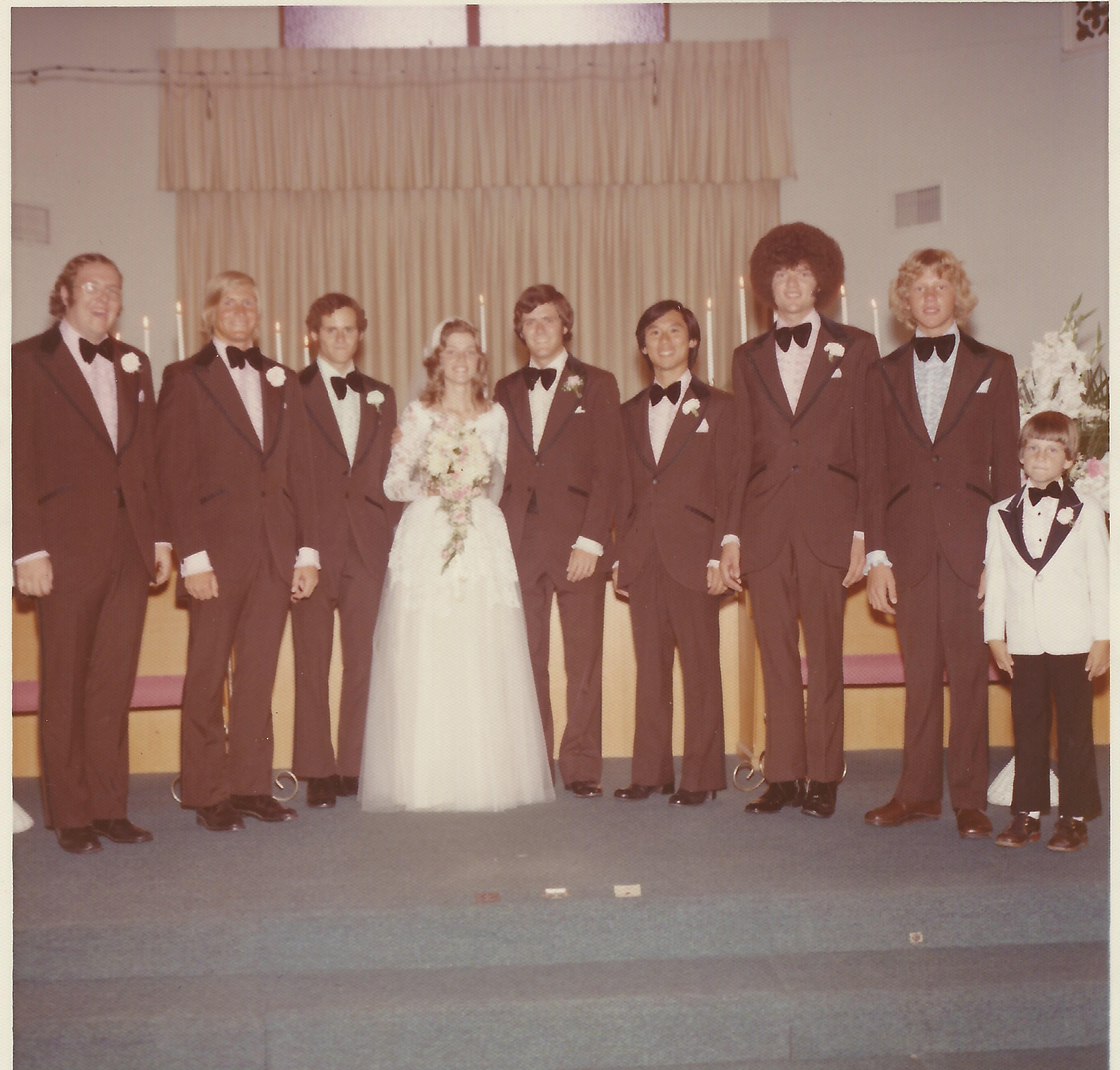
This Sunday marks 40 years since my wife Kim and I were married.  And by today’s standards, it was a very old-fashioned wedding.

Wedding 001

I was 21, she was 20.  We dated for 20 months … were engaged for four … and then got married at the church where I had met Kim two years earlier.

The wedding cost $500, and Kim paid for it herself.  (Her mother later reimbursed Kim half that amount.)  Somewhere around 400 people came to witness our vows on a miserably hot day.

Jim and Kim's Wedding Day

As church custodian, I arrived at my usual time of 8:00 am that Saturday to clean the church … then proceeded to lock my keys in my car … and had to call my laughing mother to get them out.

After I cleaned the church for five hours, I went home … put on my tux … and arrived in time for photos.

Kim’s father … our pastor … conducted the ceremony … making us kneel for more than 30 minutes while he talked about God, Abraham and Bonhoeffer.

Jim's Wedding Party

After the ceremony, some friends rifled through our wedding cards, took out the cash, and slipped it to me for our honeymoon.

We drove my mother’s car to Yosemite … mine never would have made it … and stayed in a cabin for several nights.

We rented a two-bedroom apartment in Santa Ana for $195 a month.  Kim made $1.65 working at a preschool, while I started seminary and worked at church as an ecclesiastical engineer.

People sometimes ask us the secret of our marital longevity.  My reply is always the same: “I married the right person.”

In fact, let me share with you five reasons why I know that I married the right person:

First, Kim is an emotionally strong woman.

San Diego means a lot to us.  It’s where we went for our first date … and our tenth anniversary.

We had a great time on our tenth … then drove back home to Silicon Valley where Kim entered the hospital for exploratory surgery the next day.

Kim had undergone some tests and been told that she had a mass in her abdomen.  After just ten years together, I feared I might lose her.

Thank God, she didn’t have a mass, but she did have a hysterectomy, and after giving birth to Ryan and Sarah, that was all God permitted us to have.

Young Meyer Family 001

But I remember how courageous Kim was during the entire time … and how her faith in God kept her sane.

During our last ministry, Kim was in and out of hospitals constantly.  She always handled herself well, assuring me that she’d be okay.

Sometimes I’m stronger than she is, and sometimes she’s stronger than me … but she has a resolve … a determination … that we can handle anything as long as we hold onto God and each other.

I love that about her.

Second, Kim is far more adventuresome than I am.

From ages 10 through 15, Kim went to boarding school in India and Pakistan while her parents served as medical missionaries in Saudi Arabia.  She only saw her parents a few months every year and had to learn to adjust to other cultures in primitive surroundings.

109130-SL-1-012109130-SL-1-002109130-SL-3-001

When I met her three years after she came home to the States, she talked all the time about how much she loved the Middle East.  In fact, she really wanted to be a missionary.

Kenya May 2010 1 617

But then she met me … and I’ve never been in her league as far as adventure.

In 1992, Kim and I began talking about saving enough money to visit Europe for our twentieth anniversary three years later.  But the church I served as pastor was struggling financially, and we agreed to give sacrificially for the church to survive.

So I told Kim, “Look, based on our finances, I don’t see how we can go to Europe.”  Kim responded, “If you don’t go, I’m going by myself.”

Somehow, we scraped together enough money to visit the Continent, and found ourselves on a mountain peak in Switzerland the morning of our twentieth anniversary.

Kim 1995 0011995 001

We’ve flown overseas many times since then, and due to my dislike for flying, I probably never would have gone … except for my wife, who became accustomed to flying all over the world when she was ten years old.

On our only trip to Hawaii many years ago, she insisted on hang gliding over the ocean and then being dropped into the water … while I was holding onto the boat for dear life.

IMG_0336

I love that about her.

Third, Kim is a fun-loving party planner.

The weekend I was going to turn forty, Kim told me to clear out my calendar.  I had no idea what she was up to.

Thursday night, we went to a movie and to dinner … and then spent the night in a hotel.

Friday morning, we went to the San Jose airport where we met our two kids.  Then we flew to Orange County, where we met my sister Jan … and went to Disneyland for the day.

That night, we drove to my brother’s house in San Bernardino, where all my old friends showed up for a surprise party.

On Saturday, after flying home to San Jose, Kim planned another surprise party for me at church.

Over the years, Kim has used her skills in party-planning to gather large crowds for events.

When she worked for a large child care company in San Jose, they held a dance every year … one year, as the event neared, they hadn’t sold near enough tickets.

Kim volunteered to distribute them.  The goal wasn’t to make money, but to fill the auditorium downtown with people who would watch those kids dance.

When the curtain opened, the place was packed.  Kim had done something nearly impossible … turned a disaster into a roaring success.

She later used those skills to draw large crowds for community events at our church … and she thought BIG … a little too big for some people, who felt that the purpose of those events should be to make money.

BFCC Summer Bible Camp Finale July 17, 2009 075BFCC Easter March 23, 2008 034

But her goal was to turn out a crowd so they could discover where our hidden church was located … invite people to attend … and hope that we could reach them for Christ … and she had a blast doing it.

In fact, she loves to say, “Church should be fun.”

I love that about her.

Fourth, Kim loves to reach people for Christ.

Kim was the full-time outreach director at our last church for nearly nine years.  Her work must have reached someone’s ears, because one year, she was asked to be the keynote speaker for outreach at the Bay Area Sunday School Convention.

Since I was leading several workshops of my own, I was only able to attend one of Kim’s … but her presentation blew me away.

The room was standing room only.  Kim knew her topic so well that she mesmerized the people in that room … and motivated them to do outreach in their own churches.

In addition:

*She put together ways for our church to reach its community … and built bridges with the local Chamber of Commerce.

*She visited Moldova four years in a row on mission trips … leading teams from our church the last three years.

IMG_2026BFCC Moldova Trip Photos 2 368SN851078

*She met a pastor from Kenya named Peter online.  She corresponded with him for nine months … then took a girlfriend from church and flew to Kenya to meet Peter.  She trained Peter in various aspects of ministry … trained other pastors as well … taught them how to reach out … and brought Peter to our church in the Bay Area.

Kenya May 2010 040IMG_0740

Today, Peter leads a thriving church in Nairobi, and as a bishop, he oversees 28 other pastors.  After we left our last church, Kim connected with a church in Atlanta … flew to Kenya … and trained two pastors from that church … and they now work closely with Peter to reach people in Kenya for Jesus.

*She raised $43,000 for a well in Peter’s village in less than three months.  She flew to Kenya with a team from our church to dedicate the well … and spent the day with the Vice President of Kenya.

IMG_0499IMG_0492

Although many Christian leaders are uncomfortable with women in leadership, Kim has always served voluntarily under my direction and done it all with grace and sensitivity.

Kenya May 2010 857Kenya May 2010 358

I love that about her.

Finally, Kim knows how to get things done.

Three years ago, I flew to Grand Rapids, Michigan to be trained to be an interim pastor.  It seemed like the only ministry option available to me at my age.

While I was there, the director of the ministry asked me if I’d be willing to go to New Hampshire to help out a church that was losing its pastor.  I instantly said, “Yes.”

Kim and I drove across the country where I served as interim pastor for only three months.  (The church called a pastor the second week we were there.)  Then we drove back to Southern California … without a new assignment.

My director mentioned several possible assignments in places as varied as Louisiana … South Dakota … Chicago … and upstate New York … but nothing materialized … and we were running out of time.

Finally, the director matched me up with a church in New York, and Kim and I flew there for an extended weekend … hoping and praying that things would work out.

But they didn’t, and as we were driving back to LaGuardia Airport, our future looked bleak.

With a burst of inspiration, Kim suddenly said, “I know what we can do.  I can start a preschool in our house.”

Within a few weeks, we rented a larger house in a better location … Kim sent in her application to the state … we began acquiring play equipment and tables and supplies … and on August 5, 2013, we launched Little Explorers Preschool.

LEP 2

The school has gone very well.  Kim directs, teaches, works with parents, and manages two employees, while I do the finances, marketing, cleaning, and more.

Kim and Children for Marketing

We work long hours, but enjoy having nights and weekends free … especially to drive through the mountains to see our two grandsons in Orange County.

IMG_5365IMG_5327At Corner Bakery in Irvine Celebrating Kim's 60th Birthday

Is ours a perfect marriage?  No.  We’re both strong-willed individuals.  We are both expressive and opinionated.  I can be stubborn, and Kim can be feisty … so at least life together is never dull!

BFCC Mystery on the Menu Event 001IMG_1577

I love that about her.

I am glad that God gave me Kim because:

*She is hilarious.  She makes me laugh … constantly.  She recently posted a photo online promoting the preschool and wrote, “The children never cease to be bored.”  I laughed my head off … and when I pointed out what that phrase meant, she didn’t get it … so I laughed some more.

*She is appreciative.  When I do even the most mundane tasks, she thanks me.  When I do something surprising, she is grateful.  Her lack of entitlement makes serving her a joy.

*She never nags me.  She might remind me of something I promised to do, but she’ll tell me once and trust that I’ll come through.

*She has always supported my love for sports.  Although she’s gone to many games with me, she’s happy for me to watch baseball, football, and basketball as much as I want … and has never complained about it.

BFCC Staff @ AT&T Park Nov. 13, 2007 175

*She and I can talk for hours and never run out of things to discuss.  That’s always a sign that you married the right person.

*She loves the Lord.  I tell her that on our first date, I fell in love with her heart … and to this day, that love has grown larger and stronger.

Even though we are exact opposites as far as our personalities go, we enjoy a deep, abiding love that has only grown stronger with time.

I don’t like it when people say, “I have the greatest wife in the world.”  The statement may be emotionally understandable, but it’s ultimately illogical … and is a way of saying, “My woman is better than yours.”

I’d rather say, “I married the right person for me” … and by God’s grace, I did.

Happy 40th anniversary, Sweetheart!

Read Full Post »

It’s been five-and-a-half years since I retired … or was retired … as a pastor.

There are aspects of being a pastor that I miss … and aspects that I don’t miss at all.

For example:

First, I miss studying for sermons.

I loved choosing a text or a topic, and then scouring my library until I had a stack of 25-30 books that dealt with that passage or issue.

And I loved finding an operational outline for my message.

And I loved writing the message, searching for the optimal words … creative illustrations … and practical applications.

When I was in the “study zone,” nothing else seemed to matter … and I often didn’t want the time to end.

I miss that.

Second, I miss teaching a class.

While preaching almost always consists of delivering a monologue, teaching a class can be much more of a dialogue with the students.

I loved preparing handouts … fielding questions … occasional debates … staying after class to interact … and going home feeling, “Wow, we all learned something important tonight.”

Since the senior pastor tends to be the only teacher in most evangelical churches these days … I trend I will never understand … I may never have the opportunity to teach an ongoing class for Christians in my lifetime.

I miss that.

Third, I miss counseling.

If someone came up to me after a worship service, and asked, “Pastor, do you have a few minutes?”, I thoroughly enjoyed listening to that person, encouraging their heart, and interceding for them in prayer.

If someone came to see me in my office for counseling, I considered it a great privilege, and did all I could to help the counselee feel heard and understood.

Most of us who are called to pastoral ministry just want to help people.  I do that now whenever someone emails me for counsel (usually involving pastor-church conflicts) or calls me on the phone, but it’s not the same as when people came to see me as their pastor.

I miss that.

Fourth, I miss planning for worship services.

For years, I attended a meeting – usually on a Monday evening – with people who helped me plan upcoming services.

It was fun to choose the right songs … to ask someone to share a testimony … or to select a crazy video we might show before or after the message.

And it was exciting to put together the service so it would flow well and lead people toward the preaching of God’s Word.

I don’t know how many churches have a team that plans worship anymore … much of this seems delegated to the paid worship director/pastor now … but I enjoyed the camaraderie and strategy involved in such meetings.

I miss that.

Finally, I miss taking risks to reach people for Christ.

Last week, I presented a workshop at a Christian leadership convention on “Instituting Change in Your Church.”

During my 36-year pastoral tenure, I’ve been involved in a church merger … a church rebirth … serving as an associate pastor and succeeding a senior pastor … and overseeing all aspects of the construction of a worship center, among others.

Thankfully, with each mega change, I learned a little bit more about how to cast a vision … communicate it effectively …  and bring people along to do something great for Jesus.

I miss that.

But there are things about church ministry that I will never miss … and some of them may surprise you.

First, I don’t miss weddings.

I once met a pastor who conducted 130 weddings a year on average.

That would drive me to the funny farm.

Weddings were difficult for me because I often didn’t know the couple I was marrying … so I didn’t know if they were telling me the truth about themselves during premarital counseling.

I married one couple on a Northern California beach … at least a quarter mile from the parking lot.  He dressed up like Sir Lancelot, and she appeared as Maid Marian.  The wedding guests – all 15 of them – sat on driftwood, and I think a horse was involved somewhere along the line.  I had to wait an hour after the pronouncement for my honorarium, and even then, it was like pulling teeth.

God help me.

The last wedding I conducted was at a resort on another Northern California beach.  The resort was 130 miles from my home, and my wife and I were gone 32 hours … mostly killing time until the ceremony.  The DJ was paid … the caterer was paid … the resort was paid … the wedding hostess was paid … and the pastor was stiffed.

I don’t miss that at all.

Second, I don’t miss board meetings.

For most of my ministry, I liked board meetings.  Various members didn’t always agree about everything, but we were usually able to talk matters out, come to consensus agreements … and leave as friends.

But toward the end of my ministry, I sensed that I was becoming irrelevant at those meetings.  The board had an agenda … which they did not explicitly share with me as their pastor … and the meetings became full of tension.

Then the board started making decisions outside of meetings … announcing them inside the meetings … and ignoring whatever concerns or objections I had.

My mentor says that he used to tell his staff when he was a pastor, “Our entire ministry could fall apart overnight.”

I think more ministries are destroyed inside board meetings than anywhere else.

I do not miss them at all.

Third, I don’t miss correcting staff members.

When a pastor hires a staff member, he often does a sales job … telling the potential staffer how great the church is and how much he/she is needed.

But when a staff member messes up … and they all do … many of them are not very receptive to correction.

I never yelled at anybody.  I never swore at anybody.  I treated staff members the way I would want to be treated … and often much better than the way I was treated when I was a staff member.

But in case after case, staff members turned against me after I corrected them.

What’s the alternative?  Lettings things slide?

Failing to address certain issues could have led to loss of credibility … damaged relationships … lawsuits … and even fatal accidents.

And if I as staff supervisor didn’t address those issues, I could ultimately be held responsible for staff failures.

I worked as a staff member for five pastors, and the first one corrected me more than the other four combined … and I ended up marrying his daughter!

But I don’t think I was ever as overly sensitive toward him as many staff members were toward me.

I don’t miss it at all.

Fourth, I don’t miss backstabbers.

When someone criticizes your ministry directly … using a response card, phone call, email, or a scheduled appointment … their observations might sting, but you can usually handle it, especially if you can engage them in a dialogue.

But churches … maybe more than most venues … have people who smile to your face … and stab you in the back.

I’m thinking of one woman in particular.  One day at church, she walked up and kissed me on the cheek … told my wife that she was lucky to be married to me … and then did her best to destroy me behind the scenes.

They give you the impression that they care about you … that you mean a lot to them … and then they turn around and denigrate you when you’re out of earshot.

Yes, I will let God take care of them.

But I don’t miss them at all.

Finally, I don’t miss being a spiritual target.

And believe me, Satan is in the business of targeting pastors.

In many ways, a local church pastor is the key person in advancing Christ’s kingdom.

He functions as a prophet … bringing God’s message to His people … and as a priest … representing the people before God.

Denominational leaders … parachurch presidents … seminary professors … special speakers … all must go through the pastor to communicate with a congregation.

The enemy knows that if he can take out a pastor, the ripple effect will soon become a torrent.

So the devil attacks a pastor in a variety of ways, using weapons like discouragement … betrayal … depression … temptation … and burnout.

Now that I’m not a pastor, my emotions are more stable, my friendships more solid, and my health more favorable.

I no longer sense I’m a spiritual target.

And I don’t miss it at all.

I do miss the romance of Sunday mornings … especially those last few moments before preaching … when you have no idea how God is going to use you.

But I enjoy having nights and weekends free … leaving early on a Saturday to visit my grandsons … and hardly ever hearing the phone ring at night.

I’m glad I was a pastor for many years … and I’m glad I’m doing a different ministry now.

Paul’s words in Galatians 6:9 have gotten me through many a discouraging time:

Let us not become weary in doing good, for at the proper time we will reap a harvest if we do not give up.

Do I hear an “Amen?”

Read Full Post »

Out of the hundreds of baseball books I have read, and the scores that I own, five stand out among all the rest.

Here they are:

I never saw Ted Williams play.  His last season for the Red Sox just happened to be the year I started becoming interested in baseball.

But there are few players more fascinating than Teddy Ballgame.

Growing up in San Diego, his mother was devoted to The Salvation Army, and Ted and his brother practically raised themselves.  He strove to become the greatest hitter who ever lived, and in my book, he succeeded: .344 lifetime average … 521 home runs … a .406 average in 1941 … and he hit .388 at the age of 38!

But what makes The Kid most interesting is that he could never hold back how he felt … or what he said.  He’s the Original Uncensored Superstar.

On several occasions, I asked Ted Williams for his autograph, and he signed, but he was a bit gruff about it.

But I will never forget the day my brother John and Ted had a long chat.

It was 1969 or 1970 … I can’t remember the exact date.  Ted was managing the Texas Rangers, and he came out of the hotel in Anaheim and sat on the shoeshine chair outside all by himself.  He started reading the newspaper.

Although I’ve asked many superstars for their signatures, a few have been very intimidating: Mickey Mantle … Johnny Bench … and Ted Williams, among others.

I didn’t want to bother Ted while he was reading the paper, but John decided to approach him anyway.  I thought Ted would sign something for John and that would be it, but Ted put down his paper, looked through John’s baseball cards, and they had a lengthy conversation.

I couldn’t believe it, but it’s true: Ted Williams loved kids.

Sportswriters?  Not so much … and he spends a lot of time in his book slamming certain ones … with some justification.

I’ve read this book four times and have never grown tired of it.  It’s terrific … although a little on the profane side.

Tyrus Raymond Cobb was crazy … and maybe the greatest baseball player who ever lived.

He hit .367 lifetime (a record that will never be topped) … stole 892 bases … held the record for hits in a career with 4,191 (until Pete Rose broke it) … and had a will to win that made him both a great player and a lousy person.

I picked up Cobb’s autobiography as a kid and it greatly influenced the way I played baseball in two areas:

First, Cobb’s book made me more aggressive on the basepaths.  He said that it takes a perfect throw to nail a runner, and when you’re young, you’re going to beat a throw most of the time.

Second, Cobb’s book made me use my brain just as much as my skills.  He had a reason for everything he did on the field and knew how to anticipate plays.

As some reviewers on Amazon point out, Cobb’s autobiography isn’t always accurate, but it’s a lot of fun.  Several decades later, Al Stump – Cobb’s collaborator – wrote his own book on Cobb, and tried to tell the real story – and it wasn’t always pretty.

Although I never met Cobb, a friend used to sell newspapers to him in Menlo Park, California, and said he was a grouchy old man.  But I have driven past his old house in Atherton (I have a photo of it somewhere) and have visited his hometown of Royston, Georgia, including his museum and grave.

Lawrence Ritter loved baseball, and wanted to track down some old-time ballplayers and get their recollections on tape.  But first, he had to track down the players … often without much to go on … and published the first oral history of baseball in 1966 … the glorious The Glory of Their Times.

Even though every ballplayer in the book has been dead for decades, they still speak through Ritter’s book, including Rube Marquard, Stanley Coveleski, Edd Roush, and Harry Hooper: all members of the Baseball Hall of Fame.

There are recollections from 22 players, and I was privileged to write to 13 of them and obtain their autographs, including two of my all-time favorites: Wahoo Sam Crawford and Smoky Joe Wood.

In fact, when I started writing players at the age of 13, Crawford was one of the first players to answer me.  He sent me a Hall of Fame plaque postcard which he signed at the top … and on the back, wrote, “To Jim, With All Good Wishes, Wahoo Sam.”  How can you not love someone like that?

Several months later, Crawford died, and it really hit me hard.  He was the all-time leader in triples with 312 and played in the outfield alongside Ty Cobb for years.

Two interesting facts about this book:

First, Ritter’s conversations with these players has been made into a CD which you can buy from Amazon.

Second, you can buy the Kindle version of this book for only $1.99 on Amazon … a purchase I encourage you to make ASAP!

When I was in second grade, I got pneumonia, and I was out of school for about a month.  My mother suggested that I write to the Dodgers and ask for a team roster, and they sent me their Press Guide instead.  I can still remember eating lunch while immersed in the statistics in that Press Guide … stats compiled by Allan Roth, the godfather of baseball numbers.

Fast forward ahead 8 years.  In 1969, the Macmillan Company published The Baseball Encyclopedia, a book that included the name of every player who ever lived up to that date … yes, including Moonlight Graham from Field of Dreams.  But whereas such encyclopedias only had basic information up to 1969, the Encyclopedia was thorough.

My mother gave it to me for Christmas.

I went through the entire book, writing down the names of ballplayers who were still alive that I wanted to write to.  Through a friend, I spoke to Charlie Deal on the phone, who played for the 1914 Boston “Miracle” Braves.  I still have scores of notes from old-time players who handwrote their greatest thrill in baseball for me.

The Encyclopedia has gone out of print now, and has been superseded by other encyclopedias … but I never got tired of looking through it.

Even the print was gorgeous.

This is the best baseball book that I own, and I have three copies: the original from 1985 … the updated version from 2001 … and a Kindle version.

And I read the Historical Abstract as frequently as I read my Bible.

This book is just so much fun!  Yes, James spends a lot of time writing about Win Shares … his statistical theory that determines a player’s true value … and that may or may not thrill you.

But his rankings of the Top 100 Players at each position is a never-ending source of delight.

He tells unique stories about some players … delves into archaic facts about others … and talks about the personalities of still others.

But the book is fun because James is opinionated … and usually accurate.

If you want to know about old-time players and how they compare with more recent superstars, this is the book for you.

And like the Bible, it never gets old.


Read Full Post »

Since baseball spring training is underway in both Arizona and Florida, I thought I’d change pace and write about my favorite books on baseball.

I have loved baseball for more than half a century.

It all started in 1960 when my father – a pastor – bought packs of baseball cards for me and my brother.  Some kid at church didn’t want his 1958 and 1959 Topps cards, and so Dad brought those home to us, too.

For years, I have wondered, “Why did those colored pictures of posed athletes mean so much to me?”  Maybe it’s that link to my father … or the fact that my friends began to collect cards, too … or because I was able to match the names of players that I heard about with their faces.

Growing up in Anaheim, California, my father took my brother and me to the Coliseum to watch the Pittsburgh Pirates beat the Los Angeles Dodgers, 5-2 in May, 1960.

Two things stand out for me from that game:

The grass on the field was so green that I instantly fell in love with being at the ballpark … and you could hear announcer Vin Scully’s voice reverberate throughout the stadium on people’s transistor radios.  (And 55 years later, the great Vin Scully is STILL the Voice of the Dodgers.)

We Dodger fans only got to watch 9 games on television every year: the games the Dodgers played at Candlestick Park in San Francisco.

That’s why the All-Star Game and World Series were so special to me as a kid … because they were on television.

We had a black-and-white TV even when everyone else on our block had a color set, but to me, it didn’t matter: it was baseball.

I remember running home from school in second grade to watch the end of Game 7 of the World Series and watching Bill Mazeroski hit a walkoff homer to win the Series for the Pirates.

Because you could only hear Dodger games on the radio, the only way I could gain more information about famous players was to read about them in books.  So I devoured every book I could find in the school library about baseball … and eventually read every book I could find on baseball in the public library as well.

I’ve read hundreds of books on baseball: biographies, oral histories, team histories, record books, forecast books … you name it.

And out of all the baseball books I’ve read, these ten are my favorites:

Number Ten

Although I grew up a Dodgers fan, I greatly admired the San Francisco Giants.  In fact, when my brother John and I used to play baseball in our back yard (with a tennis ball), he would be the Dodgers, and I would be the Giants.

On September 4, 1962 – Labor Day – the Giants and Dodgers played a crucial game at Dodger Stadium.  Both teams were locked in a tight pennant race … back when there were only ten teams in each league.

The attendance that day was 54,418, including my dad, John, and me.  Even though the Dodgers lost, it was a day I’ll always cherish.

David Plaut’s book Chasing October gives all kinds of insights into that pennant race that an 8-year-old kid would never have known.  When I finally found the book at a reasonable price … and now you can buy it for just $7.99 for the Kindle … I read it quickly … on one memorable occasion, with Vin Scully announcing in the background.

Number Nine

Before I read this book – which came out in 1963 – I knew nothing about the fact that eight players from the Chicago White Sox threw the World Series to the Cincinnati Reds in 1919.  As a child, I was absolutely shocked that players would actually cheat on the field.  (This was long before steroids!)

Several years after I first read this book, I began writing old-time ballplayers in the mail, asking for their autographs, and although I wrote people Chick Gandil and Eddie Cicotte, they never responded to my requests.

But the catcher for the Black Sox, Ray Schalk … who wasn’t involved in the scandal … did answer me, as well as Edd Roush, center fielder for the Reds.

This book was made into a movie … a very good movie, I thought, even though Charlie Sheen is in it … but I highly recommend this book, which has been deemed a classic since its publication.

Number Eight

It is hard to put into words how much Sandy Koufax meant to me as a kid.

He threw four no-hitters … and I listened to each one on the radio, including his perfect game against the Cubs.

He set the all-time record for strikeouts in 1965 … 382 … and I saw that last strikeout at Dodger Stadium when he beat the Braves to clinch the National League pennant in 1965.

He beat the Yankees twice in the 1963 World Series … and the Twins twice in the 1965 World Series … to bring both championships home to Los Angeles.

He seemed to be a modest, self-effacing man who was conscious of the fact that he was expected to be a role model for kids … and did it well.

In 1967, the All-Star Game was in Anaheim, and Koufax had signed to announce the game for NBC.  While hanging around the Grand Hotel the day before the game, I saw Koufax … asked him to sign my autograph book … went home for dinner … found my mint condition 1955 Koufax rookie card … went back to the hotel, and asked Koufax to sign that one as well.

I’ve been told that his signature on the card devalues its worth, but I don’t care … it still means a great deal to me.

Leavy’s book details how much Koufax meant to the Jewish community … how much he suffered as a pitcher … and why he retired at the age of 30 after winning the Cy Young Award for the third time.

Number Seven

This is one of those books you’d like to have with you on a desert island … and it’s cheaper than cheap on Amazon.

The book gives brief biographies of every player of note … and many obscure players … through 2000.

There’s a small photo of each subject (color shots for more recent players) … a record of when and where they were born and died … one line of career totals … and hundreds of fascinating stories about the players.

It’s the kind of book to peruse while you’re watching a game.  If an announcer throws out the name of a former player, just turn to his entry, and you’ll learn not only what the player did on the field, but in many cases, what he did off the field.

The only problem with the book is that it’s heavy.

Number Six

Bob Broeg was a sportswriters for the St. Louis Post-Dispatch and a frequent contributor to The Sporting News, which is how I first became acquainted with him.

This book … a classic published by The Sporting News … was published in 1971, so it leaves out great players like Nolan Ryan, Cal Ripken, Jr., and Derek Jeter.

But the book includes 40 members of the Baseball Hall of Fame, such as Grover Cleveland Alexander, Dizzy Dean, Jimmie Foxx, Lefty Grove, Walter Johnson, Mickey Mantle, and Cy Young.

Filled with rare photos, Broeg is a terrific writer, and brings each of these superstars to life with biographies that are both brief and yet complete.

The book is relatively inexpensive and seems dated, but when I finally bought it, I devoured it … right after I got married.

I’ll share my five favorite baseball books next time, but until then:

What is your favorite baseball/sports book … and why?


Read Full Post »

While going through some old church files recently, I stumbled upon a folder I forgot I had.

The folder contained documentation related to a couple who had once left a church I pastored.  I’ll call them Harry and Mary.

Harry came to Christ under my ministry.  A while later, I married him to Mary, a long-time Christian.  They attended several small groups that I led.

I even invited Harry over to watch the Super Bowl with me one year.

During premarital counseling, I discovered that Mary struggled with a particular issue.  While I made suggestions on how to manage things, there didn’t appear to be a long-term solution at hand.

Then one Sunday morning, I made a strong statement from the pulpit that reflected a value I held dear.  I could have said it better, but I explained it and moved on.

But I had hit a nerve with Harry and Mary.  They were incensed at what I had said.

Harry and Mary were part of a group that met after the first service.  When they entered the room, they immediately began criticizing me to a new couple.

That new couple never returned.

I don’t remember receiving flak from anyone else after making my statement, but Harry would not let me forget it.

He made an appointment with me in my office and wanted me to apologize for the statement that I made while preaching.

If he had said, “Jim, I appreciate your ministry.  I enjoy your preaching and have learned a lot about the Bible from you.  But that statement you made really stung, and here’s why,” I probably would have said, “Harry, I still believe in what I said, but I admit to you I could have said it better.”

But that’s not what Harry did.  He demanded an immediate apology.

Some pastors would have apologized on the spot.  Others would have stood their ground.

I tend to come from the “stand your ground” group.

And all I could think of was, “If I apologize this time for something I said while preaching, is he going to demand more apologies in the future?”

If I apologized, I was extremely concerned about the precedent I would be sending.

So I tried to explain rather than apologize … but that wasn’t enough for Harry.

He and his wife wrote a letter to the church board.  The chairman listened to the recording of my message.

The board’s conclusion: I hadn’t said anything wrong.

The board unanimously stood behind me, and Harry and Mary fired off another letter to the board, letting them know in detail why they were leaving the church.

Pastors would rather gather sheep than drive sheep away, but when sheep begin to threaten the shepherd, the shepherd must enforce boundaries.

Let me make four statements about people who threaten to leave a church:

First, making threats is a power move, not a love move.

Several years ago, I traced the English words “threat,” “threats,” and “threatening” throughout both Testaments and could not find a single instance in which those terms were used in a positive manner in Scripture.

When someone threatens us, they promise, “If you do A, I will do B” or “If you don’t do A, I will do B.”

Using a threat implies that the person making it (a) is superior to the person being threatened, and (b) views himself or herself as being indispensable.

While our world often operates by threats, that’s not the picture we receive in Scripture of how relationships operate in the body of Christ.

If I could do it all over again, I would have told Harry, “When you threaten me, I feel defensive and resistant.  If you’ll calm down and rephrase how you feel, I can hear you better.”

Second, making threats damages innocent people.

I once served on a church staff and was approached by someone who told me, “If the pastor doesn’t start doing Such-and-Such, ten percent of the people in this church are going to leave.”

That wasn’t a warning … that was a threat.

Based upon our attendance at the time, ten percent equaled 25 or 30 people.

That’s a lot of attendees … a lot of volunteers … and a lot of givers.  If they all left, it might take several years to replace them, and that can cause a pastor … or staffer … to panic.

My experience tells me that only a handful of those 25-30 people really felt strongly about the issue.  In fact, the likelihood is that most people agreed to join the cause simply to support their friends.

Knowing what I know now, I would have told the person making the threat, “This isn’t the best way to handle this situation.  Can you identify for me the two or three people who are most upset by this issue?”

If given their names, I would have said, “Chances are this is just their concern.  If this is a personal matter, I encourage someone to go and speak with the pastor directly.  If this is a policy matter, I encourage someone to go and speak with a board member directly.  But I encourage you to stop speaking for anyone who is unwilling to go directly to the pastor or the board.”

Suggesting a wiser course of action may not always work, but it’s worth a try.

Third, making threats works all too often.

This is why people do it … at least, at church.

People would never make similar threats at work, or at a government office, but they’ll do it with God’s people.  Why?

Peter Steinke writes in his book Congregational Leadership in Anxious Times that when some people use aggression and anger at church:

“Peace mongering is common.  With tranquility and stability reigning as premium values, congregational leaders adapt to their most recalcitrant and immature people, allowing them to use threats and tantrums as levers of influence.  Malcontents’ complaints never seem to cease.  Unwilling to confront the constant critic, leaders set the table for the unhappy souls to have a movable feast of anxiety.  By appeasing rather than opposing, leaders give control to reactive forces.  Feed them once and leaders can be sure they will be back for more.”

Of course, that’s the problem when threats work: it’s guaranteed those same threats will be used again.

Finally, making threats should never be rewarded.

Once Harry went to power … and refused to shift into love mode … I knew what the outcome was going to be: he and his wife were going to end up leaving the church.

For a few weeks, they sapped the energy out of the congregation, the church board, and their pastor.

More than 95 percent of our congregation liked the church the way it was.  People were growing spiritually and excited about our future.

But the more the board and I engaged with Harry and Mary behind closed doors, the less effective we were in ministering to the rest of the church.

Because of the energy sap, and because most people who make threats are never satisfied, I believe that most pastors and boards should handle similar situations swiftly but firmly by saying:

“We have listened to your complaints.  We have made a decision, and we cannot support the way you have handled things.  You have a choice: either stay at the church and support the ministry, or feel free to leave.  The choice is up to you.”

Pastors should never make threats, either, and those that do should be given the opportunity to rephrase their threat.  But if a pastor consistently says, “If you don’t do this my way, I will resign,” then a church board may reluctantly have to say, “Pastor, we don’t reward threats, so if that’s your final decision, we’ll accept your resignation.”

As a pastor, I hated it when people left the church, and tended to take it personally.

But sometimes, the best possible outcome is for unhappy people to walk out the door and never return … especially if they unwisely use threats.

And when people who use such tactics leave, throw a party!

I always did.


Read Full Post »

While working in my garage a few days ago, I couldn’t help but hear the music coming from one of the houses across the street.

The music was loud … pounding … and vulgar.

Very, very vulgar.

The man who lives in that house is the father of many children.  His kids were outside playing … hearing those horrible lyrics … and it bothered me … a lot.

One might even say that those lyrics vexed me.

I felt the same way yesterday while walking down the main street in our neighborhood.  A man was sitting in his vehicle … a rap song cranked up to harmful levels … the song filled with references to four-letter words and the repetition of the term “chainsaws.”

He was parked on the street … waiting for his child to get out of school … right next to a sidewalk where children walk home.

I’ve been noticing recently that I’m becoming increasingly vexed by things that I’m seeing and hearing in our culture … and at times, I don’t know what to do about it.

Sometimes I’m vexed by things that probably don’t bother other people.

For example, when I grew up, and a basketball player hit a long jump shot, he might slap hands with a teammate, or point at him, but that would be it.

Nowadays, when some guys hit layups, they scream at the top of their lungs and pound their chest.

That vexes me … but it’s more a matter of personal style.

However, I suppose that I’m primarily disturbed by various forms of immorality that almost everyone once considered to be wrong … but now are celebrated.

Take the Grammy Awards, for example.

I am passionate about music.  And for several decades, I looked forward to watching the Grammys every February.

But several years ago, after watching another onstage display of outright paganism … along with a visible mockery of the Christian faith … I stopped watching the Grammys.

They’re just too vexing to my spirit.

The same goes for the upcoming Academy Awards.  I used to enjoy watching them.  Now I can’t.

Just too vexing.

All the hoopla about the Fifty Shades of Grey movie vexes me, too.

No, I didn’t read the book.  (In fact, I didn’t even know it existed until a couple of weeks ago.)  And I could never see a film like that.

But a prominent Christian … a famous NFL quarterback … tweeted several days ago that he saw the film and thought it was great.

Influential Christians recommending evil … that vexes me, too … as does lying.

I took my car in for an oil change several months ago to a repair shop that I’ve frequented.  The technician told me that I needed a new tire … and I was positive that I had just purchased that same tire several months before.

So I took my car to another place that specializes in tires, and the technician told me that my tire was just fine.

I was vexed.

When someone lies to me, I become extremely vexed, which is why I can’t even watch certain politicians on television.

Those who have openly, blatantly, and arrogantly lied to the American people – regardless of their party affiliation – vex me no end.  (Wasn’t it the Who who sang, “We won’t get fooled again?”)  What guarantees do we have that their next utterances won’t be full of lies, too?

Whenever these politicians come onto my television screen, I can’t remain calm, so I either mute the sound or flip to another channel … only returning when they’ve disappeared.  (Am I the only person who does this?)

And then … there’s Bruce Jenner.

Several years ago, a friend gave me a framed cover of Sports Illustrated featuring Jenner from the summer of 1976.  A signature of Jenner appeared just below the cover.

I watched Jenner win a Gold Medal in the Decathlon during the 1976 Olympic Games.  One would have thought that he was a “man’s man.”

But now, he wants to become a woman … and the headlines in a national magazine state that he’s finally happy.

Doesn’t that vex you?

And what in the world should I do with the Jenner cover and signature?  (It’s been in storage, not on my wall.)

Some of you might be thinking, “Jim, you really have some issues.”  But I claim biblical support for some of my feelings.

Dr. Luke tells us that when Paul first visited Athens … he was greatly distressed to see that the city was full of idols (Acts 17:16).

Just this morning, while looking for a new place to take my car for an oil change, I walked into a shop office I saw advertised online.

The heavy smell of smoke repulsed me … but the large statue of Buddha vexed me.  And I can’t do business where I’m vexed.

In fact, whenever I’m vexed in spirit, I think of 2 Peter 2:7-9.  Peter writes about Abraham’s nephew Lot and highlights him as an example of a righteous man vexed by an ungodly culture:

… and if he rescued Lot, a righteous man, who was distressed by the filthy lives of lawless men (for that righteous man, living among them day after day, was tormented in his righteous soul by the lawless deeds he saw and heard) – if this is so, then the Lord knows how to rescue godly men from trials and to hold the unrighteous for the day of judgment …

While living in Sodom and Gomorrah, Lot was “distressed by the filthy lives of lawless men.”

I can relate.

There are many things I love in this world.  But more and more, I’m finding myself longing for another home … a place of purity and grace … where my spirit can enjoy rest, not torture.

As a kid, one of my favorite gospel choruses was called This World is Not My Home.

One of the lines in that song stated, “And I can’t feel at home in this world anymore.”

Am I feeling the way I do because of my age … my experiences … my theology … or because of the Holy Spirit?

I’m not sure … but I do know that feeling vexed isn’t unusual for a Christian.

In fact, let me ask:

What vexes you these days?


Read Full Post »

« Newer Posts - Older Posts »