Feeds:
Posts
Comments

Archive for the ‘Please Comment!’ Category

In the following article, I use myself as an example of a pastor who had many advantages, yet still suffered burnout.  Could this article describe you or someone you know?

While reviewing some computer files recently, I stumbled upon a note I wrote to myself in July 2005 … and I was startled.

Four years later, right before a major conflict broke out in my church, I went to a Christian counselor, who tested me and revealed that I was “severely burned out and headed for a breakdown.”

What startled me about that file from 2005 is that I had all the symptoms of burnout four years before.

At the time I wrote the note to myself, I had many advantages:

I had a great family (still do) … had a regular quiet time … exercised regularly and vigorously … lived in a place some might consider paradise, just off the San Francisco Bay … engaged in several fulfilling hobbies … finished the course work for my D.Min degree … enjoyed time off that past year to Europe, Hawaii, and Washington D.C. … and was coordinating the final stages of the construction of a new worship center.

The board chairman … the person I respected most in that fellowship … always supported me and told me, “You are a home run for this church.”

God had placed me in a church setting that seemed optimal given my training, experience, temperament, and giftedness.

And yet, I wrote to myself in 2005, after 32 years in church work, that I was unsure if I wanted to stay in ministry.

Here are my actual words:

*I am tired of all the “church crap” that I have to endure: people leaving over trivial issues, sniping remarks – without being able to “fight back” at all.

*I am hurt by people I love criticizing me with unkind and unjust statements, either to my face or behind my back.

*I am already overwhelmed with all the pastoral duties I have, which will only get worse when we grow in size – and we aren’t staffed for an outpouring!

*I love Jesus and the church and ministry but no longer love church ministry.

*I have a board that wants me to manage the staff better but won’t give me the power to fire anyone.

*I make less money than my son and far less than a new pastor would cost the church.

*Rather than spending 70% of my time in the area of my giftedness, I spend about 30% in the area of my giftedness and 70% in areas that frustrate me.

Then I wrote out a list of my current symptoms:

“My thinking is slow … my eyes hurt continually … I feel kind of numb … I’m kind of detached … I don’t feel very spiritual … I don’t seem to appreciate anything God does through me … I don’t want to be visible, but invisible … I can’t seem to remember names … I want to be home at night and not work a 50-hour week.”

And four years later, I felt exactly the same way … and it led to my exit from ministry.

Why was I feeling that way?

*Our office manager … the best I’ve ever worked with … had just moved away, leaving me with an interim office manager and thus a fresh pile of work.

*I had been dealing with a family for months where both husband and wife had affairs and the husband had twice tried to commit suicide … thankfully, failing both times.

*I had spent hours preparing a Father’s Day message … one of the best I ever wrote … which was widely criticized by two younger dads.

*The project manager for our new building – along with his wife – were continually sniping at me about our upgraded services.

*I had received a critical note from a long-time, trusted friend whom”I don’t believe I can trust anymore.”

*We’d had three deaths … one right after the other … with more looming ahead.

What was really happening?

I was dealing with the two issues that I struggled with most in ministry: management of my energy and my emotions.

Let me differentiate between them:

Energy management: I wanted to work a regular work week when I could predict when I’d have time for rest and relaxation.  It didn’t matter how long my “on” button was operating as long as I knew when I could switch it off.

My wife and I run a preschool in our house, and when 5:30 pm comes around, we’re done for the evening, and even though we both work weekends, we don’t have to.

But in church ministry, you’re never, ever done.  For example:

*the pastor has to work every Sunday, so he doesn’t get weekends off.

*he may not go out on Saturday night so he can be fresh for Sunday.

*he has to work several evenings a week because that’s when people are available.

*he may have a designated day off, but that can easily be interrupted, especially when important parishioners end up in the hospital … or die.

It’s not the number of hours that wore me down.  I often work 50+ hours a week right now but the work is enjoyable and appreciated.

No, it was the start-stop-start nature of the work that got to me.  I’d been doing it for years, but suddenly I couldn’t handle it anymore.

Maybe this is because I’m more introverted than extroverted, and introverts need time by themselves to recharge their energy.

After a long day of work, when I came home for dinner, I wanted to stay home and recharge for the next day, but I often had to go back out for a meeting… and I began to resent it.

I did good work.  I was always prepared.  God used me in many ways.  Our church grew steadily … and was the largest Protestant church in our city for years.

But for me … as with many pastors … the way I managed my energy was a key as to whether I felt like a success or a failure.

Emotional management: As a pastor, whenever I felt anger, pain, frustration, depression, anxiety, despair, or fear, I wasn’t always sure what to do with those feelings … especially if they overwhelmed me.

This is how I usually handled my feelings:

*I told the Lord how I felt.

But most of the time, He listened but didn’t respond.  (Wish the Lord gave hugs.)

*I told my wife how I felt … as we drove to and from church (she served on the staff) … when we went out to lunch or dinner … or when we walked or drove around together.

And she was usually very helpful, but sometimes she didn’t know what to do or say anymore.  I can be an emotional enigma.

*I told a Christian counselor friend periodically, and his counsel was always beneficial.  We’d go out to lunch and talk, and he could quickly name my issue and tell me how to handle things … and he was usually right.  But he was more than an hour away, so I could consult with him once or twice annually, but I couldn’t lean on him.

*I told some good friends who lived far away, and they were good listeners, but I always felt like I was bothering them.

Years before, I had received help from:

*A pastor friend.  We met for breakfast every week, and our friendship helped both of us cope with ministry pressures.  But in my last church, I reached out to several pastors, yet never found one that I clicked with.

*A small group of pastors.  I had formed such a group years before, and it lasted several years, but everyone had scattered, and I lacked the energy to start another group.

*Friends within the church, like a staff member, a board member, or a layman with whom I resonated … but most of my emotional issues involved people in that church, and I felt it was unethical to share how I truly felt about those they knew … and possibly liked.

As I’ve said many times, when a pastor is stressed out, he’s having physical issues, but when he’s burned out, he’s experiencing emotional issues.

And the body recovers much faster than the emotions do.

Let me conclude by sharing five lessons for pastors on managing energy and emotions:

First, a pastor can’t work for a church board and then tell them his problems.

By their very nature, boards are designed to maintain and advance the mission and vision of the church.  They are far more interested in a pastor’s performance than his dysfunctions.

They will pay attention to the pastor if he’s physically injured or needs an operation, but most of the time, they won’t show much concern about the pastor’s energy level or emotional management.

Years before, at another church, I once shared some deep feelings with the church board, and they just stared at me, as if to say, “We all have our problems, Jim.  Work it out yourself.”  That single incident … rightly or wrongly … affected me the rest of my ministry life.  I wasn’t willing to take the same risk after that.

Second, sometimes events converge that the pastor can’t control, but he has to do them anyway.

When a pastor is leading his church well, it usually takes everything out of him.  At the most, he can add one more project … temporarily.

But I added two: a Doctor of Ministry degree, and the construction of a new worship center … and I couldn’t delegate either one.

During the first six months of 2005, I attended my last D.Min class … had to write a paper for the class … started my final project, which ended up being 225 pages … and had to oversee the last few months of the worship center construction.

I had to finish my degree … which was a job requirement … by early 2007, and the worship center was dedicated in October 2005.  Both projects had deadlines, and I couldn’t renegotiate either one of them.

I was expected to complete them both, so I pushed ahead … and paid for it later.

Third, try and keep ministry from invading your time off.

When I first came to my last church, I proposed a sabbatical policy to the board, and they accepted it.  After six years of ministry, I was supposed to have three to six months off.

My sabbatical was due at the very time the worship center was going to be dedicated.  I couldn’t be gone during that period … or for months afterward … so I proposed that my sabbatical be delayed one year, which is what happened.

Then I made a big mistake.  I should have taken three months off, but since the church had never given the pastor a sabbatical before, I told the board, “I’ll just take six weeks off now, and more time in another six years.”

Only I never got that far.

I went to Europe with my daughter Sarah for the first leg of my sabbatical, but while I was there, the reader for my project kept emailing me about various corrections.  One time, I spent an hour using a computer at a library in Blackpool, England, working on those corrections while my daughter waited and waited for her dad.

I could never fully hit the “off” switch anywhere.

Fourth, every pastor needs a group from within the church that he can trust.

The church board can’t do this, and neither can the staff.  (If a conflict erupts, the pastor’s humanity can and will be used against him.)

Maybe the best way to do this is for the pastor to handpick several older, wiser saints … meet with them on a regular basis for prayer, counsel, and emotional support … and ask them to intervene for him with the board should the need arise.

Of all the things that bothered me, the one I wanted to change most was my job description.  Administration sapped my energy … leadership took much from me … but studying and teaching pumped me up.

But when I tried to make changes in my job description, they weren’t accepted.  Should I have been more forceful?

I once heard Chuck Swindoll say that if a pastor is out too many nights, the church won’t be able to keep him.  He’s right.

Finally, if a pastor burns out, the church should bear at least some responsibility for his recovery.

If I’m carrying a 100-pound box, and it falls and breaks my foot, my employer will pay my salary through workman’s comp until I’m well enough to return.

Why?  Because my injury happened on the job.

Ministry burnout happens on the job.  Yes, pastors are sometimes responsible for pushing too hard and failing to care for themselves, but much of the time, the pastor drops the box because he’s expected to carry too many loads.

When the pastor enters the burnout stage … and that requires a professional diagnosis … the board should work through a plan to help him recover … even if that takes extra time and money … and even if he eventually leaves the church.

But I never told my board about my burnout.  I couldn’t.  I remain convinced they would have asked for my resignation immediately.

And this is why so many pastors are either stressed out or burned out and don’t feel they can tell their boards … or anybody else in the church.

They’re afraid they will be quickly terminated.

It’s interesting to me, however, that God did not treat Moses that way.

While reading through the Book of Numbers, I’ve been noticing how many times Moses tells the Lord that leading Israel is just too much for him.

For example, in Numbers 11:11-15, Moses tells the Lord, “Why have you brought this trouble on your servant?  What have I done to displease you that you put the burden of all these people on me?  … I cannot carry all these people by myself; the burden is too heavy for me.  If this is how you are going to treat me, put me to death right now … and do not let me face my own ruin.”

The Lord didn’t tell Moses, “Suck it up, Moses.  You need to have a longer quiet time.”

No, the Lord told Moses to gather seventy elders who could help him share the load.  The Lord recognized that Moses needed help emotionally and quickly moved to assist him.

The question that haunts me is this one:

If I took care of myself … and I did … and if I had a successful ministry … and I did … and if I had many advantages that other pastors don’t have … and I did … and yet I still burned out, why did that happen?

What is it about the nature of church ministry that causes so many pastors to fry emotionally?

Read Full Post »

When my father was a kid, he and his brother Carl sneaked into the top floor of a hotel where a large group of major league baseball players were meeting … probably in the late 1930s.

I’m told they got the autographs of Babe Ruth and Lou Gehrig, among others, but that their mother eventually threw them out.

My grandmother may not have had much use for those autographs, but my mother knew what baseball meant to me.  So when I wanted to get autographs of players in my hometown of Anaheim … or in downtown Los Angeles … she let me go … nearly always with a friend or two.

Last time, I wrote about experiences I had with six baseball Hall of Famers from the 1960s: Hank Aaron, Ernie Banks, Roberto Clemente, Reggie Jackson, Al Kaline, and Harmon Killebrew.

Here are encounters with six more players, including the three most celebrated superstars of the 1960s:

Seventh, Sandy Koufax.

I can’t begin to tell you how much Sandy Koufax meant to me as a kid growing up in the greater Los Angeles area.

Due to Walter O’Malley’s stinginess, the Dodgers only televised nine games per year … all from Candlestick Park in San Francisco … so I could only see Koufax pitch on television three times a year, at best … unless the Dodgers went to the World Series, which they did three times in four years.

I did see Koufax pitch twice in person: a three-hit, 3-0 shutout against the Houston Colt 45s (now the Astros) on June 14, 1963, and a 4-2 victory against the Milwaukee Braves on October 2, 1965 … a game that clinched the pennant for the Dodgers.

Koufax pitched four no-hitters, one each year from 1962-1965 … won five consecutive ERA titles … set the (then) all-time record for strikeouts in a season with 382 … twice struck out 18 batters in a game … and had a mystique about him that’s unique even for today.

In 1966, he won 27 games and lost only 9 … and then retired at age 30 due to injuries.

I once saw Koufax on the field before a game and yelled “Sandy!” … from the Bob Uecker seats … and he actually looked up toward me.

Following the 1965 season, Koufax published an autobiography appropriately titled Koufax.  My parents gave it to me for Christmas … personally signed.

I couldn’t believe it … and still have it.

In 1967, Koufax became an announcer for the Game of the Week on NBC, and he was in Anaheim for the All-Star Game.  The night before the game, I got his autograph in my autograph book.

Although he threw left-handed, Koufax batted … and signed … right-handed.

Then I went home for dinner … begging to be taken back to the hotel … and grabbed a mint condition 1955 Koufax rookie card for him to sign if I saw him again that night.

I did see him … and he did sign it … and this may have been the first baseball card I ever got signed.

I have not taken it out of this binder for nearly 50 years.
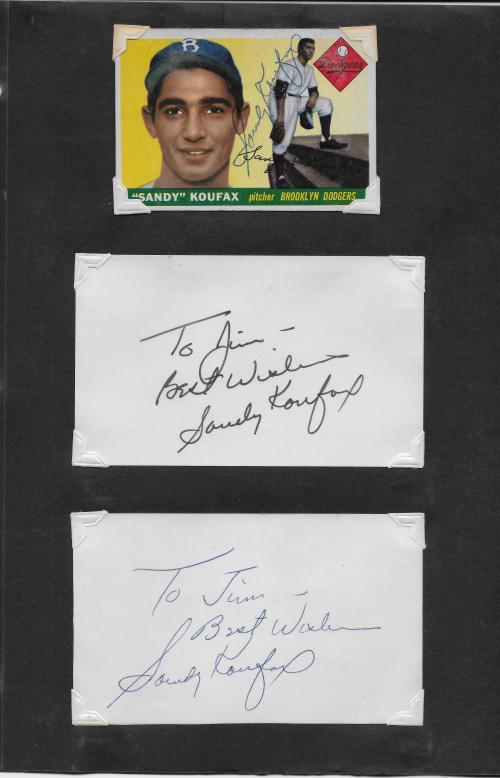
sandy-koufax-1955-topps-001

Of course, all this was before vintage cards … or rookie cards … were worth anything monetarily.

I’ve been told that by getting the card signed, I have greatly reduced its value, but I never collected cards with the idea of reselling them, and I never got autographs to sell them, either.

Koufax was a good signer through the mail in the early 1970s, and I was able to get all my cards signed that way, although I risked losing some increasingly valuable cards.
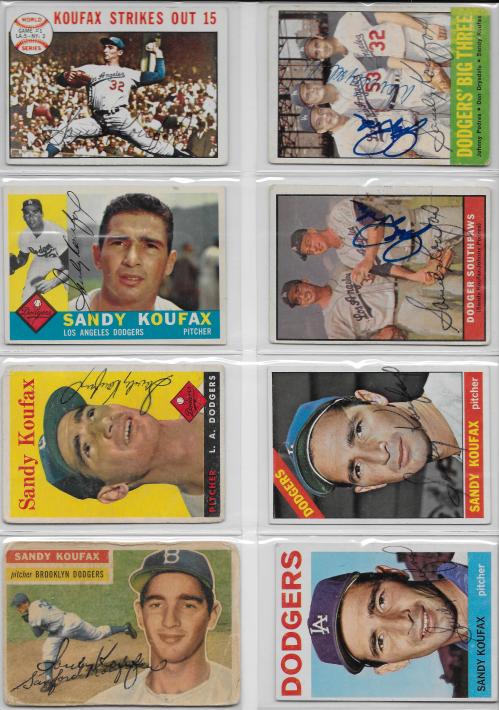
sandy-koufax-signed-cards-001

The only other time I saw Koufax in person was at spring training in Vero Beach, Florida, in 1980.  My brother and I went together for a week and had an absolute blast.

Here’s Koufax being mobbed by fans:
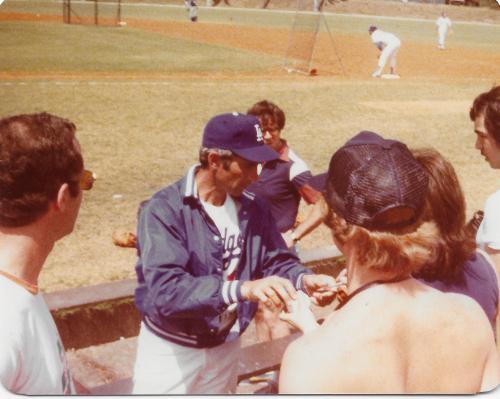
sandy-koufax-in-vero-beach-march-1980-001

Sandy is still alive and in his early 80s.  Jane Leavy’s book Sandy Koufax is a terrific read, as is Michael Leahy’s book The Last Innocents, which takes a close look at seven Dodgers’ players from the 1960s, including Koufax.

Eighth, Mickey Mantle.

The first day I ever got autographs at a hotel was at the Grand Hotel in Anaheim in April 1967.

The New York Yankees were in town, and I brought along an autograph book that had been signed by friends from fifth and sixth grade … I kid you not.

When we arrived at the hotel, there was a huge window looking into the coffee shop, and there sat Mickey Mantle … eating an ice cream sundae.

Upon spotting Mantle, some kids rushed into the coffee shop, but Mantle said he would sign when he came out … which he did … in my autograph book.

Over the next two years … 1967 and 1968 … Mantle signed at least five times other times for me … once every road trip.  (The Yankees came to Anaheim three times a year back then.)

Here are three of those signatures (remember, we didn’t have Sharpies back then):
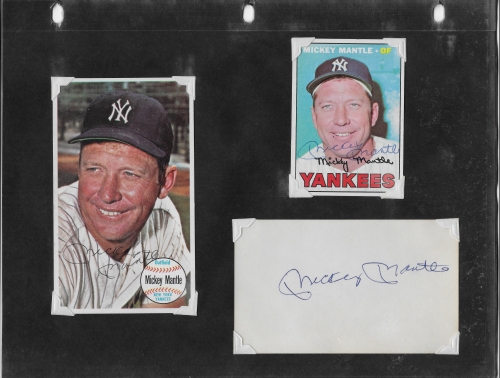
mickey-mantle-signed-stuff-001

Here are a few Mantle stories:

*A friend of mine joined me at the hotel one day to get Mantle’s autograph, and when he did, Mantle made a snide comment about his appearance, which ended up circulating all around our Jr. High school.

*My brother John and another friend decided to ride the central elevator at the Grand Hotel (which they weren’t supposed to do) and when the elevator stopped at a certain floor, Mantle got on.  When they asked him for his autograph, he yelled at them.

*A kid in a wheelchair once waited for Mantle to emerge from the hotel, and when he did, Mantle went right up to him, but the kid didn’t have a pen for Mantle to sign anything with.  I quickly offered my pen, and when Mantle was done, he asked, “Whose pen is this?”  I said, “Mine,” and Mantle signed my item next.

*I wasn’t there, but I was told that a fan wanted a picture taken with Mantle in front of the small fountain outside the hotel.  The fan was so nervous that he fell in the fountain.

*My brother’s friend Mark joined us one afternoon to try and get Mantle’s autograph.  When Mantle came out of the hotel, he signed for my brother, then boarded the bus.  When we motioned for Mantle to open the bus window, he did.  When Mark asked him for his signature, Mantle mistakenly told him, “I already signed for you,” and signed another one for my brother … which he turned and gave to Mark.

The last time I saw Mantle was before an Old-Timers game at the Sheraton Hotel in Anaheim around 1971.  Mantle took my card … turned and stared at me for a moment … and then signed it.

He and Johnny Bench were the most intimidating players I ever asked for autographs.  Maybe Bench is nice now (as he seems to be on a TV commercial), but he was tough during the latter part of his playing days.

According to former teammate Bobby Richardson, Mantle became a Christian in the closing days of his life in 1995, so I look forward to seeing the Mick again.

Ninth, Juan Marichal.

Growing up a Dodgers fan, the San Francisco Giants were their rivals … and when the Dodgers went to Candlestick Park, they could not hit Giant pitcher Juan Marichal.
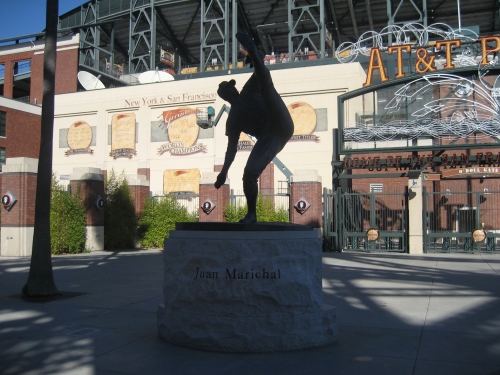
bfcc-staff-att-park-nov-13-2007-233

Marichal threw nine different pitches from three different angles (overhand, three-quarters, and sidearm) … a total of 27 different looks for a batter … but he was best known for his high leg kick, portrayed in this statue outside AT&T Park in San Francisco.
ryan-with-juan-marichal-sign-at-candlestick-1982-001

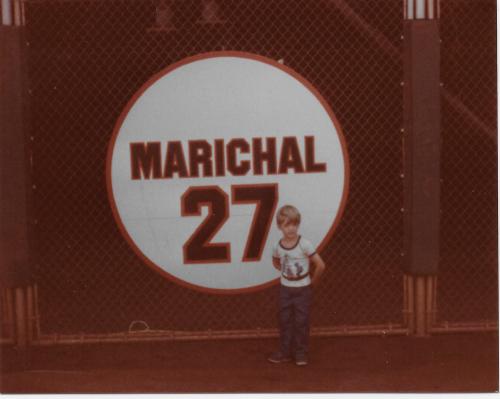
Believe it or not, the Giants used to hold a picture day at Candlestick Park in the early 1980s, and I got this picture of Ryan in front of Marichal’s number on the outfield fence.

The first time I got Marichal’s autograph was in 1968 at the Grand Hotel when the Giants came to Anaheim for an exhibition game on a Saturday before the season started.

The next time I saw him was at the Ambassador Hotel in Los Angeles around 1971 … the same hotel where Bobby Kennedy was shot in June 1968.  Marichal looked at me and asked, “Why don’t you go and get a job?”  (I worked for McDonald’s at the time but got off work to go and see the Giants.)  He usually signed only one item back then.

But the following year … 1972 … Marichal changed his disposition and signed everything in sight!

(The typical pattern is that players start off as good signers … become grumpier after gaining fame or stardom because average people, not just baseball fans, start to recognize them in public … become even worse as they near retirement … and then after a year or two out of the game, become better signers once again.)

Besides the “job” comment, I had only two other encounters with Marichal.

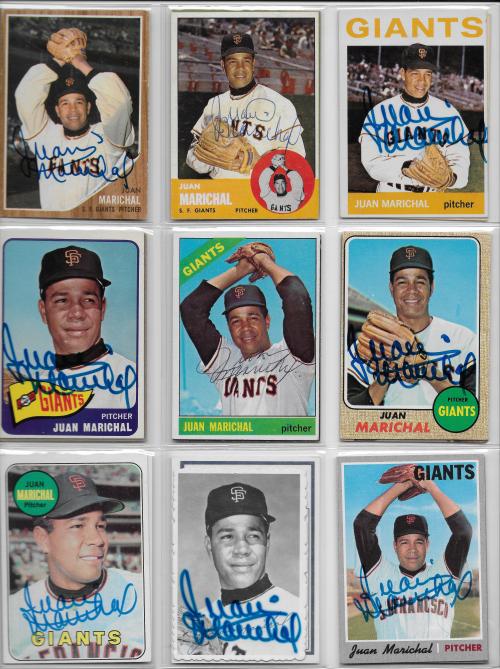
In 1983, Marichal appeared at a card show in Santa Rosa, California, and the autographs were only $2.50 each.  Marichal signed a lot of cards for me that day, and shook my hand afterwards.  He couldn’t have been nicer.

Several years later, Marichal appeared at a baseball clinic for kids several miles from my house, and he generously signed six cards.
juan-marichal-signed-cards-001

Marichal may be best known for clubbing Dodger catcher John Roseboro with a bat at Dodger Stadium in the heat of the pennant race in August 1965.

John Rosengren has written an inspiring book about that incident and the subsequent relationship between the two men called The Fight of Their Lives: How Juan Marichal and John Roseboro Turned Baseball’s Ugliest Brawl into a Story of Forgiveness and Redemption.  I keep meaning to write a blog about the book and hope to get it done sometime.

Tenth, Willie Mays.

Willie Mays is considered by many baseball experts to be the greatest all-around player in the history of the sport.  He played with passion, charisma, and daring.

And he was my brother John’s favorite player.

jim-and-ryan-southern-trip-076

The first time I got Mays’ autograph was at the Grand Hotel in 1968 … the same occasion when I first got Marichal’s autograph.

When the players came off their bus, my brother and I followed Mays into the hotel, and I took a photo of the two of them.  I still have it … somewhere … but the flash didn’t work, and Mays made a comment about it at the time.

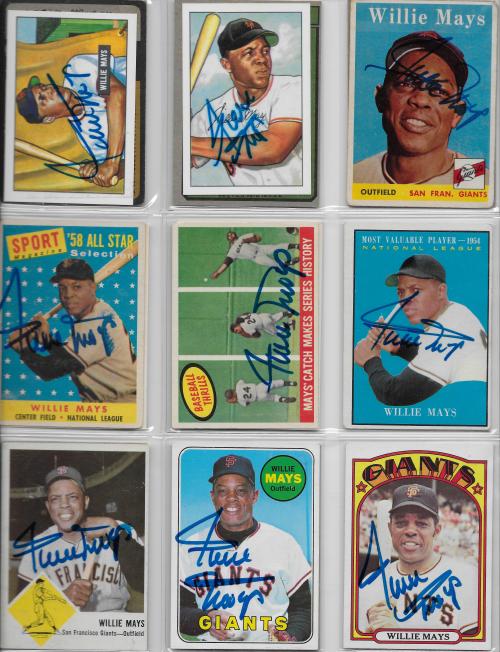
I was fortunate enough to get his signature three times that day … unlike Mantle, Mays never looked at who he was signing for … but all three signatures were different.  His autograph didn’t become uniform until he started signing at shows years later.

The next time I got his autograph was at spring training in Palm Springs in 1971.  My friend Dave and I went to the Giants hotel but we saw Mays slip away while wearing his uniform.  We jumped in Dave’s Volkswagen, followed Mays to the park, and got his autograph just as he was going into the clubhouse … but his signature (which I still have) was lousy.

This sets up the craziest autograph story I’ve ever experienced.

Remember how I mentioned earlier that the Giants stayed at the Ambassador Hotel in Los Angeles when they came to town?

Well, one time in 1972, five of us went to the Ambassador in my friend Dave’s VW bug.  We got the autographs of most of the Giants … they came out the front for a cab or to take the bus … but we missed Mays … who usually rented a car, parked out back, and drove to Dodger Stadium himself.

If we waited for Mays, we’d miss the other Giants, and we didn’t want to do that … but maybe, we thought, we can get him after the game.

However, the Giants boosters were also staying at the hotel, and somehow, one of our group found out the room number where Mays was staying … information that didn’t interest me at all.

So after the game, Mays came out of Dodger Stadium, signed maybe one autograph (with a huge crowd surrounding him), got in his car, and took off.

Please understand that back in the early 1970s, the best way to get a player’s autograph was at the team hotel.  You could write a player in the mail, but if he didn’t answer, you’d lose your valuable cards, and that was a tough risk to take.

I don’t remember who made the suggestion, but somebody said, “Hey, let’s see if we can catch Mays at the hotel.”  So we drove to the Ambassador and waited … but there was no sign of Mays anywhere.

And then someone made this fateful suggestion: “Hey, I’ve got Mays’ room number.  Why don’t we go up to his room and ask him to sign for us?”

I’m sure I said, “No!  Bad idea!  Let’s just go home.”

But what if Mays was really cool and signed for us?

Someone else prevailed, and the next thing I knew, two of my friends were knocking on the hotel room of Willie Mays … just after midnight.

Mays opened the door, and he was wearing maroon pajamas.  He took a look at the five of us … I was hiding a bit down some stairs … and one of the five asked, “Willie, can we have your autograph?”  Mays asked, “Who are you guys with?”  My friend replied, “We’re with the Giants boosters, Willie.  Can we have your autograph?”

As Mays peered into the hallway and saw five of us, he said, “I’m going to call the house man on you.”

We ran … down the stairs … into the basement … up some stairs … across the back lawn of the Ambassador … and found Dave’s VW.  Dave peeled out down Wilshire Boulevard, and when he hit the Harbor Freeway, went 85 mph … as far from the Ambassador Hotel as we could get.

The next morning, I had a crew meeting at McDonald’s, and I kept waiting for the cops to come and arrest me.

Years later, I started a sermon with that story, and Dave … who also became a pastor … has used it as well.

While discussing this incident a few years ago, we both admitted that we’re still waiting for someone to come and arrest us for what we did to poor Willie 45 years ago.

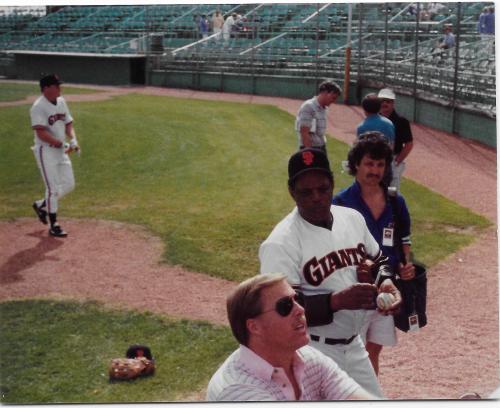
Since that incident, I’ve gotten Mays’ autograph through two main venues: in spring training and at a card show (where his signature was only $2.50).
willie-mays-in-scottsdale-001

I once read where Mays said that everywhere he goes, if he signs one autograph, he ends up signing 100.  I can’t imagine what it’s like to be so visible … and so popular … and Mays has gained a reputation as somewhat of a grouch over the past few decades.
willie-mays-signed-cards-001

And after what we put Mays through at the Ambassador Hotel, I can’t blame him.

Sorry, Willie.

Mays can hardly see anymore … if at all … and the last I heard, he charges $100 per autograph.

Eleventh, Willie McCovey.

McCovey played on the Giants with Marichal and Mays, and when Don Drysdale of the Dodgers pitched against him, McCovey absolutely murdered him.

Big Stretch became the Most Valuable Player in the National League in 1969 and hit 521 home runs in his career.  He and Mays formed a powerful one-two punch.

McCovey was always pleasant and would sign one item whenever we saw him.

One time, we left the Ambassador Hotel and followed the Giants’ bus all the way to Dodger Stadium.  McCovey sat in the very back of the bus, and we saw his silhouette all the way to the ballpark.

In 1982, McCovey made an appearance at the Old Mill Shopping Center in Mountain View, near our home in Santa Clara, and I took the whole family after church.  Each autograph was only $1.00.
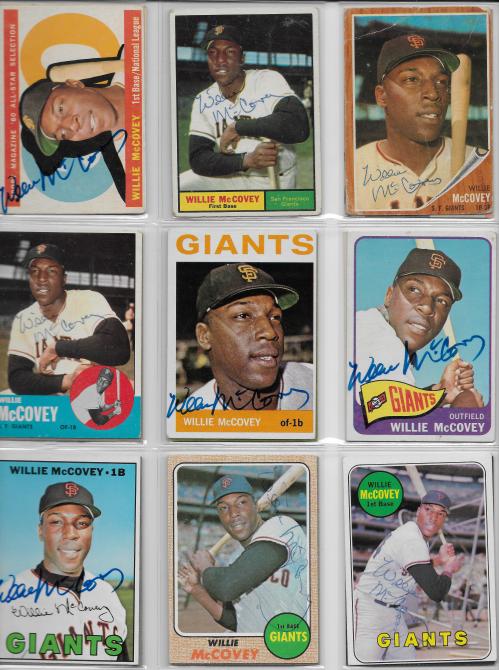
willie-mccovey-signed-cards-001

I took this picture of my son Ryan with McCovey:
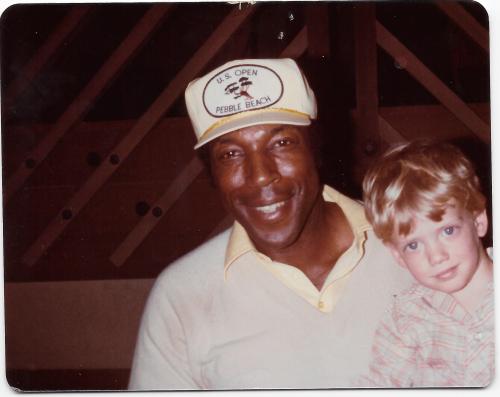
willie-mccovey-and-ryan-at-the-old-mill-in-mtn-view-1982-001

After he retired from the Giants, McCovey held an annual golf tournament at the Olympic Country Club near San Francisco every November.  Back in the 1980s, I went up there a few times and had a great time getting autographs.  Baseball players and other celebrities (like Huey Lewis) would practice their drives and putts, then go to their golf carts and just sit there waiting to go to the first hole.

Some collectors would wait by a certain hole and wait for the golfers to finish before asking them to sign something, but I went early and got autographs while everyone was still loose … and happy.

When I was a pastor in Silicon Valley in the 1990s, a guy in the church did landscaping for McCovey at his home in Woodside.  I asked him if he would ask McCovey if he’d sign a few things for me.

McCovey said no.

When the Giants built their new ballpark in south San Francisco, they named the cove behind the right field fence “McCovey Cove” in honor of Willie.  Many years later, I had the privilege of riding in the cove in a Duck Boat … piloted by my pastor friend Peter Muthui from Kenya.

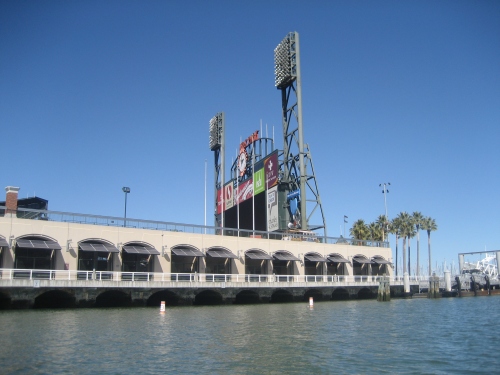
trip-to-sf-with-pastor-peter-march-9-2009-089

trip-to-sf-with-pastor-peter-march-9-2009-103

If you look closely at the photo below, you’ll see a statue of McCovey swinging a bat just above the rocks.

trip-to-sf-with-pastor-peter-march-9-2009-112

Finally, Frank Robinson.

Frank Robinson was the first player to win the Most Valuable Player Award in both the National League (1961) and American League (1966).

I first got his autograph at the Grand Hotel in 1967.  I was by myself, and Frank was okay.

But Frank could be a bit on the mean side.  With no one else around, I once asked him to sign his rookie card from 1957 in spring training as he was going from the parking lot into the clubhouse.

I can still hear him let out a yell … but he signed it.

Because he lived in Los Angeles, I saw him a few times at Lakers games in the late 1960s.

Frank was traded to the Dodgers in the early 1970s.  One night, he came out to his car and signed for everybody … something I wasn’t used to seeing.

Frank became manager of the Giants in the early 1980s, and I took a photo of him with Ryan at a Picture Day:
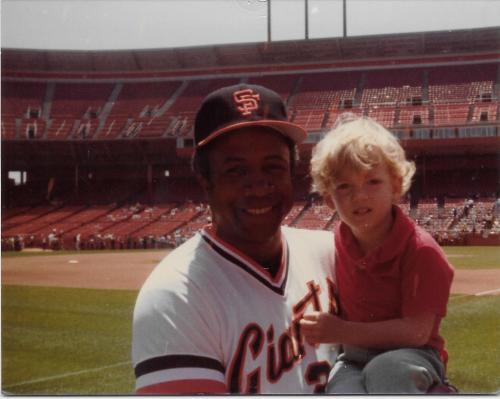
frank-robinson-and-ryan-at-candlestick-1982-001

Frank did a card show in the Bay Area in the 1990s … along with Ricky Henderson … and each autograph was $4.50 … bargains then and now.
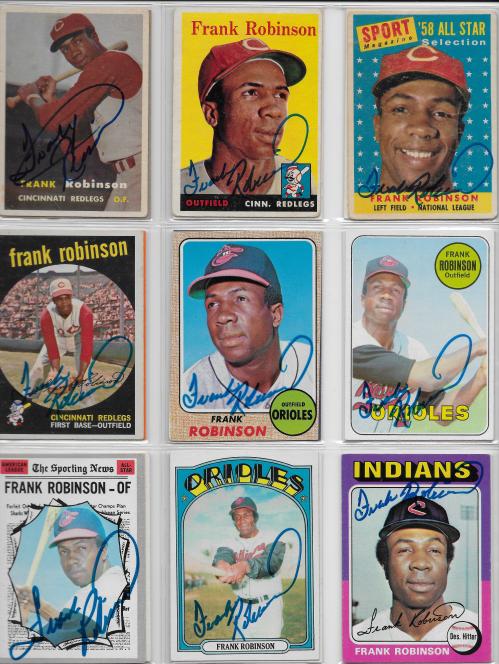
frank-robinson-signed-cards-001

The last time I saw Frank was after Harmon Killebrew’s memorial service at Christ’s Church of the Valley in Peoria, Arizona.  Due to the solemnity of the occasion, I wasn’t about to ask him … or anyone else … for a signature, but I did take his photo with my (pathetic) Blackberry.
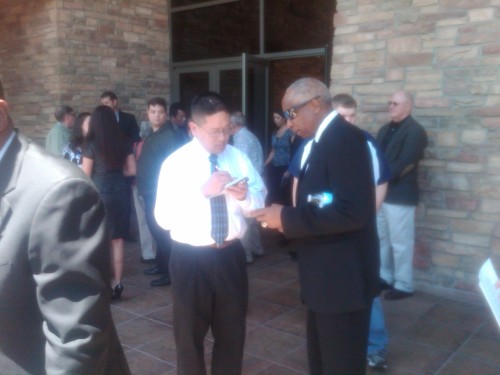
img00275-20110520-1133

After the Mays incident, I never violated a player’s privacy again, asking for an autograph only when they were in a public place.

I’ve got a lot more stories to tell … like the time a player invited me to lunch … or the time I drove a Dodger to the stadium the day before the All-Star game … or the time the league’s leading hitter sat down and talked to me for twenty minutes … or the time …
Read Full Post »

With spring training games starting in both Arizona and Florida this week, I thought I’d devote my next two articles to baseball.

When I was six years old, I began collecting baseball cards as a hobby.

Seven years later … in 1967 … I began collecting autographs of baseball players … eventually on many of those very same baseball cards … and continued off and on for the next 33 years.

Getting autographs was much simpler back then:

*We went to the hotels where the players stayed before the games, and most were great about signing when they came out for a taxi or the team bus.

*We didn’t have Sharpie pens until the early 1970s, so for a few years, I was always nervous that either my ballpoint pen wouldn’t be legible on a card or that it would skip.

*When I got someone’s autograph, I didn’t rush off to sell it.  I kept it … expecting to hold onto it for a lifetime.  If I had two of the same item, and you wanted it, I would give it to you.

*Collectors became friends and traded inside information: “This guy is really mean … that guy answers his mail … this guy is moody … that guy signs everything.”

*The longer you stayed at a hotel or a spring training practice field, the more autographs you’d get.  I was usually the last to go home.

*They didn’t have baseball card shows back then where a player would be paid to sign.  You either got autographs in person or through the mail.

*Autographs are all about time and place.  Most players would sign if you could catch them alone or somewhere where they couldn’t be rushed.

My wife has encouraged me to write a book about my experiences.  I started one a few years ago, but I wasn’t sure many people would care.

But recently, I’ve been thinking, “Maybe people would be interested if I told stories about my encounters with players like Reggie Jackson, Mickey Mantle, and Willie Mays.”

So before my memory fades, here are my experiences … and impressions … of twelve Hall of Fame baseball players from the 1960s.

Here are the first six:

First, Hank Aaron.

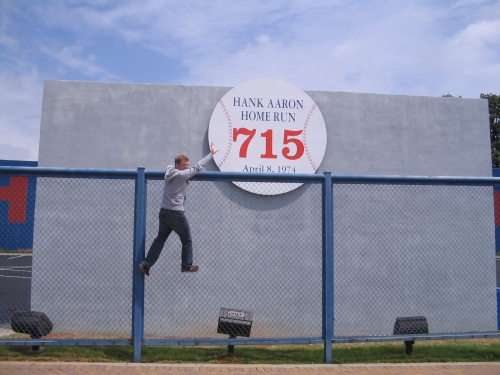
Several times, I’ve had a dream that I’m at an airport terminal with Hank Aaron.  We’re just talking, and he’s really nice, except that I don’t have anything for him to sign.

And I wake up in a cold sweat.

That’s an autograph collector’s worst nightmare … to see someone whose autograph you want and to have nothing for them to sign.

In April 1974, Aaron broke Babe Ruth’s all-time home run record, and he became world famous.

Jim and Ryan Southern Trip 205

Before that, I only saw him a couple of times, and got his autograph each time.

jim-and-ryan-southern-trip-076

In the late 1970s, he became a spokesman for Magnavox, and he made a personal appearance at a large store.  Some of my friends showed up expecting Aaron to sign for us, but he didn’t.  (I did take a picture of Aaron with my friend Dave.  As I was taking the picture, Dave said out loud, “This is my friend Hank Aaron, who won’t sign any autographs.”  Aaron muttered, “You understand.”)

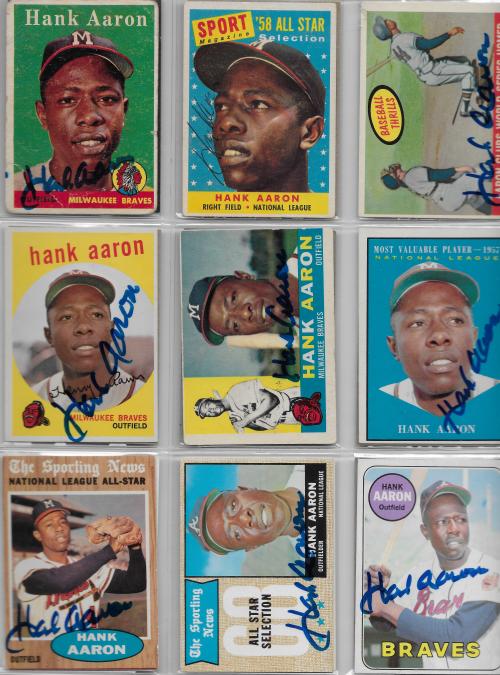
Then in the late 1980s, Aaron appeared at a card show in San Jose, and the promoter … who knew I was a good customer … introduced Aaron to me.  (I’m sure he’s forgotten.)  Each autograph was $4.50 each … a bargain for the then greatest home run hitter of them all.

hank-aaron-signed-cards-002

The first two cards are both from 1958, making them 59 years old.  I still find that amazing!

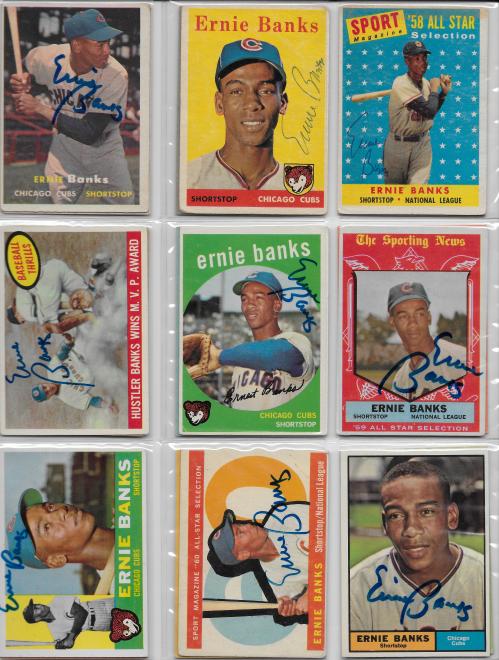
Second, Ernie Banks.

Banks had a reputation for being a super-enthusiastic ballplayer.  Every time he went on the field, he’d say, “Let’s play two!”

And he seemed like a very nice guy in person.  The first time I got his autograph, he signed 10 cards for me after a spring training game in Palm Springs in 1971.  (The second and third cards below … signed in ballpoint … were signed on that occasion.  Sharpie pens came into existence the next year, as I recall.)

ernie-banks-signed-cards-001

But many years later, I saw Banks at a golf tournament, and he was downright mean … the worst encounter I’ve ever had with a ballplayer.  (Richie Zisk of the Mariners once signed for me in spring training in Tempe, Arizona and told me, “Why don’t you go bother the other ballplayers in Florida next year?”)

I got a lot of the above autographs at a show Banks did in San Jose, and he spent most of his time joking around.  He’d sign his first name … banter with the fans for a minute … and then sign his second name.

He’s revered in Chicago, but not in my household.

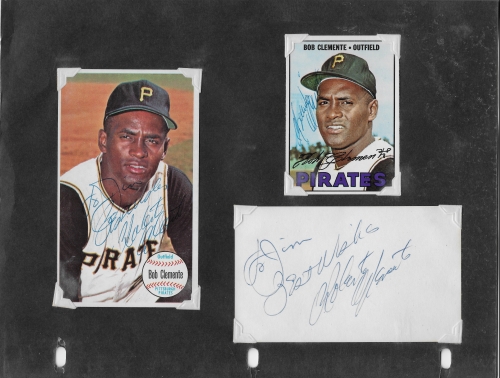
Third, Roberto Clemente.

Clemente played right field in the very first major league game I ever attended in May 1960 at the Los Angeles Coliseum.

Six years later, I saw him play at Dodger Stadium.  He had the greatest outfield arm I’ve ever seen.

The 1967 All-Star Game was held in my hometown of Anaheim, and I got Clemente’s autograph late Sunday afternoon as he was walking toward the Grand Hotel where the National League players stayed.  He looked regal in his blue suit.

Several years later, he signed a card for me after a game at Dodger Stadium.

The great thing about Clemente is that he signed all his mail.  I’d write to him every year, and he’d sign and return whatever I sent him.

signed-roberto-clemente-stuff-001

Clemente died in a plane crash on January 1, 1973 while taking relief supplies to Nicaragua.  When I read David Maraniss’ biography of Clemente a few years ago, I stopped reading before Maraniss recounted his death.  It still hurts.

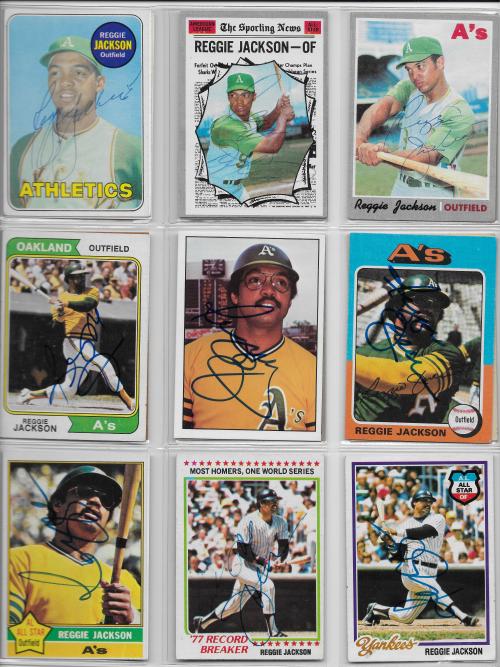
Fourth, Reggie Jackson.

Reggie came up to the Kansas City A’s in 1967.  The A’s stayed at the Jolly Roger Motor Inn across from Disneyland, and you could walk right up to a player’s room outside and knock on the door.  (Joe DiMaggio was a coach on that team!)

The next year, the team moved to the Grand Hotel in Anaheim … where all the other teams stayed … and Reggie eventually became a big star.  He hit 3 home runs and drove in 10 runs in one game in the summer of 1969.

A kid from my neighborhood named Gordy once introduced Reggie to a woman inside the hotel, and suddenly, Reggie and Gordy became friends.

Whenever the A’s came to Anaheim, Reggie and Gordy were inseparable.  Friends told me they even appeared on a post-game show from Anaheim Stadium together.

I once went to Gordy’s house and saw his large Reggie poster on the wall.  Reggie devoted a lot of space telling Gordy what a good friend he was.

But when Reggie went to the Yankees, he became a tough autograph.  I once saw him lecture a crowd after a Yankees-Angels game of at least 100 people, explaining why he didn’t want to sign for them.

Reggie wrote his full name for many years, but after he hit three home runs (on three consecutive pitches) in the 1977 World Series against the Dodgers (broke my heart), he started writing just “Reggie” or “Reggie J” … sometimes sideways or upside down.

reggie-jackson-signed-cards-001

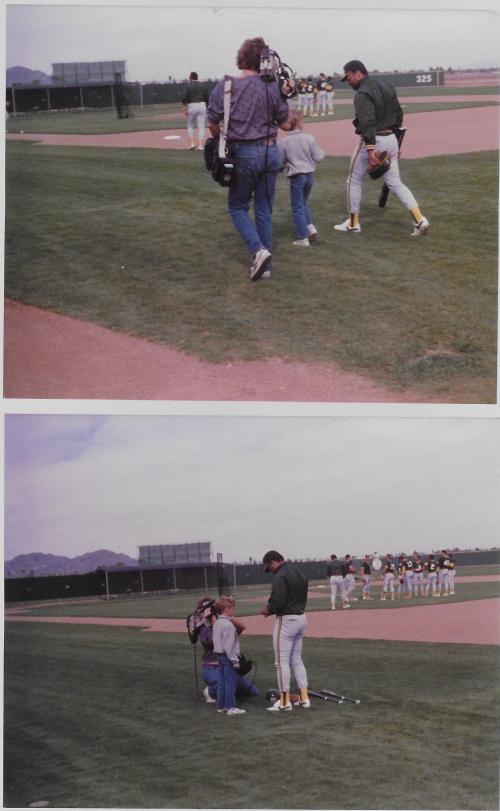
In 1987, when Reggie’s career was winding down, my son Ryan and I visited the A’s at Scottsdale Community College for spring training workouts.  Because there was a camera on Reggie, he signed two cards … on the practice field!

reggie-jackson-and-ryan-1983-001

One of my best friends growing up became a policeman in Anaheim.  He told me that after a game, a car turned the wrong way out of the stadium, and when my friend stopped the driver, it was Reggie, who asked my friend, “Don’t you know who I am?”  My friend gave him the ticket anyway.

Wish I had been there!

Fifth, Al Kaline.

Kaline was the star right fielder for the Detroit Tigers and became a batting champion at age 20.  He was always a classy guy.

While some autograph collectors were normal people, a few had their peculiarities, including a kid named Gary.  (Gary once drove Yankees’ outfielder Bobby Murcer from the hotel in Anaheim to a game show in Hollywood and I feared for Murcer’s life.)

Anyway, in August 1968, as the Tigers were heading for the American League pennant (they beat the Cardinals in the World Series), Gary brought his cassette recorder to the Grand Hotel and asked Kaline if he could interview him.  They went to the parking lot where Gary asked Kaline some softball questions and Kaline … classy guy that he is … answered them all.

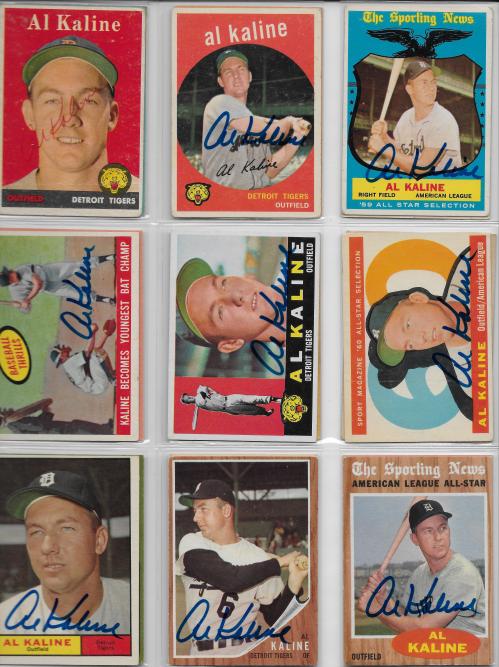
al-kaline-signed-cards-001

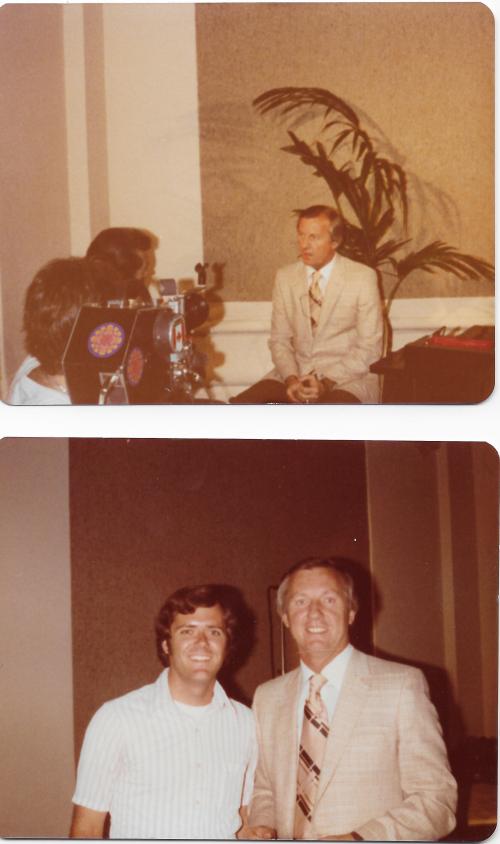
Twelve years later, Kaline made an appearance before the 1980 All-Star Game in Los Angeles, and I had my picture taken with him at the Biltmore Hotel.

al-kaline-1980-all-star-game-in-la-001

Ten years later, Kaline appeared at a massive card convention at the Moscone Center in San Francisco, and after he signed some items for me, he shook my hand.

Few players … past or present … treat collectors like people.

Kaline always did.

Sixth, Harmon Killebrew.

The second time I went to the Grand Hotel for autographs at age 13, I walked into the lobby and saw Bob Allison, Harmon Killebrew, and Jim Perry of the Minnesota Twins sitting on a couch.  They all signed, but Killebrew was especially pleasant.

Killebrew was nicknamed “The Killer.”  He was a great home run hitter and was the Most Valuable Player in the American League in 1969.

The Mall of America in Bloomington, Minnesota, is built on the site of the original ballpark of the Minnesota Twins.  There is a sign on the wall … high above a flume ride … to mark where Killebrew once hit a baseball.

20140825_113911

But he was also one of the nicest ballplayers for autographs.  If he had time, he would sign whatever you gave him.

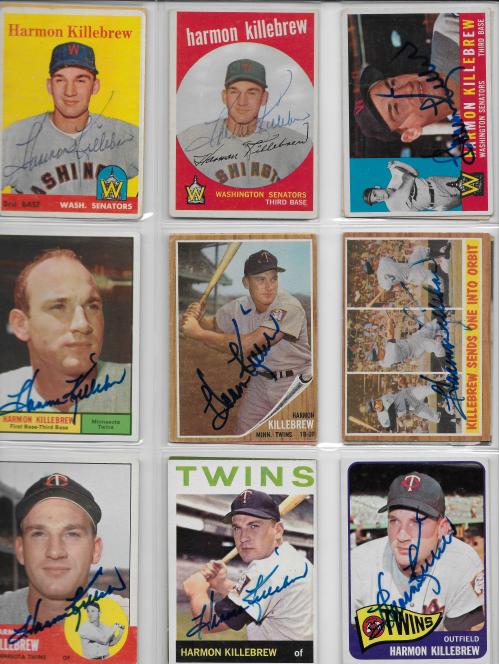
harmon-killebrew-signed-cards-001

I once asked him to sign a 1956 Topps card.  (It was his second card.)  He told me, “Are you sure you want me to sign that?  It’s worth some money.”  But I didn’t collect cards for their monetary value … I collected them so players would sign them … which he did happily.

When I was collecting, Killebrew was one of the two nicest players in the American League.

When Killebrew died, his memorial service was held at the church I was attending in Peoria, Arizona, and the public was invited.  The Minnesota Twins were in town to play the Arizona Diamondbacks, so that Friday morning, many of the Twins players attended.

They showed a video of Killebrew … who had been retired for about 35 years when the video was taken … signing autographs for a crowd of fans at Target Field in Minneapolis.

And he had a long name.

Next week, I’ll share more memories/impressions from players like Sandy Koufax, Mickey Mantle and Willie Mays.

And the Mantle and Mays stories are the best.

Read Full Post »

I could not have published what you’re about to read when I was a pastor.

Over 36 years in church ministry, there were things I did that I hated doing … and things I loved doing.

If I hated an activity, it took me a while to start and finish it … and I’d count the minutes until it was done.

If I loved an activity, I’d clear my calendar, focus like a laser beam … and pay no attention to the clock.

My guess is that the longer a pastor is in ministry, the more things there are that he can’t stand doing.

When I was a kid, the great Bible teacher Wilbur J. Smith came to our church to preach.  My parents invited him over for dinner, but he declined, stating that he no longer accepted invitations for meals.

He loved preaching … and hated dinners.

I can relate!

Here are five things I hated doing as a pastor:

First, I hated editing church publications.

It’s my belief that everything that a church publishes for public consumption has to be perfect.

Just one misspelled word or a phrase with garbled syntax can lessen a church’s image in the eyes of some people.

Many years ago, the church I served as pastor spent $5000 on a full color brochure that we gave to our guests.

I was on the marketing team that designed the brochure and had reviewed it repeatedly for errors.

A prominent evangelical leader was so impressed with the brochure that he wanted to include it in a book he was writing.

I was thrilled … until I noticed that the word “activities” was spelled “activites” instead!

And that sunk our chance to have the brochure included in anybody’s book.

After that misstep, I was doubly conscious of only putting out perfect publications.

So every week, I reviewed the bulletin/program.

And every month, I proofread the church newsletter.

As a perfectionist, I’m a good proofreader.  I edited and proofread my book Church Coup and have discovered only two errors in the 289 pages of the paperback version.

I don’t mind proofreading my own writing, but I hate proofreading other people’s writing.  (One staff member had dyslexia and couldn’t write a decent sentence.  I had to rewrite everything he gave me, which ticked him off.)

Why didn’t I farm things out?

Because publications have to be read both for grammar and for content … and I could do both quicker than anyone else.

But after years of proofreading, I dreaded it more and more.

Second, I hated performing weddings.

I created four criteria for marrying a couple: they both had to be Christians; they had to attend our church while undergoing counseling; they had to agree to four to six counseling sessions with me; and they had to agree not to sleep together until their wedding day.

After reading those conditions, the majority of couples found someone else.

But if a couple met my conditions, I’d marry them even if I thought they were a mismatch.

The worst wedding I ever did involved a couple I can’t adequately describe.

They wanted to get married on a beach in Northern California.

I dressed up in my suit one summer day and drove 90 minutes to this small parking lot … then had to walk about a half mile over sand to the site of their wedding.

The guests sat on driftwood … all 15 of them.  The groom dressed like Sir Lancelot, and the bride dressed like Maid Marion.

I kept asking myself, “What am I doing here?”

After the ceremony, I waited a solid hour for my honorarium of $100, which didn’t come close to paying for my humiliation.

Another time, I married a couple at the chapel at The Presidio in San Francisco.  Before leaving home, my wife agreed to be in charge of my clothes.

When we arrived at The Presidio for the wedding, my wife had left my suit coat at home.

I had to borrow one from the chauffeur!

But those stories don’t reflect why I didn’t like weddings.

If the wedding was held inside our church, then I was in charge, and my anxiety lessened considerably.

But if the wedding was held away from church … and most were … then others were in charge … and my anxiety could go through the roof.

More times than not, I represented the spiritual part of things … and the rest of the festivities seemed to contradict the spiritual.

In addition, a wedding usually involved a rehearsal and dinner the day before, with the wedding itself the following day … which meant I’d invest anywhere from ten hours to more than a day … and sometimes, I’d never see the couple again.

The last wedding I did involved 32 hours on my part … and the couple stiffed me on the honorarium.

Just another reason why I came to hate most weddings.

Third, I hated the logistics of getting to a hospital.

Rather, I hated driving to hospitals and finding a parking place.

Once I found a patient’s room, I loved talking with them, and reading God’s Word, and praying with them.

But getting to the hospital was often another matter.

During my last ministry, the area hospitals I visited lacked reserved parking for clergy.

Whenever I had to go to Kaiser Hospital in Oakland, for example, I’d have to fight through all the signals and traffic, search ten or fifteen minutes for a parking space near the hospital, walk at least a quarter mile, ascend crammed elevators, and hunt for a patient’s room.

Once I got there, I was in my element.

But getting there could be maddening, and the entire round trip could take two hours.

In addition, most medical emergencies happened either on Thursdays (when I studied at home) or on Fridays (my day off) … and that time was precious.

And as pastors know, one emergency situation can throw your entire week’s schedule off kilter.

I loved being a pastor to people in the hospital.

I just wish I’d had a chauffeur.

Fourth, I hated board meetings.

Early in my ministry, board meetings made me anxious.

I never knew who was going to surprise me with criticism or a dumb suggestion or information about someone I didn’t care to know.

In my middle years, I loved board meetings, because that’s where I received approval for the agenda items that God had given me.

When I knew the board members personally, and I knew they stood behind me no matter what, I enjoyed attending them and found them productive.

But when I didn’t know the board members well, and they collapsed on me when I needed them most, those meetings became chores … and bores.

I once heard Bill Hybels say that the elders in his church held their meetings in homes.  They’d have dinner together, let him give a report, and then sometimes dismiss him and carry on without him.

You can do that if you trust the board.  You can’t if you don’t.

My last few months in ministry, I didn’t trust the board, and had to endure meetings long into the night … and wished I was home instead.

Finally, I hated staff confrontations.

I once spent several hours with a nationally-known church consultant.

He asked me some questions about my staff at the time, and then queried:

“Jim, are you a highly responsible person?”

I replied, “Yes.”

He continued, “Do you only have to be told to do something once?”

I replied, “Yes.”

He concluded, “But Jim, not everyone is like you.”

He was right.

I couldn’t understand staff members that came in late … left early … didn’t show up for events … left their offices a mess … were always disorganized … and never got their work done.

I couldn’t live with myself if I acted like that.

I was never a “helicopter pastor.”  If we hired someone, I expected them to do the job without constant reminders or warnings.

But if they weren’t doing the job, I had to intercept entropy and confront them … and I hate confrontation.

This is why I always liked Steve McGarrett on the original Hawaii Five-O TV show.  McGarrett had no problem confronting anybody, whether it was a two-bit thief, a local gangster, or an international agent like Wo Fat.

Chuck Swindoll once said that half the time he confronted someone, it worked out well, and half the time it didn’t.

Most of my confrontations seemed to fall in the latter category.

If I had to confront you about something, things had gotten really bad.

I always did it … I just hated doing it.

Pastors are all different.

Some hate administrative work … others hate social events.

Some hate preparing their sermon … others hate making small talk.

As time goes by, pastors are often able to rewrite their job descriptions so they’re doing what they love and avoiding what they hate.

If they can negotiate such changes, they can last many years in ministry.

If they can’t make such changes, they may burn out prematurely.

Because burnout isn’t about doing too much work … it’s about doing work that’s unpleasant and unproductive.

In one of my doctoral courses at Fuller, our professor told us that pastors should spend at least 70% of their time doing things they love and 30% doing things they don’t.

But if you’re spending 30% of your time doing what you love, and 70% doing what you hate, that’s a recipe for failure.

The problem many pastors have is that (a) we either view ourselves as indispensable, meaning we have to do everything and be everywhere, or (b) we believe that people expect us to do everything and be everywhere.

Both are common … but are recipes for disaster.

If you’re a pastor, which areas of ministry do you despise doing the most?

If you’re not a pastor, which areas of ministry do you think he dislikes the most?

Read Full Post »

Sixty years ago, a young pastor lived across the street from my uncle and aunt in Garden Grove, California.

This pastor told them that he was starting a new church in the community and asked them to join it.

They declined.

That pastor’s name?

Robert Schuller.

Dr. Schuller believed that when a pastor was called to a church, he should be committed to that church for life.

Although Schuller’s story didn’t end well, he remained the pastor of Garden Grove Community Church … and then the Crystal Cathedral … for his entire ministry career.

I believe that most pastors take that attitude when they’re called to a church: “I’m going to stay here for the rest of my life … or until God takes me home … and that means I’m not going to run whenever trouble starts.”

My ministry is primarily focused on helping pastors and church board members who are struggling in their relationship to handle their disagreements in a biblical, just, and loving manner.

Yet pastors are being forced out of their positions – often by church bullies – at an ever-increasing rate … and I don’t think that pastors should automatically resign when that happens.

But I believe there are times when the best decision a pastor can make is to resign unilaterally and voluntarily.  In such cases, the pressure doesn’t necessarily come from outside the pastor, but often inside the pastor.

When should a pastor resign?

First, when he’s disqualified himself morally.

The first thing most of us think of when we read the above phrase is adultery.

I’m sure many pastors think to themselves, “If I was ever guilty of sleeping with someone other than my wife, I’d quit immediately.”

And yet it’s shocking how many pastors have fallen morally and yet continue on as if nothing ever happened.

Rather than leaving, they wait until they’re caught and then resign … sometimes years or even decades later.

And I always wonder, “How could they hold and preach from the Holy Bible … and serve holy communion … and do it all in Christ’s holy church … when they’re leading such unholy lives?”

More than twenty years ago, I remember a nationally known pastor who resigned from his church for “inappropriate behavior.”

Interviewed in front of his house by a television crew, this pastor stated that he had no business ever being a pastor again.

I thought to myself, “Wow.  You just don’t hear that anymore.”

After running the clip, the female host told her television audience, “The minister’s attitude is refreshing.”

But I have since discovered … from two reputable sources … that the pastor didn’t resign voluntarily but was caught doing things pastors shouldn’t do.

There are other sins that might disqualify a pastor from office as well, including stealing church funds, physical abuse, blatant lying, or even murder.

But for some reason, it’s relatively rare for a pastor to blow the whistle on himself.

Is that due to a pastor’s high commitment level, or his pride?

Second, when the congregation no longer responds to his preaching.

Many years ago, I had lunch with a former pastor who had led a megachurch for more than two decades.

This pastor was well-known in many circles and had written a book that still sold thousands every year.

He told me that for some reason, his people had stopped listening to his sermons.

In fact, he felt they needed to hear a fresh voice.

So he went to the church board and told them he wanted to negotiate a settlement so he could leave.

I can relate to this pastor’s story.

During my final pastorate, over my first few years, my sermons were very well received.

But over my last few months, I just wasn’t connecting as I once had.  Some of my humor fell flat … I started repeating myself … and I may have preached in a tone of frustration.

Looking back, maybe I was trying to work out solutions to my own problems through my preaching rather than dealing with the congregation’s issues.

Toward the end, there were Sundays where nobody told me they “liked my sermon.”

When a pastor receives positive feedback from a sermon, it provides much-needed fuel for his next message … but when he receives little to no feedback, it can become very demoralizing … and, in some cases, serve as a signal that the pastor needs to leave.

Third, when you’re hanging on for a paycheck.

I once worked with a pastor who had announced to the church that he was going to retire at a future date.

After he made his announcement, he didn’t do very much around the office.

He signed checks … came to my office and talked … and spent most of his time just killing time.

I never saw him read a book.  I never saw him study for a sermon.

He came to the office late, and left early.

There’s a sense in which we can understand a situation like this.  If a pastor has served a church faithfully for years, and wants to give them plenty of advance notice that he’s going to retire, maybe he shouldn’t be expected to be a ball of energy.

But what bothers me is that there are thousands of pastors around who aren’t nearing retirement and yet act just like they are.

Life’s too short to be unhappy and unfulfilled in your job.

My counsel to a pastor who is just putting in time would be, “Get out … as soon as you can … because your people deserve a more energetic and effective shepherd.”

Fourth, when attendance is in a death spiral.

Forgive me for the following cynical statement, but I believe that it’s true:

“Many churches exist to pay the pastor’s salary.”

This statement refers to churches that:

*were once growing and vibrant.

*have been in steady decline for years.

*struggle just to put on a service every Sunday.

*are wearing out their few remaining lay leaders.

*nobody wants to invite their friends to attend.

*allocate the overwhelming bulk of their income to the pastor’s salary.

*have no positive plan for turning the church around.

I wrote an article about this situation a while back because it’s so common:

When Should the Pastor of a Church in Steady Decline Leave?

After soliciting responses from some top Christian leaders, I synthesized their counsel and then wrote this article:

Turning Around a Declinling Church

Let me make this bold statement: unless the pastor of a church is willing to reinvent himself, the pastor who presided over a steady decline rarely presides over a turnaround.

It would be helpful for a church in steady decline to bring in an outside consultant to take an objective look at their situation as well as their future, but such a church usually needs a new pastor with fresh vision and energy.

Fifth, when the pastor can no longer endure personal and family attacks.

If a pastor is a strong individual, most people unhappy with his ministry will just leave the church … a few loudly, most quietly.

If a pastor is more passive or perceived to be weak, a bully may try to take him out … or organize a faction that starts making demands and threats.

Pastors know they’re going to be criticized: after sermons, on response cards, through emails, via anonymous letters, and worst of all, through messages relayed by others.  (“So and So is mad at you.”)

Much of this is par for the course, but when people threaten the pastor’s reputation or job, and add threats and demands, it can become a bit much … and sometimes, become abusive.

I believe that when a pastor is being abused, the church board needs to step in, calm down those making the threats, and encourage them to modify their behavior … or leave the church.

But if the board won’t do that … or the threats originate with board members … then most pastors can only take so much.

But what pushes most pastors over the edge is when professing Christians attack his wife and children.

This happened to me during my second pastorate.  The seniors class rebelled against me and drew up a list of all my faults … including those of my wife and kids.

My wife’s offense?  Her slip was showing one Sunday.

When the board unanimously stood with me, my attackers immediately left the church, but it was almost more than we could take.

We all have a different threshold for criticism.  Maybe you can take more than I can.

But when pastors are “mobbed” by a sizeable portion of the congregation, why put up with it?

And short of a heaven-sent revival, what can a pastor do to mollify such people?

Just leave ’em behind.

Sixth, when the pastor would rather be doing something else.

Years ago, I knew a pastor – a very godly man, in my view – who was being consistently attacked at church.

The pastor lived across the street from the church campus, and had some used refrigerators in his garage, which he loved to work on.

One Sunday night, after a terrible congregational meeting, my friend walked across the street to his home and decided to resign and fix refrigerators and appliances for a living.

I began serving in church ministry at age 19, and worked only for churches for nearly the following four decades.

So when I was forced out of my church, I couldn’t identify any transferable skills that I could use to start a business or land a decent secular job … unless flipping hamburgers and cooking fries counts for something.

But many pastors do have those skills, and if the day ever comes when they’d rather make a living in a previous profession, then maybe that’s what they should do.

My first seminary professor was the great Dr. Charles Feinberg.  He told my Old Testament class, “Gentlemen, if you can do anything other than being a pastor, do it!”

He was right.

Finally, when the church board asks for your resignation.

I sometimes hear stories about pastors who were fired by their elders or deacons.

Sometimes he’s fired after a Sunday service … or at a special/regular board meeting … or by two board members who meet with the pastor privately … or sometimes through an email or a letter in the mail.

In a perfect world, it would be preferable if the board asked the pastor for his resignation, and the pastor traded it – and a unifying letter – for a generous severance package.

But all too often, the pastor is fired unilaterally … without any explanation … without letting him ask questions or give feedback … and without any severance package.

However, if a board has prayed about it … consulted with outside experts … and every person on the board is in agreement, then the board should ask the pastor for his resignation rather than firing him outright.

This not only preserves the pastor’s dignity, but sounds much better on a resume.

However, if the board does ask the pastor for his resignation, they shouldn’t force him to quit right then and there.  (Some boards prepare a letter they want the pastor to sign ahead of time.)

The pastor needs time to think, pray, and speak with his family … and yes, giving him time runs the risk of his saying, “No, I’m staying” or even leading a counterattack.

But if the board unilaterally fires the pastor without notice or any good reason, many in the congregation may rebel, and the church may dwindle significantly, and require years to rebuild.

In almost every case … unless a board is composed of cruel and godless individuals … I believe that a pastor should resign if the board asks for his resignation.

Can you imagine other scenarios where a pastor should resign voluntarily?

Read Full Post »

For many years, I struggled with jealousy toward those in ministry who seemed more successful than I was.

In my mid-twenties, I was a full-time youth/Christian education director at a church in Orange County, California.  A friend I’ll call Ben … the pastor’s son … was a youth pastor at a church I had admired all my life, and he was making plans to attend seminary outside California.

Ben recommended that the church hire me as his replacement, and since many people already knew me, that’s what happened.

But right off the bat, I ran into resistance.

One high school girl told me that she felt sorry for me because I didn’t compare to Ben.

The adult youth leaders openly resisted my leadership.

An adult youth leader once stared at me and finally said, “Jim, you’re just so different than Ben” … intimating that wasn’t a good thing.

The following Christmas, Ben returned to the church and spoke on Sunday to a packed house where I was forced to sit on the platform and watch the lovefest between him and the congregation.  It hurt … immensely.

When I left that church three-and-a-half years later, I tried to pave the way for the next youth pastor.

A few years later, the pastor retired, and who did the church hire as their new pastor?  That’s right … Ben.

When I left that church, I became pastor of a small church in Silicon Valley.  Pastor Joe led the largest church in the area, and one Sunday when I was on vacation, I took my family to that megachurch.

It was so crowded that we sat on the last row of the balcony.  It was a hot day … the a/c wasn’t working … and we could barely see the stage.

But boy, could Pastor Joe pack them in!

I served a church of less than 100 people, and Pastor Joe pastored 2000 … and had co-written a book with someone who had a study Bible named after him.

To me, Pastor Joe was the epitome of success … and I felt great jealousy toward Pastor Joe because he seemed wildly successful while I was not.

But then something happened that profoundly impacted those feelings.

I had started a Spiritual Leadership Retreat for pastors and their board members in our district the year before.

Pastors often attend conferences … return home … tell their board members what they learned … but meet resistance because the board didn’t hear what the pastor heard.

So, I thought … let’s get pastors and their boards together, bring in a speaker, let him do a few sessions, and then after each session, ask the pastors and their boards to discuss the speaker’s ideas immediately.

We needed a speaker for our second retreat, and someone suggested Pastor Joe, so I contacted him, and we met in a restaurant to talk.

Going into that luncheon, I was greatly intimidated by Pastor Joe.  After all, he was a SOMEBODY while I was a NOBODY.

But during our three hours together, he poured out his heart to me about all the problems he was having in his church.

The biggest problem involved a staff member who was single and had been caught having sex with another woman.

The pastor and his elders decided to remove this man from his position … keep him at the church … put him under an accountability group … and give him a job as a church custodian.

Pastor Joe could not have predicted the avalanche of criticism he would receive.  He had received 300 letters that he could not bear to answer about the decision he and the board had made.  Half the writers felt the decision was too strict, while half felt the decision was too lenient.

The pastor also shared some shocking news with me.  While he had a degree from a Bible college, he had never gone to seminary, and his lack of a master’s degree made him feel very insecure.

So he overstudied.  He spent 15 hours a week on his Sunday morning message … 15 hours on his Sunday evening message … and 20 hours on his Wednesday night message.

Why did he spent 20 hours on his midweek message, I wondered?

Because, he told me, on several occasions, he stood up to speak and John MacArthur was sitting in the congregation, and Joe didn’t want to say anything inaccurate.

The three hours I spent with that pastor did more to cure me of jealousy than anything I’ve ever experienced.

Here is what I’ve learned about jealousy over the years:

First, we should never compare ourselves to others because God has made us all so different.

Whitey Herzog was a Hall of Fame manager who led both the Kansas City Royals and St. Louis Cardinals to World Series championships.

During his heyday in the 1980s, Herzog was often considered to be the best manager in baseball, an accolade he disputed.  He said the only way to tell the best manager was to give several managers the exact same players and see where they finished at the end of the year … an impossible feat.

In the same way, the only way to compare pastors would be to take a few of them … put them all in the same community … give them the same number of people … give them the same size campus and buildings … give them identical staffs and board members … give them the same income … and then see how they fared five years later.

But since that’s completely unrealistic, why even try to compare ourselves with others?

It may be human, but it’s ultimately counterproductive.

Second, jealousy often doesn’t start inside of us but within the followers of others.

Before Jesus’ baptism by John the Baptist, John’s ministry took people by storm, and his followers reveled in their access to this superstar and his fame.

But then Jesus came along and began baptizing as well.  The Baptism Wars were ready to start when John’s disciples said to him in John 3:26, “Rabbi, that man [notice they won’t name Jesus] who was with you on the other side of the Jordan – the one you testified about – well, he is baptizing, and everyone is going to him.”

There wasn’t any problem between John and Jesus.  The problem was with John’s followers.

In the story I told above about Pastor Ben … the youth pastor I succeeded … there wasn’t any problem between us.  We often met for meals at denominational events and laughed about my perception of the way people adored him.

And years later, I served as his teaching pastor for sixteen months.

Since we can’t stop people from comparing us to others, we either have to plug our ears or realize that we have our admirers as well, even if they aren’t as numerous or vocal.

Third, our job isn’t to become famous or well-loved, but to carry out God’s unique assignment for us.

In John 3:27-29, John tells his followers that he knows his role very well.  Jesus is the bridegroom, and John’s assignment is to be Jesus’ friend, or best man.

In other words, John says, who cares what people think about me as long as Jesus receives the spotlight?

That’s what he meant when he said, “He must become greater; I must become less.”

During my second staff assignment, I occasionally preached from the church’s large pulpit.  There was a small plaque attached to it that only the preacher could view.  The plaque read, “Sir, we must see Jesus.”

I’ve heard guys preach who told story after story where they were the heroes … and those individuals often acquired a large following.

But like John, there comes a time when we all have to say, “I don’t even care if people remember my name as long as they see Jesus.”

And since He’s why we serve, there’s no reason to be jealous of Him.

Fourth, every pastor has his successes … but they only last for a season.

After a very slow start, I’ve had some successes in ministry:

*I once appeared with several other pastors on a live radio program in the Bay Area.  I was very nervous going in, but talked quite a lot, and when I drove back to my church for our midweek Bible study, the congregation gathered in the lobby to greet me.

While that was cool, nothing really happened because of it.

*I pastored the largest Protestant church in a city of 75,000 for years.

But it didn’t last.

*The starting quarterback of the Oakland Raiders attended my church one year right before the season started.

But he only came for three weeks … and went on to became the worst quarterback in the league.

*I earned a doctoral degree, and enjoyed my classwork immensely.

But two years after graduation, I was forced out as pastor.

*I wrote a book, which I never thought I’d do, and it’s fun to see it on Amazon.

But the paperback has stopped selling, and as of this writing, it’s number 2,176,901 on Amazon, although I did sell one today, which will probably help me jump over a million places.

Our perceived ministry successes often don’t last very long.  John the Baptist’s ministry came and went quickly.  Jesus’ ministry lasted less than four years.

Years ago, I became convinced that success in ministry can only be measured by faithfulness.  On occasion, God lets us taste greater success, but it rarely lasts forever, because …

Finally, great success is often followed by great suffering.

When Paul ascended to the third heaven in 2 Corinthians 12, he said he “heard inexpressible things, things that man is not permitted to tell.”

Paul was tempted to say, “Wow!  I’ll bet nobody else has had this experience!  I am obviously someone very special!”

But, Paul writes, “to keep me from becoming conceited” he received “a thorn in my flesh,” some kind of nagging bodily ailment.

When I sat in that restaurant with Pastor Joe, and heard him tell me about the 300 critical letters he had received, I reminded myself of an adage I had often heard:

“Big churches have big problems … small churches have small problems.”

At that moment, I realized that if I were ever to pastor a large church, I would probably have to suffer greatly … and I wasn’t sure I wanted to pay the price.

And I was instantly cured of jealousy.

A year-and-a-half after our initial meeting, Pastor Joe died.  I never found out what killed him, but mean-spirited criticism, constant stress, and sitting in a chair studying fifty hours a week surely didn’t help.

Several years later, that church of 2000 had plunged to 400 … and was barely holding on.

_______________

When I was in seminary, we had to attend chapel four times a week.  Because we had to leave for work after chapel, my friend Dave and I both sat together on the back row.

Today, Dave pastors a large church.  He’s on the radio every day in many US markets.  I often watch his service on Roku.  He has a lot of influence in the Calvary Chapel movement.  He wrote the notes for The Word for Today Study Bible.  He hosted Chuck Smith’s question and answer radio program with Chuck many times … especially at the end of Chuck’s life.

I don’t feel any jealousy toward Dave.  He’s been my friend for nearly 50 years.  I know how gifted he is and how hard he’s worked over the years.

In fact, I’m happy for him … and when the Lord takes me home, I want Dave to conduct my memorial service.

Dave has a very public ministry.  By contrast, mine is quite private.

I spent two hours on the phone yesterday with a leader who has been struggling with some issues in his church.  The situation is complex … without easy answers … but I know I was able to help him.

At this point in my life, I wouldn’t trade places with Dave for anything.  I am quite content with my small ministry and glad that the Lord has called me to it.

And in the end, isn’t the antidote to jealousy to be content with the place, people, status, and salary the Lord has given us?

Read Full Post »

Many years ago, a church that I served as pastor held an Italian-themed outreach event on our campus one gorgeous Saturday evening.

Because we had a lagoon behind our property, my wife obtained a gondola and we offered our guests rides while someone serenaded them.

After one gondola ride, I greeted a woman I didn’t know and learned that she was from the Czech Republic.

As we walked toward the back entrance to our multipurpose room, she suddenly stopped and refused to go further.  When I asked her what was wrong, she said that she was afraid of entering the church building.

We weren’t going to enter the worship center … merely a larger room used by various groups … but she became so petrified she would not advance a step further.

Many people in our culture won’t set foot on a church campus for a variety of reasons.  Some have terrible memories from childhood.  Others can’t forget the way a family member was mistreated.  Still others are possessed by hostility toward God or pastors or churches as a whole.

But sometimes, people have a negative reaction because a church long ago made them feel so uncomfortable … or anxious … or excluded … or afraid … that they don’t want to feel that way again.

My wife and I attended a church in our area recently for the second time, but sadly, it will be the last time because that church … like thousands in our country … simply wasn’t ready for anyone new to show up.

The only way for any church to grow is by reaching newcomers … and you can only attract and keep them when you make them feel comfortable enough to stick around.

Let me share with you five things that many churches do to keep people from returning … and this is only a brief list:

First, they let the church phone go unanswered.

I was once speaking with a pastor in his office when the phone rang.  When I asked him, “Shouldn’t you get that?”, he said, “No, the church answering machine will get it.”

But if a church wants to reach people for Christ, they need to treat every call as precious.  You never know who’s on the other line.

I once read a story about a Christian leader who called many churches in his community before Christmas.  In more than half the cases, nobody picked up the telephone.

We had a rule in our last church: during office hours, we will personally answer every call that comes in.  When the office manager needed to use the restroom, she would first ask me or another staff member to answer the phone until she returned.  If the entire staff was going out to lunch, the office manager would arrange to have a volunteer answer the phone during her absence.

There are many people who will call a church once.  If nobody answers, they figure nobody cares … or they will call the next church on their list … and it won’t be yours.

What if it’s a potential leader … a large donor … or that prized volunteer you so desperately need?

Second, they fail to greet every guest personally.

Years ago, the late Howard Hendricks – speaker, author, and professor at Dallas Seminary – said that whenever he visited a new church, he played a little game.

He tried to enter the worship center without anyone greeting him.

Over the years, I’ve tried playing the same game, and so far, I’m winning.

A while back, I visited a church that meets on Sunday mornings at the local community college.  I walked past two booths without anyone greeting me, and then I walked straight into the auditorium while a greeter kept his back to me while talking to someone he knew.

After I sat down, an older woman told me that I was sitting in her friend’s seat, and that she always sat next to her friend, the implication being that I was doing something wrong by coming to her church.

So I left and never went back.

The greeters in a church are crucial.  Most people receive a warm feeling when someone says hi to them.

I’ll never forget the first time I visited Saddleback Church in Orange County where Rick Warren is pastor.  They were meeting at Trabuco High School in the early 1990s.  As my wife and I walked toward the gymnasium, we were instantly greeted by a couple of younger people who communicated, “We are so glad you’re here.”  Their greeting took a lot of our initial anxiety away.

Then we were greeted when we entered the gymnasium.

Greeters don’t corner newcomers and ask if they can teach the fifth grade class.  They just stick out their hand, say hi, and welcome you to their church.

I believe that greeters are so important in a church that they should be trained on a regular basis … and it’s so vital that the pastor may need to do the training himself.

Third, they fail to keep their promises.

I am one of those people who take their promises seriously.  I try and underpromise and overdeliver.

But some churches do the opposite in their advertising: they overpromise and underdeliver.  And when that happens, many people will stay away.

My wife and daughter and I recently visited a church on Christmas Day that advertised their service from 10:00 am to 10:45 am.  We had visited several years before and didn’t return, but thought we’d give them another chance.

We didn’t get out at 10:45, though … we got out at 11:15.

Another time, my wife and I visited a church near our home and she signed up for a women’s Bible study, leaving her name and number.

She’s still waiting for a call.

Someone gave me a gift card to Kohl’s for Christmas, and I received a 15% off card in the mail.  The checker at Kohl’s honored both cards, and I left a satisfied customer.

Church leaders need to make sure they honor their promises as well.

Fourth, they fail to use visuals during the Sunday service.

A church I admire has an annual emphasis on doing things for their community over several weeks.  To celebrate what they did, they showed a video recapping the highlights of the previous few weeks.

It was quick … celebratory … and effective.

Even though I wasn’t there to witness what happened, the video made me wish I had been there.

I am a firm believer that churches need to use visuals as much as possible.  Most churches nowadays have large screens to project the lyrics of praise songs.  They need to do more than that, however:

*Put the announcements on the screen while they’re being made.  Some people respond better to what they see than what they hear.

*Celebrate every major victory with either photos or a video.  It will make people feel that they were present at the event.

*The pastor should use photos when he speaks.  When I was a pastor, I took hundreds of digital photos everywhere I went.  Most of them went unused, but when I told a story, I’d often say to myself, “Hey, I have a photo of that.”  And I knew how to find it quickly.  In fact, I had a private rule to use at least seven photos during every sermon.

*Use video when it’s appropriate.  When I saw a concert at the Hollywood Bowl last fall, the performer used video.  When I attend a major league baseball game, they use video.  If you attend a business presentation, they use video.

For years, I’ve felt that whenever a pastor refers to a scene in a movie, he should show that scene during his sermon.  It has more of an impact than if he tries to describe it.

There’s a famous church in London called Holy Trinity Brompton.  They meet in an old Anglican Cathedral down the street from Harrods.  I’ve visited the church three times.  What do they do in that old building?  They use photos and video.

Why don’t more churches use visuals?  I don’t think the reason is theological.  I tend to think it’s due to laziness.

We use microphones so people can hear.  We need to use visuals so people can see.

Finally, they fail to plan the service wisely.

When I go to a play, I receive a program telling me the names of the actors as well as the scenes.

But when I visit most churches nowadays, I don’t know what’s going on.

On Christmas Day, the congregation sang six stanzas of “O Come, All Ye Faithful,” even though the song officially has only three.  Then at the end of the service, we sang all six stanzas again, and I thought to myself, “Somebody didn’t plan this well.”

I like an order of service.  I like to know who did the announcements … who read the Scripture … and who gave the message.

But many churches have dispensed with that information altogether, and to be honest, it makes me anxious.

My wife and I attended a service a while back that met in a middle school.  The pastor spoke for a solid hour without notes, but his message was, in my view, much too long.

If a sermon is good, I don’t want it to end.  If a sermon isn’t good, I want to escape.  When it isn’t all that good, and the pastor goes on and on, I feel like a prisoner in church.

It’s fine to be spontaneous in the Spirit.  Just let us know the general structure of the service … or guests may not return.

_______________

I pastored four churches.  Two were under 100 … one was over 200 … and one was over 400.

I became a more effective pastor when I decided to ruthlessly evaluate how each church was doing and create a plan for becoming more outreach-oriented.

Most pastors focus on what’s happening on the stage … especially the worship music and the sermon.

But sometimes the impact of a church is determined more by little things like answering the phone promptly … greeting every guest warmly … keeping promises effectively … using visuals in the service regularly … and planning the service wisely.

What are some areas that make you feel uncomfortable at church?

Read Full Post »

While reading the Christmas story again last week, I was struck by a phrase in Matthew 1:19.  After Mary was discovered to be pregnant – presumably with another man’s child – Joseph her fiancee had several choices to make.

Because he was “a righteous man” – a man who thoroughly kept the Mosaic law – he intended to break off their betrothal because she had been sexually unfaithful to him.  According to Deuteronomy 22:23-24, Joseph had every right to not only “divorce” Mary but also to insist that she be stoned in order to “purge the evil from Israel.”  Scripture seems to indicate that most men in Joseph’s situation would have had Mary executed.

But Matthew tells us that Joseph was guided by a different spirit.  The ex-taxman writes that Joseph “did not want to expose her to public disgrace” so he decided to “divorce her quietly.”

He did not want to expose her to public disgrace.  How unlike our culture.  How unlike our media.  And sadly, how unlike Christ’s church.

I’ve been reading Gayle Haggard’s book Why I Stayed recentlyAs you may recall, Ted Haggard was the pastor of New Life Church in Colorado Springs – a mega church of 14,000 – as well as the president of the National Association of Evangelicals.  Some unflattering news surfaced about him a few years ago, and Pastor Haggard resigned from both his positions.  Many women – even Christian women – would have left Mr. Haggard at that point, and would have been biblically justified in doing so.  But Gayle chose to stick it out with her husband, thus the title of the book.

The story of her relationship with Ted makes for fascinating reading, but I was far more interested in the latter half of the book.  Gayle describes the way that prominent Christian leaders, the church’s governing board, and their friends treated them during this time, and although she maintains a gracious, non-vindictive spirit throughout, the same cannot be said for the believers involved.

The Haggards – including Gayle, who was innocent of wrongdoing – were treated in a humiliating way by the church they founded in the basement of their home.  Within a week of their departure, all traces of their ministry at the church had been purged.  People who knew them were interviewed so as to find more “dirt” on them.  Both believers and non-believers were able to say anything about them they liked but the Haggards were not permitted to reply.  They were even told they had to leave the state of Colorado which meant that their children had to leave behind their friends and schooling.

No matter what they did, it was eventually misinterpreted.  No matter what they said, it was flagrantly disregarded.

Pastors are fond of preaching on the fact that God can use anyone, even a liar like Abraham, a murderer like Moses, an adulterer like David, and a hothead like Peter.  But let that same pastor fall into sin and he will be tarred, feathered, and blogged about ad infinitum, often by people who are his own teammates.

Phil Keaggy, who has long been my favorite Christian male artist, co-wrote a song with Sheila Walsh called “It Could’ve Been Me.”  The song always makes me think and can bring me to tears.  (The song is found on the CD Way Back Home and is available on iTunes if you’re interested.)  After describing the fall of a Christian leader, Keaggy’s powerful chorus nails each one of us to the wall:

But it could’ve been me,

I could’ve been the one to lose my grip and fall.

It could’ve been me

The one who’s always standing tall.

For unless you hold me tightly, Lord,

And I can hold on too,

Then tomorrow in the news

It could be me, it could be me.

Just four chapters after Matthew 1, the grown-up Jesus said in the Beatitudes, “Blessed are the merciful, for they will be shown mercy” (Matthew 5:7).  When Mary “fell” – which is what Joseph thought until the angel enlightened him – Joseph chose mercy over vindictiveness.  Mary’s pregnancy undoubtedly caused her to lose her local reputation as a virtuous woman.  It might even have ended her chances of ever marrying anyone.

But although we now know the back story, neither Joseph nor the folks in Nazareth did at the time.  A modern love story would probably tell us that Joseph married Mary anyway, but as a keeper of the law, he couldn’t bring himself to do that … until God told Joseph that Mary was not only his soul mate but also the mother of the promised Messiah.

When pastors are forcibly terminated from their churches, they suffer many losses: their jobs, their income, their houses (in some cases), their careers (potentially), their marriages (sometimes) and most of their church friends.  And though they’re almost always innocent, their family members suffer those same losses.

But just like Mary and Ted Haggard, they also lose their reputations, whether the charges made against them are valid or not.

I find it ironic that pastors, who are conduits of God’s grace to scores of sinners throughout their ministries, cannot find that same grace when someone accuses them of wrongdoing.

May I urge you, not only at this Christmas season, but in every season of life, to be gracious toward every sinner who comes into your life, whether it’s a woman pregnant out of wedlock or a pastor who has been forced to leave his church because our Lord Jesus Christ suffered public disgrace that we might become recipients of His grace.

That’s why II Corinthians 8:9 is my favorite Christmas verse: “For you know the grace of our Lord Jesus Christ, that though he was rich, yet for your sakes he became poor, so that you through his poverty might become rich.”

May God give us the ability to treat wounded Christian leaders with the same grace that Christ has shown us … because only grace can lead us home.

Merry Christmas!

_______________

I wrote this article six years ago.  It was among the first ones that I published.  It’s still relevant today.

Read Full Post »

Which two areas in a local church have the greatest potential to catapult a pastor out of ministry?

According to church conflict expert Dr. Peter Steinke, those two areas are money and sex.

When I first became a pastor, I was unprepared for the value placed on money in the local church.  In fact, I can’t recall even one word being devoted to the topic in seminary.

But the quickest way for a pastor to be pushed out the door is for him to mess up – even in a small way – on church finances.

Let me share with you seven brief thoughts I’ve learned about pastors and church finances:

First, the pastor’s personal finances need to be in pristine order.

A pastor needs to watch his spending and his indebtedness very carefully.

Although they shouldn’t, some people watch the kind of car the pastor drives and the kind of house in which he lives … and if they think he’s being excessive, they will rip into him behind his back.

One famous pastor bought a cabin in the mountains with income unrelated to his church ministry, but a vocal minority howled about it, and it became a factor in his eventual departure.

I remember hearing another time about a pastor who had a gambling problem.  As I recall, he finally gambled away his house … and soon afterwards, his career.

My wife and I have lived by a budget for most of our married life.  We both have set allowances every month, and we can spend those funds however we like, but each of us is accountable to the other for every other expenditure.

I check my bank accounts online nearly every day and balance my checkbook at the same time.  At any given moment, I know exactly how much money we have and how much we have to spend.

Because when it comes to personal finances, I hate being surprised.

In 36 years of ministry, I can’t recall a single time that anyone criticized me in the area of personal finances.  I’m sure some did, but their comments never got around to me.

But realize this: people assume that church funds are managed the way the pastor manages his own funds.

This area is crucial because of the next lesson:

Second, the pastor must give generously to his local church.

By generously, I mean at least a tithe, and preferably beyond a tithe.

I don’t know if he still does this, but for years, whenever he preached on giving, Pastor Bill Hybels from Willow Creek Community Church would invite people up to the front after his message so they could view his checkbook and see how much he gave to the church.

Following his example, I did this for years, but my son Ryan was the only person who ever took me up on it!

If a pastor isn’t giving at least a tithe to his church, he can’t speak with integrity on the subject, and that will come through in his preaching.

The day after the conflict broke in my last church seven years ago, I preached on the story of the widow’s mite from Mark 12:41-44.  I was so rattled that I forgot my tithe check at home.  Between services, I drove home, wrote my usual check, returned to the church, and dropped the check in the offering … then shared that story during the second service.

I don’t believe that if a pastor tithes, his church will automatically do well financially, but I do believe that if a pastor doesn’t tithe, his church won’t do well financially.

And there are always a few people in the church who know the truth about the pastor’s giving, especially the money counters and the financial secretary.  During anxious times within the congregation, if even one financial person tells someone else about the pastor’s giving patterns … well, let your imagination run wild!

Third, the pastor should never handle people’s donations: period.

In my last ministry, people would sometimes come up to me after the service – especially people on the worship team – and tell me, “Hey, Jim, I wasn’t able to put my donation in the offering today.  Will you take care of this for me?”

I always told each person the same thing, “No, I don’t handle money, but let’s go together and you can put your donation in the drop safe.”

We had a slot carved out of the wall next to the church office where people could insert their donations.  They went down a chute and instantly fell into a safe.

I treated other people’s money like poison.  I didn’t want anything to do with it.

In that way, it would be difficult to accuse me of stealing someone’s donation, whether by cash or by check.

Years before, at another church, someone once slipped fifty dollars in cash under my door.  Whoever put the money there didn’t identify themselves or the purpose of their gift.

When I mentioned it to the finance team leader, I thought he’d hand me the money.  Instead, he immediately deposited it in the offering … and his actions protected my financial reputation.

Fourth, the pastor needs to make sure that people’s donations are protected by safeguards.

I once knew a married couple who scooped up the Sunday offerings, took them home, counted them together, and then deposited the funds in the bank the following day.

This practice was a carryover from the previous administration, and when I found out about it, I quickly put a stop to it.

Another time, a law enforcement officer in our congregation told me that after the offerings were taken in each service, a woman took the proceeds, walked several hundred feet by herself, and then locked the money away until after the service.  He told me, “It’s dangerous for her to carry those funds by herself.  What if someone knows her route, hits her on the head, and steals the money?”

I didn’t think about things like that because I was preaching when she made her walk, but his comment spurred me to make sure that she was accompanied by at least one other person … preferably a strong man.

We eventually devised a system that started with donations … ended with the bookkeeper writing checks … and covered everything in between.

For example, we always made sure to have three people counting money.  If one person counts the offerings, they might be tempted to embezzle funds.  Even two people working in concert could engage in embezzling.  But when there are three money counters, embezzlement almost never occurs.

Fifth, the pastor must communicate that the church budget is a servant, not a master.

Let’s say that you have a family budget, and that you have a category marked “household repairs.”  You just fixed your garbage disposal for $200 so you have little money left for other problems.

But then your refrigerator begins to leak water, and after calling out a friend, he tells you, “Your refrigerator is shot.  You need another one.”

Since the “household repairs” category has been depleted, are you going to wait months to buy a refrigerator?

No, you’ll move heaven and earth to buy one right away, regardless of the budget category.  Your family NEEDS a refrigerator.

Unfortunately, I’ve dealt with a handful of board/finance people who act like the church budget is a master.  If a category becomes depleted, they’ll say, “I’m sorry, but we just don’t have funds for that item until next year’s budget.”

Church budgets should be as flexible as possible.  Yes, God’s people need to learn to live within their means, and yes, some items and repairs can wait, but there are times when a church will limp along unless it replaces the copier or fixes that leaky toilet in the men’s room.

One of the great things about not being a pastor is that I don’t have to consult the bean counters anymore.

Sixth, the pastor needs to realize that money flows toward the most effective ministries.

In my last ministry, my wife was our church’s outreach director for nearly nine years, and she knew how to get things done.

One Saturday night early in her tenure, we had a big feast on the lawn outside the worship center.  The place was packed, we had gondola rides on the lagoon adjoining our property, and the mayor and his wife even stopped by for a visit.

My wife’s vision and passion to reach people became contagious.  One couple in particular began donating large amounts of money directly to her ministry through the offering.

Some on the board were very upset about this development.  They wanted to ask the couple to give to the general fund instead.

While I understood their viewpoint, I pointed out that if the couple was told where to give the funds, they might stop giving altogether.

During our entire time in that church, funds flowed easily toward the outreach and missions ministries because that was the primary area that God was blessing.

But there were other ministries that weren’t as well funded … mostly because nobody was very excited about them.

I still believe this basic principle: money flows toward the ministries … and churches … that God is blessing.

Finally, the pastor needs to monitor the financial systems privately but stay away from the money publicly.

If there’s a breach in the financial systems of a church, the pastor may very well be blamed, even if he had nothing directly to do with a violation.

For that reason, the pastor needs to make sure that his church does everything in the financial realm properly, because if he doesn’t, it may be his head that rolls.

About ten years ago, a prominent megachurch here in Southern California suspended the senior pastor because of financial irregularities involving a staff member.  The pastor knew nothing about the staff member’s sloppiness, yet the pastor was scapegoated and eventually forced to resign.

I believe that a pastor’s involvement … at least in a small or medium-sized church … extends even to who the money counters are.  Whenever my last ministry needed a new money counter, I would make a list of potential volunteers.  We needed someone who was committed to the ministry … had a lifestyle of integrity … and who would keep their mouth shut about who gave how much.

Those people aren’t always easy to find, but they are worth waiting for.

At home, I’m hands on with the money: budgeting … keeping records … transferring funds … paying bills online … the works.

But even though I could handle the funds directly inside a church, it’s crucial that I delegate those duties to others who are optimally qualified or else I will be viewed as a control freak.

Nearly twenty-five years ago, I was pastoring a new church in Silicon Valley.  We had the location, the staff, and the ministry for growth, but in that resistant environment, the ministry was not growing as fast as I wanted … and that included the finances … which made me anxious and even fearful at times.

One night, during our midweek worship time, the Lord spoke to me in an audible voice … the only time I ever remember this happening.

His word was just for me.  The Lord said, “You take care of the ministry, and I will take care of the money.”

And He did.

The Lord wants all of His shepherds to know that taking care of the money is a huge part of taking care of the ministry.

Read Full Post »

Out of all the types of conflict I endured during my 36 years in church ministry, I had more trouble with paid youth leaders than anyone else.

Whether they were called youth ministers … pastors … directors … or student ministry directors, I often struggled in my working relationship with them.

Did I try and micromanage them?

No.  I served three pastors as a youth pastor, and none of them micromanaged me, so I made sure to give them plenty of space to develop their own ministries.

Did I insist they work unreasonable hours?

No.  I expected that they would work a minimal number of hours, but I’ve never been a workaholic, and didn’t expect staff members to outwork me.

Did I yell at them in anger?

No.  I never yelled at any staff member.  There were times I felt like screaming, but by the grace of God, I kept it together.

Did I confront them unreasonably?

No.  Most of the time, if I had a concern or a question about their ministry, I’d walk down the hall and speak with them personally and directly in their office.

I tried to convey several basic expectations whenever I worked with a paid youth leader:

*I expect you to carry out our church’s mission and vision statements.

*I expect you and your adult leaders to attend at least one worship service on Sundays.

*I expect you to be present during office hours … which you set.

*I expect you to be present during staff meetings.

*I expect you to let me know what you’re doing in your ministry.

*I expect you to let me know of any potential problems with youth or their parents.  If you inform me right away about any possible blowback, I will back you to the hilt.

*I expect you to fight for your viewpoint on any area where we disagree, but once I’ve made a decision, I expect that you will abide by it.

Those seem like simple guidelines, don’t they?

Yet I was amazed at how often they were violated.

Most of the time, conflict occurred because the youth leader viewed himself as a pastor equal in authority to the lead pastor.

*The youth leader had his own congregation: the youth group.

*The youth leader had his own staff: adult volunteers.

*The youth leader had his own office and computer.

*The youth leader carried out ministry in specific church rooms.

*The youth leader ran his own budget and planned his own events.

*The youth leader was viewed as “our pastor” by his adult volunteers and young people.

But the youth leader didn’t like having to be accountable to anyone … much less the lead pastor.

I saw this latter point demonstrated over and over again.

*One youth leader went on vacation for two weeks without asking my permission.  He had only been on the job for two months.

*One youth leader told me he no longer believed in our church’s mission/vision.

*One youth leader not only let his adult volunteers skip worship services, but started a home church with them without telling me.

*One youth leader purchased expensive equipment for youth ministry … then kept the equipment at his house.

*One youth leader shared a large room with other ministries, but refused to clean up after using it … even when I asked him to do so repeatedly … upsetting the rest of the staff.

I could go on and on, but you get the idea.

Over time, paid youth leaders created a big headache for me.

On the one hand, everyone expected us to have a thriving youth ministry … especially the parents of middle school and high school parents.

On the other hand, I had to restrain myself from firing several leaders … even though they deserved it … because it takes a long time to find another one.

One time, we had a youth leader whom I really liked.  He was getting ready to graduate from seminary, and I offered him a job after graduation.  The youth group wasn’t big enough to support a full-time person, so I asked him to lead the youth and do some teaching for adults (teaching was his primary spiritual gift), but he refused.

Either he was going to work exclusively with the youth, or he wasn’t going to work at all.

I suspected that he didn’t want to be accountable to me as his supervisor, so I let him walk.

But after he left, boy, did I hear about it!

One parent … with whom I had always gotten along … raked me over the coals in an email, telling me that something was wrong with our church because we couldn’t seem to hold onto youth leaders.

The ensuing search took about a year.  After reviewing nearly 200 resumes, we brought eight different candidates to the church.

Either the youth didn’t think they were cool enough … or they made a bad impression on the staff … or they lacked solid character … or something wasn’t right.

Under pressure, we finally hired someone the kids thought was cool … but one of the adult volunteers came to me a year later and poured out instance after instance of unethical behavior … right at the beginning of the summer.

I took two days to investigate the charges.

Evidence in hand, I confronted the youth leader … who didn’t see anything wrong with anything he had done.  In fact, he later told me that I was the problem.

The youth leader deserved to be fired.  Immediately.  I asked pastor after pastor, “If this person did these things at your church, what would you do?”

Everyone said, “Fire him.”

But that meant that all the events the youth had planned for the summer would be cancelled because we didn’t have anyone else available who could step in.

Against my better judgment, I let him stay … and he ripped me to shreds in private … and a few months later, he finally resigned and left the church.

When I was a pastor, I suffered more sleepless nights over staff issues than anything else … and the majority of those times involved paid youth leaders.

Let me share four conclusions I’ve reached about lead pastors working with paid youth leaders:

First, most young spiritual leaders do not share the values of their pastor/supervisor.

A professor from my seminary told me that since many new students come to the school without a basic sense of morality or ethical behavior, the school puts them through a morality/ethics orientation class when they first arrive.

A Christian counselor told me that our culture is raising a generation of sociopaths who can’t distinguish right from wrong.

I noticed a pattern among several of the youth leaders I supervised: it was okay for them to cut ethical corners as long as they got the job done.

In their world, the ends did indeed justify the means … but not in my world.  (Is it okay for a youth pastor to use four-letter words on youth outings … or to drive well over the speed limit with youth in the car … or to trade equipment bought by the church without anyone’s permission?)

These scenarios raise a key question: should the pastor/supervisor adjust himself to his staff members, or should the staff members adjust themselves to their supervisor?

I stand in the latter camp, but my guess is that most young leaders are in the first camp.

Second, many in the Buster Generation act like they already know everything.

I believe that the Boomer Generation (those born between 1946 and 1964) were willing to learn from the previous generation (the Builders).

For example, Rick Warren (a Boomer) considered W. A. Criswell (a Builder) to be his father in the faith.

And when I was a youth pastor, I certainly obeyed my Builder pastors and submitted to their authority.

Maybe I’m wrong … or overgeneralizing … but I just haven’t seen the Buster Generation (those born between 1965 and 1983) wanting to learn nearly as much from the Boomers.

In fact, I’ve often said that the Busters act like world history began the day they were born.

I saw this attitude most often during staff meetings.  When a ministry dilemma came up, I’d share with the staff what I’d learned about an issue over the years, including mistakes I’d made.

The other staff members were usually appreciative, but many times, I watched the youth leaders roll their eyes and act like, “I don’t need to hear this from you.”

My kids are both Busters, and they’ve told me, “Dad, not everyone in our generation is like that.”  But sadly, all too many are.

I remember reading an article in a Christian magazine about ten years ago where the children of Boomer parents who attended my university severely criticized the way their parents’ generation did ministry … and these were kids in their early twenties.

Paid youth leaders can bring that same mindset into their relationship with their pastor.

Third, many in the Buster Generation hate the institutional church.

I can’t speak for Millennials here .. just for Busters.

Most of the youth leaders I knew did not like the structure of a local church.

They were happy to collect a salary from their church … while inwardly rebelling against it.

There are things that I don’t like about the institutional church as well.  Sometimes we’ve adopted a business model and superimposed it over the local church … and then tell people they have to support the institution with their attendance, time, and money.

That kind of mentality can drain the life out of a local church.

But I had one youth leader tell me that he didn’t believe in the institutional church anymore and that he was looking at other models instead.

That’s fine with me if you accompany that statement with your resignation … but not if you stay inside the church and undermine what we’re doing … which he did.

This disdain for structure and organization may explain why so many younger people choose missions over local church ministry.

I finally began telling rebellious youth leaders, “Look, if you just want to hang out with the youth, and you want nothing to do with the church as a whole, then take an offering every week among the youth, and whatever they put in will be your salary.  But as long as this church is paying your salary, you need to have some connection with the church as a whole.”

Finally, a church that finds a good youth leader should hold onto him for dear life.

I once asked a veteran youth pastor, “What should I look for in a potential youth person?”

He replied, “They have to love the Lord … and they have to love kids.”

I once knew a man who led the youth ministry at one of Orange County’s top churches.  As I recall, he was there for several decades … well into his fifties.

For a long time, I wondered, “How can the church employ someone that old?”

But he worked hard … he loved the kids … and his character was solid.

I don’t know the average tenure of a youth leader anymore, but it’s probably still less than a year.

Yet I subscribe to the axiom, “It is better to have no one than the wrong person.”

It’s tough being a youth leader.  You have to account to more people than anybody else in the church.

In one church where I worked with youth, I was accountable to the senior pastor … the Christian Education Committee chairman … the committee as a whole … the parents of the youth … and anybody who wanted to take a potshot at me.

With a youth group of 100 kids, I was out every Sunday night … every Wednesday night … most Friday or Saturday nights … and all while I was writing a seminary thesis … finishing work for my degree … trying to pay attention to my wife … and caring for our newborn son.

One December, I was out fifteen straight nights.  In the end, I couldn’t keep the pace, and longed to be a pastor somewhere … anywhere … with much less to do.

In my case, I was using youth ministry as a steppingstone to becoming a senior pastor … and I was very upfront about it.

But if you can find someone called to youth ministry who loves Jesus … loves kids … has a solid character … and willingly submits to one supervisor (usually the lead pastor) … then grab him … keep him happy … and never let him go.

Based on the way I was trained, I don’t know what I could have done differently with the various youth leaders I worked with.

I liked them personally.  I tried to spend time with them.  I listened to them.  I fought for them to be treated well.

And yet in the end, my efforts were never reciprocated … and I was often undermined.

My wife told me, “Jim, you’re too nice, and they’re taking advantage of your niceness.  You need to be tougher with them.”

Maybe she was right.

But I also have reason to believe that I was a father figure to most youth leaders, that they had trouble getting along with their own fathers, and that they projected those troubles onto me.

A former missionary once told me, “We could win the world for Christ if missionaries could just get along.”

A corollary might be, “We could have far healthier and better churches if pastors and their staff members could just get along.”

And in my case, that refers specifically to youth leaders.

Read Full Post »

« Newer Posts - Older Posts »