This Sunday marks 40 years since my wife Kim and I were married. And by today’s standards, it was a very old-fashioned wedding.

I was 21, she was 20. We dated for 20 months … were engaged for four … and then got married at the church where I had met Kim two years earlier.
The wedding cost $500, and Kim paid for it herself. (Her mother later reimbursed Kim half that amount.) Somewhere around 400 people came to witness our vows on a miserably hot day.

As church custodian, I arrived at my usual time of 8:00 am that Saturday to clean the church … then proceeded to lock my keys in my car … and had to call my laughing mother to get them out.
After I cleaned the church for five hours, I went home … put on my tux … and arrived in time for photos.
Kim’s father … our pastor … conducted the ceremony … making us kneel for more than 30 minutes while he talked about God, Abraham and Bonhoeffer.
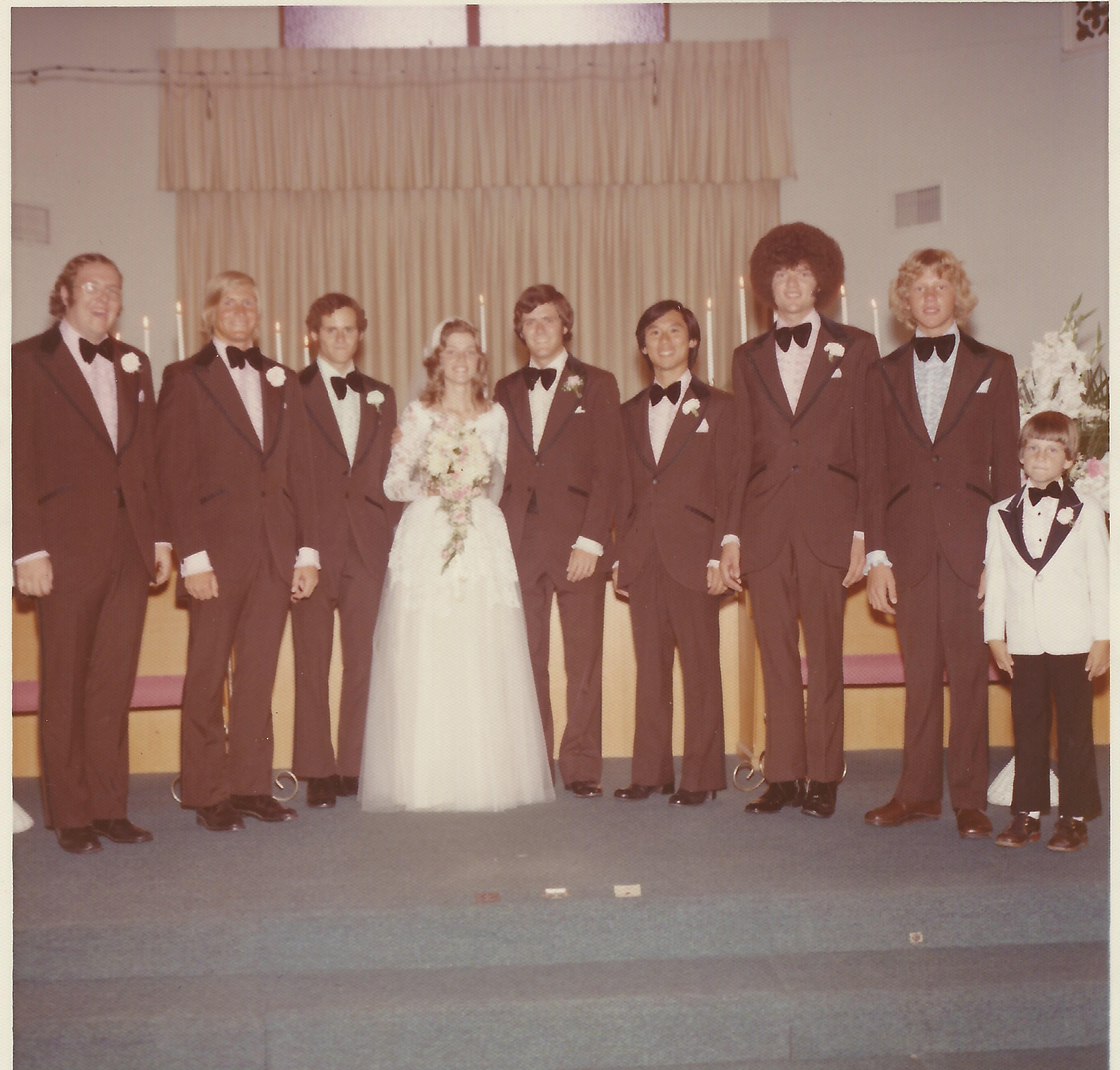
After the ceremony, some friends rifled through our wedding cards, took out the cash, and slipped it to me for our honeymoon.
We drove my mother’s car to Yosemite … mine never would have made it … and stayed in a cabin for several nights.
We rented a two-bedroom apartment in Santa Ana for $195 a month. Kim made $1.65 working at a preschool, while I started seminary and worked at church as an ecclesiastical engineer.
People sometimes ask us the secret of our marital longevity. My reply is always the same: “I married the right person.”
In fact, let me share with you five reasons why I know that I married the right person:
First, Kim is an emotionally strong woman.
San Diego means a lot to us. It’s where we went for our first date … and our tenth anniversary.
We had a great time on our tenth … then drove back home to Silicon Valley where Kim entered the hospital for exploratory surgery the next day.
Kim had undergone some tests and been told that she had a mass in her abdomen. After just ten years together, I feared I might lose her.
Thank God, she didn’t have a mass, but she did have a hysterectomy, and after giving birth to Ryan and Sarah, that was all God permitted us to have.

But I remember how courageous Kim was during the entire time … and how her faith in God kept her sane.
During our last ministry, Kim was in and out of hospitals constantly. She always handled herself well, assuring me that she’d be okay.
Sometimes I’m stronger than she is, and sometimes she’s stronger than me … but she has a resolve … a determination … that we can handle anything as long as we hold onto God and each other.
I love that about her.
Second, Kim is far more adventuresome than I am.
From ages 10 through 15, Kim went to boarding school in India and Pakistan while her parents served as medical missionaries in Saudi Arabia. She only saw her parents a few months every year and had to learn to adjust to other cultures in primitive surroundings.



When I met her three years after she came home to the States, she talked all the time about how much she loved the Middle East. In fact, she really wanted to be a missionary.

But then she met me … and I’ve never been in her league as far as adventure.
In 1992, Kim and I began talking about saving enough money to visit Europe for our twentieth anniversary three years later. But the church I served as pastor was struggling financially, and we agreed to give sacrificially for the church to survive.
So I told Kim, “Look, based on our finances, I don’t see how we can go to Europe.” Kim responded, “If you don’t go, I’m going by myself.”
Somehow, we scraped together enough money to visit the Continent, and found ourselves on a mountain peak in Switzerland the morning of our twentieth anniversary.


We’ve flown overseas many times since then, and due to my dislike for flying, I probably never would have gone … except for my wife, who became accustomed to flying all over the world when she was ten years old.
On our only trip to Hawaii many years ago, she insisted on hang gliding over the ocean and then being dropped into the water … while I was holding onto the boat for dear life.

I love that about her.
Third, Kim is a fun-loving party planner.
The weekend I was going to turn forty, Kim told me to clear out my calendar. I had no idea what she was up to.
Thursday night, we went to a movie and to dinner … and then spent the night in a hotel.
Friday morning, we went to the San Jose airport where we met our two kids. Then we flew to Orange County, where we met my sister Jan … and went to Disneyland for the day.
That night, we drove to my brother’s house in San Bernardino, where all my old friends showed up for a surprise party.
On Saturday, after flying home to San Jose, Kim planned another surprise party for me at church.
Over the years, Kim has used her skills in party-planning to gather large crowds for events.
When she worked for a large child care company in San Jose, they held a dance every year … one year, as the event neared, they hadn’t sold near enough tickets.
Kim volunteered to distribute them. The goal wasn’t to make money, but to fill the auditorium downtown with people who would watch those kids dance.
When the curtain opened, the place was packed. Kim had done something nearly impossible … turned a disaster into a roaring success.
She later used those skills to draw large crowds for community events at our church … and she thought BIG … a little too big for some people, who felt that the purpose of those events should be to make money.


But her goal was to turn out a crowd so they could discover where our hidden church was located … invite people to attend … and hope that we could reach them for Christ … and she had a blast doing it.
In fact, she loves to say, “Church should be fun.”
I love that about her.
Fourth, Kim loves to reach people for Christ.
Kim was the full-time outreach director at our last church for nearly nine years. Her work must have reached someone’s ears, because one year, she was asked to be the keynote speaker for outreach at the Bay Area Sunday School Convention.
Since I was leading several workshops of my own, I was only able to attend one of Kim’s … but her presentation blew me away.
The room was standing room only. Kim knew her topic so well that she mesmerized the people in that room … and motivated them to do outreach in their own churches.
In addition:
*She put together ways for our church to reach its community … and built bridges with the local Chamber of Commerce.
*She visited Moldova four years in a row on mission trips … leading teams from our church the last three years.



*She met a pastor from Kenya named Peter online. She corresponded with him for nine months … then took a girlfriend from church and flew to Kenya to meet Peter. She trained Peter in various aspects of ministry … trained other pastors as well … taught them how to reach out … and brought Peter to our church in the Bay Area.


Today, Peter leads a thriving church in Nairobi, and as a bishop, he oversees 28 other pastors. After we left our last church, Kim connected with a church in Atlanta … flew to Kenya … and trained two pastors from that church … and they now work closely with Peter to reach people in Kenya for Jesus.
*She raised $43,000 for a well in Peter’s village in less than three months. She flew to Kenya with a team from our church to dedicate the well … and spent the day with the Vice President of Kenya.


Although many Christian leaders are uncomfortable with women in leadership, Kim has always served voluntarily under my direction and done it all with grace and sensitivity.


I love that about her.
Finally, Kim knows how to get things done.
Three years ago, I flew to Grand Rapids, Michigan to be trained to be an interim pastor. It seemed like the only ministry option available to me at my age.
While I was there, the director of the ministry asked me if I’d be willing to go to New Hampshire to help out a church that was losing its pastor. I instantly said, “Yes.”
Kim and I drove across the country where I served as interim pastor for only three months. (The church called a pastor the second week we were there.) Then we drove back to Southern California … without a new assignment.
My director mentioned several possible assignments in places as varied as Louisiana … South Dakota … Chicago … and upstate New York … but nothing materialized … and we were running out of time.
Finally, the director matched me up with a church in New York, and Kim and I flew there for an extended weekend … hoping and praying that things would work out.
But they didn’t, and as we were driving back to LaGuardia Airport, our future looked bleak.
With a burst of inspiration, Kim suddenly said, “I know what we can do. I can start a preschool in our house.”
Within a few weeks, we rented a larger house in a better location … Kim sent in her application to the state … we began acquiring play equipment and tables and supplies … and on August 5, 2013, we launched Little Explorers Preschool.

The school has gone very well. Kim directs, teaches, works with parents, and manages two employees, while I do the finances, marketing, cleaning, and more.

We work long hours, but enjoy having nights and weekends free … especially to drive through the mountains to see our two grandsons in Orange County.



Is ours a perfect marriage? No. We’re both strong-willed individuals. We are both expressive and opinionated. I can be stubborn, and Kim can be feisty … so at least life together is never dull!


I love that about her.
I am glad that God gave me Kim because:
*She is hilarious. She makes me laugh … constantly. She recently posted a photo online promoting the preschool and wrote, “The children never cease to be bored.” I laughed my head off … and when I pointed out what that phrase meant, she didn’t get it … so I laughed some more.
*She is appreciative. When I do even the most mundane tasks, she thanks me. When I do something surprising, she is grateful. Her lack of entitlement makes serving her a joy.
*She never nags me. She might remind me of something I promised to do, but she’ll tell me once and trust that I’ll come through.
*She has always supported my love for sports. Although she’s gone to many games with me, she’s happy for me to watch baseball, football, and basketball as much as I want … and has never complained about it.

*She and I can talk for hours and never run out of things to discuss. That’s always a sign that you married the right person.
*She loves the Lord. I tell her that on our first date, I fell in love with her heart … and to this day, that love has grown larger and stronger.
Even though we are exact opposites as far as our personalities go, we enjoy a deep, abiding love that has only grown stronger with time.
I don’t like it when people say, “I have the greatest wife in the world.” The statement may be emotionally understandable, but it’s ultimately illogical … and is a way of saying, “My woman is better than yours.”
I’d rather say, “I married the right person for me” … and by God’s grace, I did.
Happy 40th anniversary, Sweetheart!

 Restoring Kingdom Builders
Preaching and Pastoral Termination
August 10, 2015 by Jim Meyer
“If you can preach, people will forgive you for all kinds of mistakes, but if you can’t preach, they will nail you on everything they can.”
That’s a paraphrase of what a megachurch pastor once said during chapel when I was in seminary … and there’s a lot of truth in that observation.
For a long time, I have believed that the primary way for a pastor to create conflict in his church is to promote change without first receiving the approval of the board, staff, and key leaders.
Change creates anxiety … causes people to complain … the complainers organize … they oppose the change maker … and if he doesn’t comply with their wishes … they strategize his demise.
But I have a theory … and I haven’t read this anywhere … that preaching may ultimately be the primary source of conflict in a local church.
Let me make my case:
First, the pastor is the only authority figure in modern life who tells people collectively how to live.
When I saw my doctor recently, he offered a few suggestions for helping me to become more healthy … but he did not gather all his patients in a room and bring us a lecture.
When I see a politician giving a speech on television, if he’s too prescriptive (Americans need to drive less, cut our electrical use, conserve water) I might talk back to him or change the channel.
All week long, we resist people in our lives who tell us how to live … even if they’re experts in their field.
And then we come to church on Sunday.
And what happens? A man stands up … using the Bible as his source … and tells us: “You need to trust God more … humble yourself before the Lord … share your faith with your neighbors … treat your wife better … be honest at work … obey our country’s leaders …” and so on.
If we believe the Bible … and we like the pastor … and we’re walking with the Lord … we’ll want to comply with the pastor’s directives.
But if we don’t believe Scripture … or we dislike the pastor … or we’re not walking with God (and this incorporates a large percentage of any congregation) then we may very well resist the pastor’s words.
Paul … Stephen … Peter and John … all were persecuted because of their preaching.
They didn’t arouse opposition because they were disorganized administrators … or insensitive counselors … or poor staff supervisors … or even weak leaders.
No, they aroused opposition because of their preaching … just like Jesus did.
Sometimes it doesn’t even matter what a pastor says … just that he’s the one saying it.
My guess is that people complain more about their pastor during the two hours after he’s preached than during the rest of the week combined.
Why? Because he’s just finished telling them how to live … and they don’t like it.
Second, the pastor arouses rebellion by preaching against specific sins.
If a pastor preaches against the sins of others, we’re all for him.
But when he starts preaching against our sins, we may very well rebel.
And if he doesn’t stop, we may even seek to take him out.
I think it’s safe to say that if John the Baptist were around today, he wouldn’t have a large congregation. His preaching was too specific … too condemning … and way too personal.
Yet Herod Antipas liked to listen to John preach. Mark writes that “Herod feared John and protected him, knowing him to be a righteous and holy man” (Mark 6:20).
But Herod’s wife Herodias felt differently: “So Herodias nursed a grudge against John and wanted to kill him” (Mark 6:19). Why did she feel that way? “For John had been saying to Herod, ‘It is not lawful for you to have your brother’s wife'” (Mark 6:18).
It took Herodias a while, but she finally took John out … for good … because he was preaching directly at an area of her life (marriage) where she refused to change.
It’s possible for one family member to love the pastor’s preaching … and for another member to hate it … even though the pastor has no idea who feels which way.
Whenever I preached against a specific sin … and if you’re being honest with the biblical text, you have to so … I hoped that my preaching would cause people to experience immediate transformation in that area of their life.
But sometimes, preaching causes sin to surface in someone’s life … at least for a few minutes. If people repent, they’ll grow spiritually. But if they resist, they’ll blame the messenger for coughing up their pain.
The experts tell us that it only takes 7 to 10 people to force out a pastor in any size church.
My guess is that a high percentage of those individuals are getting back at the pastor for preaching against specific sins in their lives … even if they aren’t conscious of it … and won’t ever admit it.
Third, the pastor’s authority, words, and manner can arouse open resistance.
Resistance toward preaching takes various forms:
*Not showing up. During the final few months of my last church ministry, one board member in particular stopped coming to worship services. I’d look down and see his wife … smiling … but he wasn’t sitting next to her … and I knew that wasn’t a good sign.
*Wandering around in the back. In that same church, another board member never brought his Bible … and spent his time during my sermon doing everything besides sitting down and listening to the sermon.
*Watching from another room. Still another board member from that church wouldn’t come into the worship center, but watched the service from a monitor in an adjoining room.
*Crossing arms. My worst all-time antagonist once left the church for a year, then returned on a Sunday when I was preaching through Mark and spoke about Herod Antipas executing John the Baptist. The antagonist sat twenty feet away from me with his arms folded … staring me down … then complained to the board chairman that I aimed the sermon at him. I will never forget his body language that day because he launched a rebellion soon afterwards.
*Rarely looking up. I’ve written before about a board member who spent 90% of the sermon time reading the notes in his Scofield Bible. If all the pastor ever sees while preaching is the tops of some people’s heads … and they won’t look at him … that may signal resistance in action.
*Criticism after the sermon. One time, when I served as guest speaker at a church, a staff member came to the front to make the announcements after I spoke, and tried to rebut something I said during the message. I’m not sure everyone caught it, but I sure did.
This resistance could be to the pastor as a person … or a leader … or a counselor … and be communicating the message, “I don’t like or respect you, so I certainly don’t want to listen to you.”
But it could also be resistance to the pastor’s tone … speaking style … use of language … stories … cadence … sense of authority … or any one of a hundred other things.
Whether the pastor’s preaching reveals or causes resistance, though, there is no doubt that most church antagonists find fault with their pastor’s preaching … even if they never tell him to his face … but discerning observers may very well notice.
Finally, the pastor claims to be speaking for God … but some hearers just won’t buy it.
I was a pastor for 36 years. During that time, what give me the right to stand up and tell people how to live?
In my mind, I was called by God to speak the Word of God to the people of God. Any authority I had came from God’s call to ministry and from using Scripture as my authority.
While a pastor is speaking, many of his hearers identify him as God’s messenger … and sometimes, with God Himself.
And whether they’re conscious of it or not, they can project their feelings about God onto their pastor.
If they’re angry with God, they can become angry with their pastor. If they’re disappointed with God, they can become disillusioned with his messenger. If they’re wounded because God hasn’t protected them from suffering, they can blame God’s servant for the way they feel.
Seven years ago, I gave a message called “Defending Biblical Marriage.” Using Matthew 19:4-6 as my text, I stated that Jesus reiterated that God designed marriage to be between one man and one woman.
Without my knowledge, a board member and his wife invited a journalist from the local paper to hear me speak that day. Being an unbeliever, I heard that she did not like my message … and later on, that leader asked me not to speak anymore on controversial issues.
But I couldn’t do that. I had taken a vow at my ordination … which none of the board members knew about … that I would preach the whole counsel of God … which, in my mind, means that I am free to speak on any and every issue as long as I’m basing my remarks on the authority of God’s Word.
It is entirely possible that the ensuing conflict in my church was launched after I gave that message.
A colleague of mine who does church interventions once told me that he visited a congregation that was having massive problems. As I recall, the pastor had been forced from office.
During his intervention, my colleague discovered that 14 church leaders were engaged in sexual immorality. 14!
Let’s say that you were the pastor of that church, and you were preaching through the Ten Commandments, and you came to the seventh commandment: “You shall not commit adultery.”
With 14 leaders violating that commandment, how do you think they would respond to you?
They’d want your head.
Yes, conflict often arises in the church parking lot … and inside staff offices … and through cell phones … and during board meetings.
But my theory is that conflict originates more often inside the worship center during the pastor’s sermon than in any other place in the community.
What are your thoughts on this issue?
Share this:
Posted in Conflict with Church Antagonists, Conflict with Church Board, Conflict with the Pastor, Pastoral Termination, Please Comment! | Tagged how preaching creates conflict, preaching and pastoral exits, preaching and pastoral resignations | Leave a Comment »