Feeds:
Posts
Comments

Archive for the ‘Current Church Issues’ Category

How often do you reflect upon the people who have made a significant impact on your life?

Nearly twenty years ago, Gary McIntosh, a teacher from Talbot School of Theology (my seminary), stopped by the church I served as pastor in Silicon Valley.  Gary came to visit a former student, John, who was also our church’s outreach director.  John kindly introduced me to Gary.

I knew Gary from his Church Growth Newsletter and appreciated his work, as did many pastors I knew.

A few years later, when Gary was writing his book Make Room for the Boom … or Bust, he invited me to write the chapter on the rebirthed church model.  I had two weeks.  (The book has long been out-of-print, but ten years ago, I found and bought three copies at the Crystal Cathedral bookstore.)

Shortly after the book was published, Gary invited me to lecture for one of his doctoral classes at Talbot.  As exciting as that was, I valued the hours we spent together – five of them at his home – even more.

Several years later, I invited Gary to a lead a Saturday seminar at our church involving forty of our leaders.  Many of the profound changes we made to reach our community originated with those meetings.

When I was nearing the end of my doctoral studies at Fuller Seminary, the director of the final project/disseratation tried to switch advisors on me, which would have negated all the work I had already done.  (I was integrating Scripture with family systems theory and the recommended advisor insisted I use another system.)

I called Gary to ask him what I should do, and he volunteered to be my reader – and with his sterling reputation, Fuller quickly approved him.  It was an honor to have him critique my work – and saved me scores of hours of work.

Last summer, Gary invited me to attend the Society for Church Consulting conference at Biola/Talbot last month, where I met various Christian leaders who are trying to turn around churches that are struggling.

Calvary Chapel at Talbot School of Theology

With the room filled with experts like Paul Borden, Aubrey Malphurs, and Carl George, Gary hit a grand slam with his presentation on how a consultant can help turn around churches of various sizes and ages.

Beginning of Gary's Lecture on Church Turnarounds

During the conference, Gary introduced me to several Christian leaders who have already made a profound impact in my life and ministry.

While at the SFCC meetings, I also learned how many other students, pastors, and leaders have been impacted by Gary, who has already published 18 books, with three more coming out in 2012!

I thank God for raising up people like Gary who are fulfilling their calling and making a difference in the lives of so many leaders and churches.

Who has made a significant difference in your life?

When is the last time you thanked them?

With Gary McIntosh at the SFCC Conference

Read Full Post »

It’s tough to say goodbye, isn’t it?

It’s tough saying goodbye to your family after Christmas, or to a friend you may never see again, or to someone who is ready to meet Jesus.

And it’s especially tough saying goodbye to a church family.

In fact, two years ago yesterday, my wife and I said goodbye to a church family we served for 10 1/2 years.  We tried our best to leave in a Christ-honoring way.

Years ago, I learned this adage: “The way you leave is the way you’ll be remembered.”

The following article is written primarily for lay people (rather than pastors and paid staff) who are thinking about leaving their church.

(If you want to think through whether or not you should leave, check out this article: https://blog.restoringkingdombuilders.org/2011/05/09/when-to-leave-your-church/)

Assuming the Lord is leading you to leave, how can you honor Him in the way you do it?

Let me suggest five ways:

First, articulate why you’re leaving.  Put it in clear language.  Examples:

“I cannot support the change in direction from missional to institutional.”

“I can no longer use my spiritual gifts in this church.”

“We need a church closer to home.”

“I need to be in a church that takes community outreach seriously.”

“I simply do not like the pastor.”

Be honest with yourself at this point.  While it’s possible that you’re leaving because of a single issue, the likelihood is that you’re withdrawing because of multiple issues.  Write them all down.

Second, compose a note to the pastor and church leaders.

When they leave a church, most people slip into the night and say virtually nothing to their church’s leaders.

As a pastor, I’d sometimes wonder, “Where has So-and-So gone?  I haven’t seen them around the church for weeks.”  In a smaller church, I’d contact those people myself.  In a larger setting, I’d ask a staff member to do it.

But invariably, the ensuing conversation would be awkward for both parties.  Those missing weren’t honest either with me or the staff member.  We’d hear, “I’m just taking a break” – but what the missing member wouldn’t say is: “I’m checking out other churches on Sundays, and if I find the right one, I’m not coming back.”

Without a letter, the church’s leaders, as well as your friends, will privately speculate as to why you left – and they’ll most likely get it wrong.

They’ll guess it’s your walk with the Lord, or your marriage, or job stress … in other words, they’ll blame you for leaving … and in the process, they won’t stop to ask if there’s something they’re doing wrong that prompted you to go.

Only you can enlighten them.

That’s why once you’ve decided to leave, it’s best to write a letter to the leaders and make a clean break.

You’re still free to visit the church and retain friendships.  But you need to clarify your status so people won’t guess (wrongly) why you’re not around … and so people stop contacting you to join a small group and serve in the nursery.

Third, write and send a classy letter.  Guidelines:

*Address the Senior Pastor, the governing board members, and any staff you’ve worked with closely.  If you send a letter to one person, they may choose not to tell the other leaders you’ve left – or why.  By sending your letter to all the key leaders, the reasons for your leaving will be shared accurately.

Should you send an email?  You can, but you have no idea to whom it will be forwarded.  I’d send hard copies of letters via snail mail to people’s homes (not the church, where lay leaders may not check their mail for weeks) so everyone gets it at the same time.  (And it makes it harder to pass your letter around.)

*Write a one-page letter, but no more.  Be succinct.

*Thank the pastor and the leaders for their service and what they’ve meant to you.  Even if you’re feeling angry or hurt, you can always say something positive about the church and its leaders on paper.  (If you write a nasty letter, the leaders will forget your reasoning and focus on your tone – and you will look bad.)

*Be truthful about why you’re leaving.  If the music director is an alienating egomaniac, then speak the truth in love.  If you feel like a misfit, tell the leaders you’ve tried but can’t seem to fit in.  If you think the church is going liberal theologically, say so.

If your letter is gracious but candid, it will be taken seriously, and may even do some good.  For instance, if three good people leave because of the arrogance of the music director, the leaders may need to look into that matter more closely.

However, my experience is that once you announce that you’re leaving, the chances that anyone from the church will contact you are minimal … except for those people who want to use your departure to make a case against the pastor.  Refuse to play their game!

*Write a first draft and let it sit for a few days.  Then read it again and make appropriate changes.  Ask family or friends to read your letter and offer suggestions.

Fourth, when you leave, LEAVE.

The worst antagonist I ever had in a church left the church … and then returned a year later to lead a rebellion.  It was classless, tasteless, and unambiguously evil.

When some people leave a church, they stop attending services, serving, and giving, but sneak back around to be part of a small group.  While some church leaders may look the other way if you do that, do you realize the signals you’re sending?

Please, find another church and leave your former one behind.  It will cause less heartache for everyone involved.

Finally, leave with your head held high.

God leads us to jobs – then leads us to new ones.

The Lord may call us to live in the West – then call us to live back East.

The Lord leads us to one church for a few years – then He leads us away.

If you’re leaving because you’re bitter, then maybe you should feel guilty when you depart.  But if the Lord is directing your steps, then just obey your Savior – and go.

If people from the church contact you, there’s no need to manufacture reasons for your departure.  You’ve already worked through why you’re leaving in your own mind.  Stick to your story without deviation and people will respect you.

But no matter how nicely you leave, some churchgoers will be hurt and some friends may shun you … and then you’ll learn who your real friends are.

Just realize there are seasons to all of our lives.

The writer of the Book of Ecclesiastes put it this way in 3:1-7:

“There is a time for everything, and a season for every activity under heaven:

… a time to search and a time to give up,

a time to keep and a time to throw away …

a time to be silent, and a time to speak …”

If you’re happy with your church, great!

If you’re not … maybe it’s time to make a tough decision.

May the Lord grant you the courage you need.

Check out our website at www.restoringkingdombuilders.org  You’ll find Jim’s story, recommended resources on conflict, and a forum where you can ask questions about conflict situations in your church.

Read Full Post »

There’s an article in the news right now about a small church in Kentucky that has voted to ban interracial marriage in its midst.  The church is being widely condemned for its stance.

Based on the number of people who voted on this issue (fifteen, with many abstentions) it seems like the church has been excluding a lot more than interracial couples.

This led me to thinking: how often do Christian churches unintentionally exclude people from their midst?

Here’s a partial list of those we tend to exclude:

First, churches exclude non-Christians.  When I was 16, I invited two friends to my church after months of sharing Christ with them.  We had a missionary as a guest speaker, and the service went nearly two hours.  I could never get my friends to return to church after that.  The truth is that we weren’t ready for them at any service we had.

We assumed that unbelievers wouldn’t be interested in our church – so they weren’t.

Okay, you say, the church is for believers, not unbelievers.  By God’s grace, I led a friend to Christ when he was 17, but when I finally brought him to church, he did not feel included, and didn’t attend for years.

That’s why I’ve always loved the approaches of Willow Creek and Saddleback churches toward spiritually lost people.  Those churches make them feel welcome.

Second, churches exclude those from other denominations.  I grew up in Baptist churches for the first 14 years of my life.  I attended a non-denominational church for the next 7 years, and have served in Baptist churches ever since.

I’m drawn to Baptist emphases like biblical authority, personal conversion, and eternal security.

But I’m embarrassed by Baptist tendencies to be legalistic, contentious, and anti-intellectual.  (You guessed it – the Kentucky church that banned interracial marriage is Baptist.)

Jesus never commanded us to make Baptists – or Lutherans, Methodists, or Quakers, for that matter.  He commanded us to “make disciples of all nations.”

The more a church emphasizes its denomination, the fewer people it will reach for Jesus.  Let’s partner with Christ in making followers of Jesus, not members of any particular organization.

And if you can show me a New Testament verse that shows me I’m wrong, I’ll repent in writing.

Third, churches exclude those who are politically liberal.  While I’m against abortion and gay marriage on biblical grounds, I’m enthusiastically pro-gospel – but I don’t think we can preach both messages effectively at the same time.

I visited a church not long ago where the pastor twice condemned abortion during his message while attempting to convert unbelievers to Christ.  While I admired his courage, he may have needlessly turned off possible converts.

I spent nearly 30 years serving as a pastor in politically liberal communities, and I made two discoveries: (a) some political liberals are open to receiving Jesus, and (b) they are open to hearing sermons about what Scripture teaches about moral and social issues if they are well-thought out and presented – but not in the same message.

If we insist that people become conversatives before they become Christians, we’re replicating the error of the early church which insisted that Gentiles had to become Jews before they could become believers.

When a person receives Jesus, He transforms people’s hearts and ultimately aligns their values with Scripture.  There’s a time to be evangelistic and a time to be prophetic, but let’s not place unnecessary barriers in the way of lost people.  The crucial issue is, “What will you do with Jesus?”

Fourth, churches exclude singles.  I once served in a church that had an annual Sweetheart Banquet around Valentine’s Day.  For a price, couples could come to church and eat a meal, listen to a speaker, and enjoy entertainment.  That’s fine, although I’d rather be somewhere else with my wife on Valentine’s Day …

Anyway, every time we had a Sweetheart Banquet, the singles at church complained that the event automatically excluded them … and they were right.

So the next year, we’d try and have a Friendship Banquet for singles and couples … but it rarely worked.

I’m all for celebrating love and romance, but can’t churches offer something more for singles as well?  After all, Valentine’s Day is the single most painful day for them in the entire calendar.

Finally, churches exclude the poor.  When do we do that?

Ever heard announcements like these?

“We’re taking signups for summer camp right now.  The cost is $875 per kid.  Parents, we need your deposit of $350 by next Sunday to hold your spot.”

“Ladies, come out to our annual Mother-Daughter tea next Saturday.  The cost is only $50 per family.”

“Men, we’re getting ready for our annual men’s retreat this winter.  $200 will hold your spot and we’ll need another $300 one week before the retreat.  This year’s theme is “Touching the Poor for Jesus.”

Do you know how the poor react when they hear announcements like these?  They feel violated.  Their church has excluded them from activities and events on the basis of money.

Yes, they can always attend church services and small groups for free … but most of the time, they’re not going to tell anyone how hurt they feel about not being able to afford these gatherings.

I know … some churches offer scholarships, but you either have to know someone or ask for help … and that gets old after a while.

My wife and I had a policy for years that if our church did have a big event, we’d set aside 10% of the tickets for people who couldn’t afford to go … and we’d pro-actively invite certain people to come as guests.

Let me end this article by quoting from Eugene Peterson’s introduction to The Gospel of Luke in The Message:

“Most of us, most of the time, feel left out – misfits.  We don’t belong.  Others seem to be so confident, so sure of themselves, ‘insiders’ who know the ropes, old hands in a club from which we are excluded.

One of the ways we have of responding to this is to form our own club, or join one that will have us.  Here is at least one place where we are ‘in’ and the others ‘out’ … but the one thing they have in common is the principle of exclusion.  Identity or worth is achieved by excluding all but the chosen….

Nowhere is this price more terrible than when it is paid in the cause of religion.  But religion has a long history of doing just that, of reducing the huge mysteries of God to the respectability of club rules, of shrinking the vast human community to a ‘membership.’  But with God there are no outsiders.”

And then Peterson goes on to tell us how Luke’s Gospel includes outcasts like Gentiles, women, common laborers (like shepherds), the racially different (think Samaritans), and the poor.

Didn’t the angel tell the shepherds, “I bring you good news of great joy that will be for all the people?”

If our God includes everyone in His message of salvation, shouldn’t our churches work harder at removing barriers that exclude people?

My wife and I attend a church that includes everyone.  Maybe that’s why it’s grown so rapidly.

I’d love to hear your thoughts on this matter.

Read Full Post »

It’s quiz time.  What’s the first thing that comes to your mind when I say …

Moses?

Maybe the term “leader,” or the ten plagues, or the Ten Commandments.

Shakespeare?

Possibly “playwright,” or Hamlet, or Stratford, or even the new film Anonymous.

Barry Bonds?

How about Giants, or 73, or 762, or steroids?

Richard Nixon?

Watergate.

My wife and I visited the Richard Nixon Library and Museum last weekend in Yorba Linda, California.  The place was packed.

Entrance to Richard Nixon Presidential Library and Museum

Nixon is the only native Californian to be elected President.  For that reason, I heard his name a lot growing up.

He was a Congressman and Senator from California and then Vice-President under Dwight Eisenhower for eight years.  Then he ran for President against John Kennedy in 1960 and barely lost.  When he ran for Governor of California two years later and lost (to current Governor Jerry Brown’s father Pat), most people wrote Nixon’s political obituary.

I remember sitting in the living room of my grandparents’ house in Whittier – where Nixon lived and went to college – in 1968.  My grandfather said, “God help this country if Nixon isn’t elected President.”

Later that year, Nixon held a rally at the Anaheim Convention Center, just a couple miles from my house.  My friend Steve invited me to come and sing in a youth choir, which I did.  We followed a woman all through the Convention Center, certain it was Pat Nixon.  (It wasn’t.)  We later sang, “Nixon’s the One” with everyone else.

This time, Nixon barely won the election, and easily defeated George McGovern for President in 1972.

The left hated Nixon, as did the press, but a lot of significant events occurred during his Presidency, such as the first men landing on the moon …

Apollo 11 Space Suit

and Nixon’s visit to China after more than two decades of world isolation …

Statues of Nixon and Chou-en-Lai

and, of course, Watergate … the third-rate burglary of the Democratic National Headquarters located in the Watergate complex in Washington, DC.

I’m old enough to remember the Watergate hearings featuring John Dean and all the revelations of a secret taping system in the Oval Office … and the shock many of us experienced reading transcripts from those tapes … because our President, who was raised a Quaker, swore profusely on them.

The Nixon Museum has an entire section devoted to Watergate – and nothing is covered up.

And then on August 9, 1974, Nixon resigned the Presidency and flew away on this helicopter:

US Navy Helicopter used during Nixon Presidency

Nearly four years later, I got Nixon’s autograph on a 3×5 card after an Angels-Brewers game at Anaheim Stadium.  Nixon lived down the coast in San Clemente and was a frequent guest of Angel owner Gene Autry.  There were only four of us around him that night, and the Secret Service allowed us to approach the former President because he liked the attention.

When Nixon was finally laid to rest, I remember watching his funeral on television, with Billy Graham presiding.

President Nixon's Gravesite

Why am I writing about Nixon?

Because for many people, he’s remembered for only one thing: the way he left office.

How fair is that?

Nixon was also a multi-instrumentalist, and a brilliant student, and a devoted husband and father, and an expert in foreign affairs, and the author of many books, and a huge sports fan, and a lover of model trains, as we saw when we initially entered the museum:

Model Trains in Nixon Museum

He also appeared on the cover of Time more than anyone else in history: 54 times.

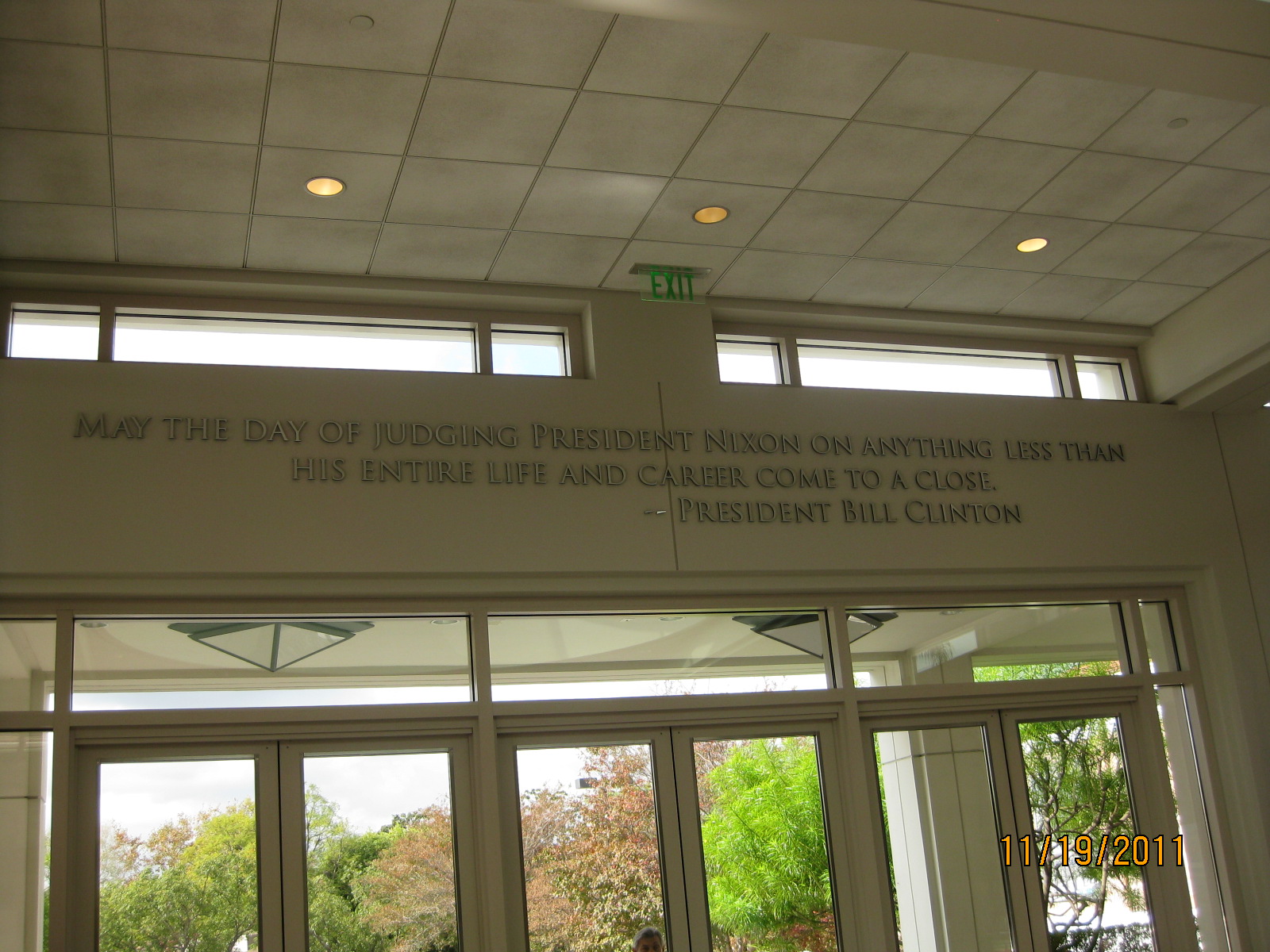
I’m not a big fan of former President Bill Clinton, but I thought that what he said at Nixon’s funeral was the most profound thing I saw all day at the library.  His words are etched above one of the entrances:

Quote from former President Clinton above entrance

He said: “May the day of judging President Nixon on anything less than his entire life and career come to a close.”

Amen.

We’ve all messed up in our lives.

Some of us have nagging habits we’ve never quite been able to shake.

Some of us have done some really stupid things that few people ever found out about.  (While walking around my college recently, I remembered opening emergency doors three separate times during my freshman year.  In each case, I quickly walked away so I wouldn’t get caught.  Thankfully, I’ve never opened one since.)

Some of us finally conquered a temptation as we got older, only to meet an even greater temptation soon afterwards.

If we’re going to remember Nixon only for Watergate, then maybe we should only be remembered for failing a class, or a divorce, or a temper tantrum, or overspending, or committing a crime … but aren’t our lives much more than our mistakes?

Besides, the whole world hasn’t been watching and recording every detail of our lives.

The gospel of Jesus Christ promises that those who repent of their sin and receive Christ are granted complete and lasting forgiveness by God’s grace.  The hope of every believer is that when we stand before God someday, He will not see our sin but Christ living in us.  We want the Lord to evaluate the totality of our lives rather than just focusing on our failures.

When people someday walk through the museum of your life – which may be done either through a written obituary or a memorial service – how do you want them to evaluate you?

That’s how the Lord wants us to evaluate others.

Read Full Post »

I’ve seen it all my life.

Maybe you have, too.

Something ominous happens at work … or inside your family … or at church … but nobody is willing to talk about it openly.

Somebody lost their job … or went to jail … or is no longer attending your church … but everything is hush hush.

Is that wise?

The reason I bring this up is because most church leaders that I know are great at covering up stuff.

Let me explain.

Imagine that some individuals inside a church of 300 attendees band together to change the music during worship.  They don’t like guitars and drums and want the church to use the piano and organ instead.

So they begin making demands of the pastor and governing board, threatening to leave the church – and take their offerings with them – unless the pastor capitulates in their favor.

While there are pastors who would cave in at this point, let’s pretend that the pastor of this church refuses to meet the group’s demands.

So the group – composed of 35 people – all leaves the church together and forms another church at the local high school cafeteria (where they can’t have a piano or organ, but that’s another story).

What should the pastor and governing board tell the congregation about what happened?

Here are some options:

(a) Pretend those people never existed and refuse to talk about them again.

(b) Talk about them only inside the confines of staff and board meetings.

(c) Only talk about them if church attendees ask about them.

(d) Tell the whole church during Sunday worship … or in an all-church letter … or in a public meeting.

Which option above would you prefer?

The vast number of leaders I have known would opt for option “a,” including taking their names off the membership roster, church directory, and newsletter list as soon as possible.

Option “b” is a given.  Only certain churches would opt for option “c.”

And few if any churches would opt for option “d.”

However, congregational consultant Peter Steinke has a different take on this matter in his insightful book Congregational Leadership in Anxious Times:

“A conflict-free congregation is incongruent not only with reality but even more with biblical theology.  Jesus upset many people emotionally.  The life of Jesus takes place against a backdrop of suspicion, opposition, and crucifixion.  The Christian story is underlined with conflict.  Early on, we encounter the emotional reactivity of the religious leaders, who see Jesus as a threat to their authority and belief system.  Eventually the tension between the roaming preacher and the established religious order comes to a dramatic point.  Tension leads to crucifixion.”

Most of us would agree with those seven sentences.

Steinke continues:

“The church has had divisions from its inception.  No doubt, it has fought senseless battles, squandered its resources on frivolous issues, sent negative signals to society, shattered its unity, and forfeited chances to share its goodwill.  Some churches work through the reactive period and emerge stronger.  Others shuffle from crisis to crisis.  What makes the difference in outcomes?”

(By the way, don’t you just love Steinke’s writing?  He’s good.)

And then he says this:

“Nowhere in the Bible is tranquility preferred to truth or harmony to justice.  Certainly reconciliation is the goal of the gospel, yet seldom is reconciliation an immediate result.  If people believe the Holy Spirit is directing the congregation into the truth, wouldn’t this alone encourage Christians who have differing notions to grapple with issues respectfully, lovingly, and responsively?”

Hmm.  Do you agree with the author at this point?

Then how about this question:

“If potent issues are avoided because they might divide the community, what type of witness is the congregation to the pursuit of truth?”

Using the group of 35 people I mentioned earlier as an example, should the pastor and leaders tell the congregation anything about their departure?

Here is one final statement from Steinke:

“In the early stages of a conflict, it is almost impossible to over-inform.  As much information as possible is needed.  Providing information tends to minimize the need for people to create information for themselves through gossip and embellishments of what they have heard from rumor.  By communicating forthrightly, leaders also treat the members as mature adults who can handle whatever information is shared, not as children who need to be protected from bad news.”

I do not pretend to have the final answer concerning this dilemma, but more and more, I lean toward truth over tranquility.

Someone recently told me about a controversy that surfaced in his church.  Within one week, half the people had left.

This stuff happens, and because pastors know how emotionally reactive some people are whenever they share potentially volatile information, most pastors choose not to mention such issues in public.

Where do you stand on this issue?

For example, if a staff pastor suddenly vanished from your church, do you want the leaders to tell the congregation why?  Or do you think such an announcement would be divisive?

Truth or tranquility?

Your call.

Read Full Post »

Why should anyone officially join a church anymore?

For years, I had a ready answer: to commit yourself to a specific group of believers at a specific time and place.

But I’ve changed my tune – and am willing to be shown the light.

I grew up in an era when pastors offered altar calls at the end of every service.  While we sang a hymn, the pastor would invite attendees to walk to the front of the church (“the altar”) which signified they were making a spiritual decision.

Sometimes if you walked forward during the first stanza, you were indicating you desired salvation.  Second stanza?  Baptism.  Third stanza?  Rededication.  Final stanza?  Church membership.

Choreography aside, membership was considered so important that (a) you made your desire for membership public, and (b) it became the culmination of the conversion-baptism-rededication sequence.

In one church, a man named Gary walked forward for salvation on Sunday morning.  He was baptized that night and immediately voted into membership.

We never saw him again.

The practice of “instant membership” is still followed in some churches.  I recently visited a church in my area where two women went forward after the sermon and were quickly voted into membership by the worshipers.  (I didn’t vote.)

Although some would disagree, “instant” membership seems like “cheap” membership to me – and cheap membership feels meaningless.

I know a pastor who leads a church without formal membership.  If someone desires membership, they fill out a card and are told, “Now you’re a member.”

This leads me to ask: where does the whole membership idea come from, anyway?

Does it come from Scripture?  I’ve searched the New Testament and can’t find “official membership” anywhere.  The word “member” is used in passages like Romans 12:4-5; 1 Corinthians 12:24; Ephesians 3:6; 4:25; 5:30 – but it metaphorically compares believers to parts of the body, not joining a local church.

So if the New Testament doesn’t command or emphasize official membership – and it doesn’t – then how essential is it for spiritual growth or serving Jesus?

Once upon a time, churches were divided into members and non-members.  If you weren’t a member, you didn’t feel that you belonged.  Some churches even practiced “closed communion” where only members could take the Lord’s Supper.

When you became a member, you were invited to the front of the worship center on a Sunday morning and given the right hand of fellowship by the pastor – an indication that you were now “official.”

And yes, people back then treated members differently than non-members.

Sadly, this kind of thinking still occurs.  I received a phone call several years ago from a man who was in the hospital and near death’s door.  He asked if I would come and pray for him.  I instantly agreed.  He told me that he’d called another minister in town who asked, “Are you a member of our church?”  When he said he wasn’t, the pastor declined to see him.

To me, that’s wrong.  I don’t see a member/non-member distinction in the New Testament.  If we are to pray for and love our enemies, as Jesus commanded, then certainly we are to do the same for non-members.

In fact, the trend for the past 30 years has been to assimilate unchurched people into church life – loving them unconditionally – so they do receive Christ eventually … whether or not they ever formally join the church.

Every church has non-members who attend regularly, serve willingly, and give generously.  And every church has members who attend sporadically, never serve, and rarely give.

Aren’t those in the first group acting more like members – and are more committed – than those in the second group?

In our haste to quanitfy everything, are we making distinctions that neither Jesus nor His apostles ever made?

What are the advantages of membership to a church?

*Bolster congregational statistics (“We have 300 members.”)

*Expect people to attend, serve, and give consistently

*Can discipline members (especially leaders) and hold them accountable

*Can remove the membership of troublemakers

What are the advantages to a member?

*Get to vote on a handful of issues (usually annually)

*Receive a membership certificate

*Receive a church constitution

*Feel like you really belong

When a person first joins a church, they are showered with attention.  But doesn’t that usually fade over time?

Maybe I’m blind, but it seems to me that membership confers few benefits but requires enormous responsibilities.  In fact, the church receives 90% of the benefits without offering much that is unique.

For example, in Ken Sande’s book The Peacemaker, he assumes that Christians in a local church will become members.  Why?  So that church leaders have leverage (“accountability”) when dealing with uncooperative individuals.

So does membership have an inherently strong control component built in?

I haven’t heard one word about membership at the church we’ve been attending the past 16 months.  The church is about three words: WIN, TRAIN, SEND.  More than 1,400 people have come to Christ already this year.

They’re much more missional than institutional.

In fact, I’ve observed that the more missional a church is, the less they emphasize membership, but the more institutional they are, the more they emphasize it.

In other words, if we can’t convert unbelievers into believers, then at least we can convert believers into members.

While I believe that church membership can be meaningful, we need to create a better rationale for the practice than “we’ve always done it that way” or “it means something to me” or “it signifies loyalty to my church.”

When I join Costco, I receive lots of benefits, like bulk packaging, cheap lunches, free samples, and great discounts.  I willingly pay my dues every June for those privileges.

But what do I get for joining a church that I don’t get if I don’t join?

I can still join in worship, hear sermons, sample refreshments, attend classes, join a small group, use my spiritual gifts, ask for prayer … and so much more.

Want to straighten me out?

Read Full Post »

Who were your heroes growing up?

I had so many.

In baseball, I loved Sandy Koufax, Brooks Robinson, and Willie Mays.

In football, it was Johnny Unitas and Lance Alworth.

And in basketball, it was Jerry West.  Number 44 of the Los Angeles Lakers.  Their All-Star guard who was nicknamed Mr. Clutch.

West could do anything on a basketball floor.

In 1969, a man from my church took my brother and me to 13 Laker games at The Forum, including all four games in the Finals against the hated Boston Celtics.

Jerry West scored 53 points in Game 1, and although plagued by a hamstring problem, he scored 42 in Game 7.  He was named the MVP of the Finals, the only player ever so named from a losing team.

When he came off the court after Game 7, the great John Havlicek of the Celtics told West, “I love you and I just hope you get a championship.  You deserve it as much as anyone who has ever played this game.”

The great Bill Russell – the second greatest player of all time – told West at a night held in his honor two years later, “If I could have one wish granted, it would be that you would always be happy.”

That’s how his opponents felt about the guy.

Last year, I worked my way through Roland Lazenby’s Jerry West: The Life and Legend of a Basketball Icon.

This past Tuesday, West by West: My Charmed, Tormented Life, his psychological autobiography, was released to the public.  I had to have it.

What a book!

It’s a glimpse into the mind and heart of a champion, but also an honest portrayal of why West is such a complex person.

West talks about the beatings he received from his father as a child – for no reason at all.  (West kept a shotgun under his bed and told his father that he’d use it if he had to.)

Because hanging around the house was so unpleasant, West found solace in a variety of solitary outdoor activities, including hiking, fishing – and shooting hoops.

Jerry West worshiped his older brother David.  David planned to study for the ministry and become “a man of God.”

But when David was killed in the Korean War, life in the West household changed forever.

Despite the heartaches, West eventually became one of the greatest athletes in West Virginia history.  He became a first-team All-American, won the gold medal in basketball (along with Oscar Robertson) in the 1960 Olympics in Rome, and went on to establish an incredible 14-year career in the National Basketball Association.

I got his autograph on several occasions.  He once appeared at the Broadway Department store near my home.  Hardly anybody showed up to meet him or obtain his signature (they weren’t worth much then) – so I got signed pictures for many of my friends.

When my wife was pregnant with our first child, we didn’t know what to name him if he was a boy.  (We didn’t want to know the sex.)  One month before his birth, I noticed in the LA Times that Jerry West had named his new son Ryan Andrew.

And that’s what we named our son.

West was so good that his silhouette is on the NBA Logo.  In Bill Simmons’ The Book of Basketball – published in 2009 – Simmons rates West the 8th greatest player of all-time, ahead of immortals like Oscar Robertson and Kobe Bryant.

Jerry West is now 73 years old.  He serves as a consultant with the Golden State Warriors, having left the Lakers after spending four decades with the organization.

And yet with all his accomplishments, West has never truly been happy.

He talks openly in the book about how much he hated losing to the Celtics (6 times in the Finals in the 1960s) and how that led to a divorce, how he’s never learned to swim, how he hates the limelight, how he’s spent years battling depression – and how tough it is being a perfectionist.

I always hoped that Jerry West was a Christ-follower, yet there isn’t any evidence to support my wish.

But I have to admire his honesty.

I’ve been seeing some TV commericals recently featuring happy people who finally say, “I’m So-and-So, and I’m a Mormon.”

Translation: if you become a Mormon, you can become happy like me.

(If I became a Mormon, I’d have to commit intellectual suicide, so that’s not an option.)

Mormons come off to me as image conscious.  In my opinion, they’re not very good at being real.

They’re too busy trying to be perfect.

We Christians are anything but perfect.  We not only have weaknesses, but we sin.  That’s why we need Jesus – and why only Jesus will do.

In fact, sometimes we struggle with sins for years.  And sometimes we struggle with our humanity, too – just like Jerry West.

I resonate with people who are honest, which is why I love West’s book.

I’m drawn to honest people, even if they’re deeply flawed.  It’s why I love the Psalms so much.

I can’t relate to seemingly perfect televangelists who cultivate an antiseptic image so they can keep the donations flowing.

But I definitely connect with people who are real.

Thank you, Jerry, for letting me know I’m not the only person who struggles with certain issues.

I just wish I knew more Christians who are like you.

Read Full Post »

What is the state of your soul today?

Most of us – including Christians – aren’t thinking too much about our souls.  We’re preoccupied with our bodies, emotions, and minds.

I typed the word “soul” into my iTunes search engine to see how the word is used in song/album titles.

The Beatles released an album called Rubber Soul.

Buffalo Springfield did “Mr. Soul.”

The Music Explosion sang “A Little Bit ‘O Soul.”

Sam and Dave did “Soul Man.”

But those are largely references to “soul music,” not the inner, invisible essence of a person.

Abba had a song called “Hole in Your Soul.”

Glenn Frey of the Eagles recorded “Soul Searchin’,” although he was referring to romantic love.

The Yardbirds did “Heart Full of Soul.”

Tracy Chapman performed, “All You Have is Your Soul.”  That’s getting closer.

Christian artist Carolyn Arends sang “I Am a Soul.”

And the Christian Irish band Iona once released a song called “Factory of Magnificent Souls.”

But the great hymns get it right, like “Lover of My Soul” and “Be Still My Soul” and “Arise, My Soul, Arise” and “It is Well with My Soul.”

The reason I bring this up is because of a church service my wife and I attended last month.

There’s a church betweeen our house and the 101 Freeway that I’ve passed scores of times.  One Sunday, we decided to check it out.

It turned out to be a very charismatic church, which made me somewhat uncomfortable.  There were aspects of the service that didn’t reach me … but some did.

One part of the service was reserved for those who needed prayer … for healing, for a job, for family problems … whatever.

If someone wanted prayer, they raised their hand where they were sitting, and others came around them, laid hands on them, and prayed for them.  That part of the service was very meaningful … and so rare in churches today.

At the end of the pastor’s Bible-based message, he admitted that many years ago, he was forced to leave the mission field because of depression.  He talked about his struggles to overcome his pain and how he needed others to help him climb out of his hole.

The service lasted nearly two hours.  Some of it wasn’t my style, but when we left, I told my wife, “That service was about healing people’s souls.”

And it made me wonder: how much emphasis are churches putting on the soul anymore?

David said of the Lord, “He restores my soul” (Psalm 23:2).

The Sons of Korah sang, “As the deer pants for streams of water, so my soul pants for you, O God” (Psalm 42:1).

That same psalm ends with this question: “Why are you downcast, O my soul?”

David wrote, “Bless the Lord, O my soul … praise the Lord, O my soul …” in Psalm 103:1-2.

Jesus asked, “What good is it for a man to gain the whole world, yet forfeit his soul?  Or what can a man give in exchange for his soul?”  (Mark 8:36-37)

And He reminds all of us that the greatest commandment (Deuteronomy 6:4-6) is to “love the Lord your God with all your heart and with all your soul and with all your mind” (Matthew 22:37).

Souls aren’t just for Sundays.

We Christians need to take care of our bodies.

We need to understand and control our emotions.

We need to stimulate our thinking through reading and sermons and discussions.

And churches should be wholistic in their approach.

But most of all, we need to specialize in healing souls.

People can go to fitness centers and health food stores to build up their bodies.

They can visit a psychologist or psychiatrist to address their emotions.

They can enroll in a college course or read a book to feed their minds.

But only a local church can really address the health of the human soul.

How do you think churches are doing at that?  How can they improve?

What is the state of your soul today?

Read Full Post »

Is there anyone in your life right now with whom you’re experiencing conflict?

A neighbor?  A brother?  A co-worker?  A fellow believer?  A wife?

Peacemaker Ministries was founded 29 years ago to help Christians deal with the conflicts in their lives.  In fact, Peacemakers is one of the few organizations around that is dedicated to helping believers deal with conflict.

You can read more about the organization’s history here:

http://www.peacemaker.net/site/c.aqKFLTOBIpH/b.958339/k.4C8D/Mission_History_and_Organizational_Structure.htm

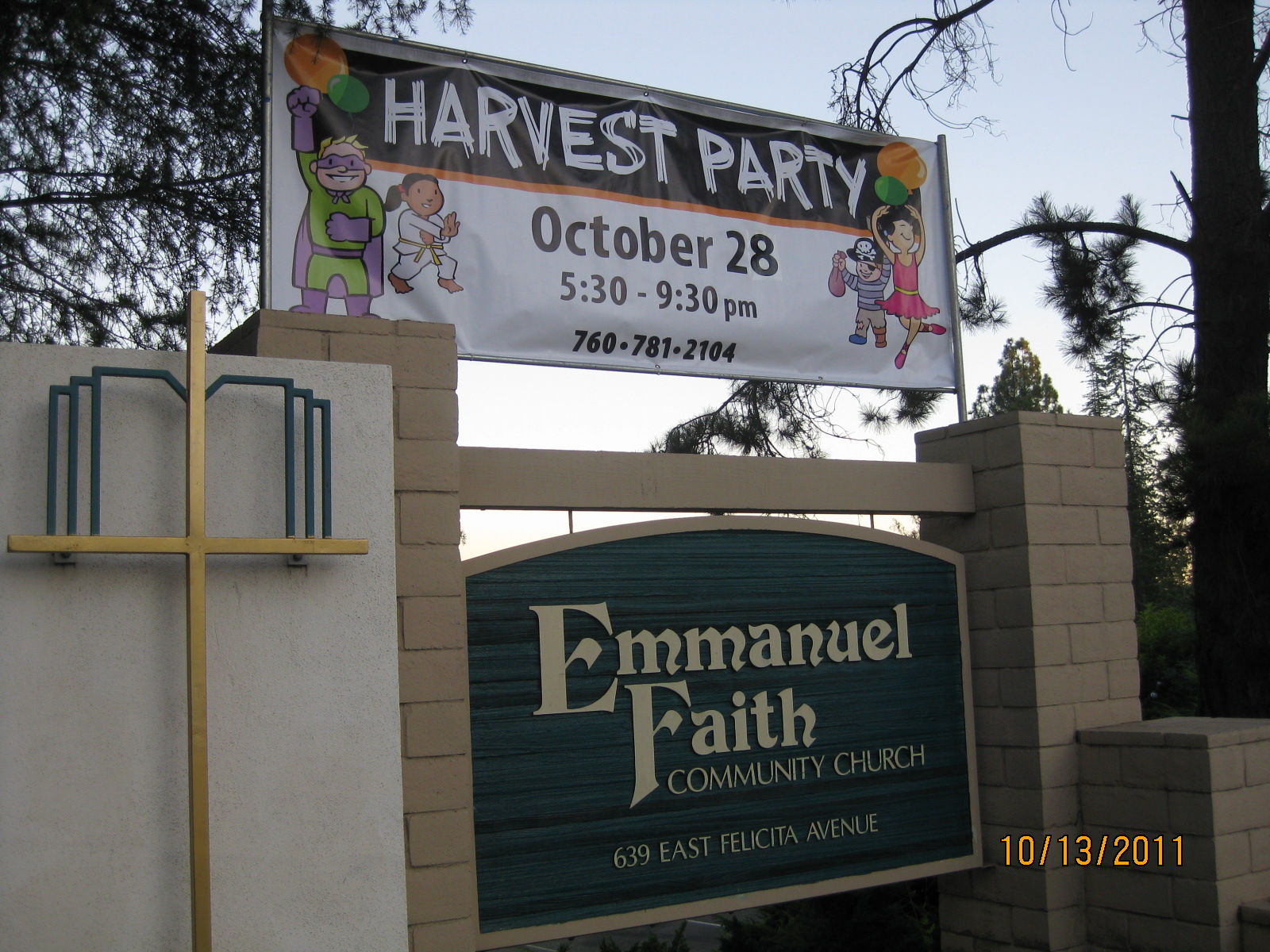
Last Thursday, I attended Peacemakers’ all-day Conflict Coaching event in Escondido, California.  The course was held at Emmanuel Faith Community Church.  My wife attended the church as a little girl.

Emmanuel Faith Sign

I spent a lot of time in preparation for the seminar, reading Ken Sande’s book The Peacemaker and engaging in four hours of prework beforehand.

We had two instructors, one an attorney (whose niece was on the TV show The Bachelor) while the other is a staff member from Peacemakers.

Instructor from Peacemaker Ministries

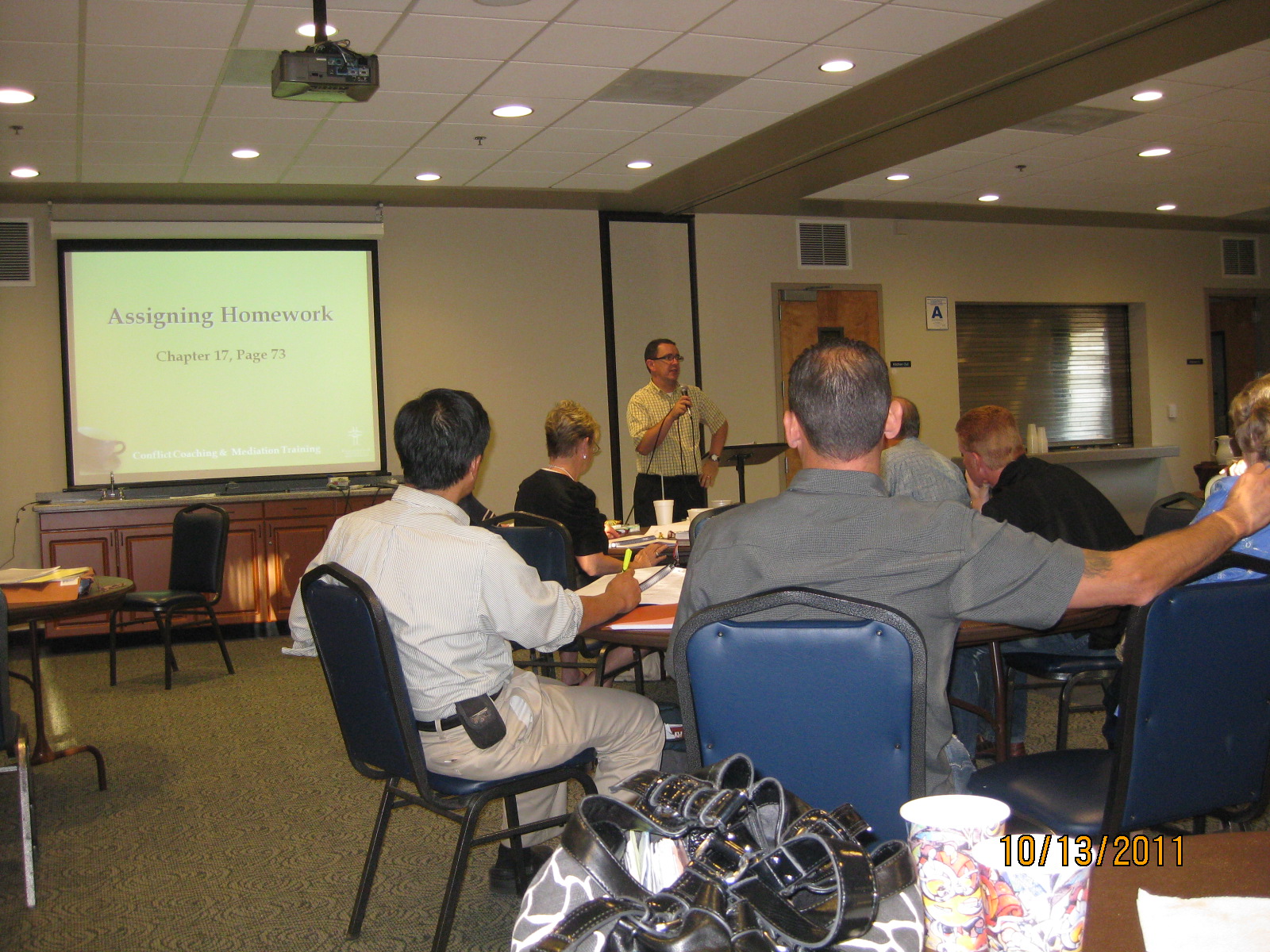
Much of the seminar was devoted to roleplaying.  We participants were given a scenario involving a dispute between two individuals.  We watched our instructors engage in role play, and then we were assigned a partner and practiced using biblical principles for peacemaking at our tables.

Engaging in Role Play

When each role play was over, we critiqued ourselves and then received a critique from our partner.  Personal involvement made the time fly by.

My preparation and attendance at the seminar lead me to four conclusions about conflict:

First, almost all conflict begins with interpersonal tension.  Family squabbles usually start with a rift between two people.  Church conflicts easily proceed from personal to official gripes.  Resolve a dispute with a temporary opponent and the conflict vanishes.  Fail to resolve the dispute and the conflict grows – and your opponent can become permanent.

Second, Christians need to take the initiative in resolving disputes.  Most of us shy away from conflict.  When I’m channel-surfing, if I come across two politicians arguing, I almost always change the channel.  Part of the reason that I’ve pursued conflict studies is because I’m tempted to avoid conflict at all costs.

But as I learned at the Peacemakers’ class, avoiding conflict is an escape mechanism that usually makes conflict worse.

Ken Sande and his organization have put together a way of visualizing possible solutions to conflict in the form of a diagram that summarizes our options when we’re in conflict.  This diagram is called “The Slippery Slope of Conflict.”  I encourage you to take a moment and check it out:

http://www.peacemaker.net/site/c.aqKFLTOBIpH/b.958151/k.5236/The_Slippery_Slope_of_Conflict.htm

I found their Peacemaker Pamphlet to be of great value in summarizing biblical values of peacemaking.  The pamphlet includes the “Slippery Slope” diagram:

http://www.peacemaker.net/site/apps/ka/ec/product.asp?c=aqKFLTOBIpH&b=6598003&en=jkKOK0ONIfIMJ0NSLmLOK2PRLqK1IcOPKeI0JaOSLuIbF&ProductID=923407

I plan to buy a bunch of these pamphlets and use them in my ministry.

Third, peacemaking starts with a pure heart.  While I appreciate the techniques that are advocated by Peacemakers, they don’t work unless a person’s spirit is right before God.  As Colossians 3:15 puts it, “Let the peace of Christ rule in your hearts, since as members of one body you were called to peace.”  However, once a person has practiced these techniques, he or she gains a greater level of confidence in addressing conflict situations.

Finally, every church should put together a Peacemaking Team.  If God ever called me back into pastoral ministry, I would make it a priority to identify a group of at least 3 individuals who could attend Peacemakers’ training and form a Peacemaking Team inside the church.

When I was a pastor, and two people were engaged in a dispute, I encouraged them to work matters out together.  I tried to coach them but tended to abdicate responsibility after that.

But there were times when I could have done more coaching than I did.

In addition, a Peacemaking Team can advise the pastor/staff/board to use biblical principles of peacemaking whenever a major conflict is brewing in a congregation.

Now that I’ve attended this seminar, I know better how to coach others toward conflict resolution in a biblical manner.

Since The Peacemaker book deals mostly with interpersonal conflict, I didn’t use it for my doctrinal studies, which involved antagonism in churches.  In fact, Sande’s book fails to mention much at all about major church conflict, especially conflict that involves the pastor – my primary area of interest.

But that’s not where most people live.  Instead, people want to know how to settle disputes with a spouse, a supervisor, or a sibling.

For those kinds of issues, I strongly recommend the resources and training provided by Peacemaker Ministries.

If you’re interested, please check out their website for training opportunities near you:

http://www.peacemaker.net/site/c.aqKFLTOBIpH/b.3041587/k.C206/Foundational_Skills_Training.htm

Read Full Post »

How concerned are you that churches in our country are not reaching young adults?

Last Saturday night, my wife and I attended worship at our home church.  The service theme was, “What is the point of church?”

Our pastor interviewed David Kinnaman, president of the Barna Group, a Christian research organization located in Ventura, California.  Kinnaman’s new book, You Lost Me, was published by Baker Books on October 1.

Here is a link to the book’s Amazon page if you’d like to order it:

http://www.amazon.com/You-Lost-Christians-Church-Rethinking/dp/0801013143/ref=sr_1_1?s=books&ie=UTF8&qid=1318269304&sr=1-1

The theme of our pastor’s questions and Kinnaman’s remarks was that the church in America is losing those who are 18 to 30 years of age.

He gave six reasons why this is the case:

First, the church is overprotective.  You’ve heard of “helicopter parents” who are always hovering over their children?  Kinnaman believes that we have too many “helicopter churches” as well.  He says that young adults want to take risks but that churches tend to be risk-averse.

I saw this in my last church when we tried to take mission trips.  Yes, it can be dangerous to travel to Africa and Eastern Europe, but if God is leading us there, can’t we count on His protection?

Some churches have also become overprotective in ministry because they listen more to attorneys than to God.

Second, the church is shallow.  Young adults claim that churches are boring and that they don’t experience God when they attend.  There’s nothing vibrant happening.  Our pastor mentioned that when he meets with key leaders to plan weekend services, they try to build two or three “Ministry Moments” into the service so people can connect with God.

Too many churches are shallow because pastors have stopped teaching through biblical passages during worship.  The pastor comes to a scriptural text or a topic with preconceived points he wants to make and sidesteps around difficult issues.  I’m always playing mental chess with pastors, asking myself, “But what about this issue?”  In my estimation, only 10% of all pastors in our day are dealing with tough texts or hard issues.  We’ve become a mile wide and an inch deep.

Third, the church is antiscience.  Kinnaman noted that more than half of all Christians are involved in technology, engineering, or health care – fields that all require a scientific bent – but that churches are either silent or antagonistic toward these areas.  He also mentioned how anti-intellectual many Christians are today.

Science was never my best topic, so whenever I discussed it while teaching, I quoted from acknowledged experts.  But if you have a brain, most churches today aren’t going to challenge your thinking too much.  Paul said it best in 1 Corinthians 14:20: “Brothers, stop thinking like children.  In regard to evil be infants, but in your thinking be adults.”  We need more churches that are both intellectually and spiritually credible.

Fourth, the church is repressive.  Young people believe this is especially true when it comes to sexuality.  Kinnaman observed that young adults value their relationships more than anything else, and that they tend to derive morality from their friends, not the church.  When the two clash … they lean toward their friends … because if they side with the church, they may lose their friends.  Kinnaman also noted that although Christians were once viewed as the mainstream in our country, now we’re considered to be the fringe.  He also stated that there are 23 million Christians in America who no longer attend church.

This is a tough one.  While I have always valued friends, I was taught to value following Jesus and standing alone even more.  If the two clashed, I went with Jesus.  Today, when the two clash, young adults are following their friends.

Fifth, the church is exclusive.  Kinnaman noted that people in our country have become skeptical about everything, especially authority structure.  We see this in the lack of confidence that people exhibit in government, academia, business, and the press – and unfortunately, churches are not immune from such skepticism.  And our belief that Jesus is “the way, the truth, and the life” doesn’t mesh with the way most people think today.  It’s too narrow.

If I could pastor again, I would reserve 10-15 minutes at the end of each message for people to ask questions and challenge what I said.  When I visit churches today, if the pastor says something that I don’t agree with, there is no way for me to ask him for clarification or for me to express a viewpoint.  (If I email him, I almost never receive an answer.)  Even in university settings, students are able to ask questions of a professor, but we don’t allow that in our churches.  What are we afraid of?  (Probably missing the kickoff at 1:15.)

Finally, the church is doubtless.  The church feels unfriendly for those who doubt.  Kinnaman says that people do not feel comfortable expressing their mental reservations or emotional issues in a church setting.

I probably identified with this issue the most.  When you’re in pain, and you take a risk and share your feelings with other Christians, the way they respond indicates whether you’ll talk to them again or not.  If they respond with a monologue or condemnation, you’ll go elsewhere to share.  But if they respond with genuine understanding, you can receive real help.

Our pastor ended the session by encouraging our church to be real, relevant, and relational.  (I might add that we need to be rational as well.)

How do you react to these six observations by David Kinnaman?  I’d love to hear your ideas.

Read Full Post »

« Newer Posts - Older Posts »