Feeds:
Posts
Comments

Imagine that you have a friend who is married and has two kids.

She’s been struggling with her marriage, and one day, she tells you that she and her husband have separated.

She proceeds to tell you – in great detail – why her husband is 100% to blame for their failed relationship and why she has done everything right … and nothing wrong.

You want to support your friend … to listen to her pain, and be a safe person, and gently offer her advice … but you also know that she’s responsible for at least some of the problems in her marriage.

Here’s your dilemma:

Do you become so empathetic that you side with her completely?  (“You should never have married him, he’s a selfish pig, and you deserve full custody of the children.”)

Or do you share with her biblical principles of marriage?  (“Marriage is for life, you lack biblical grounds for divorce, and the right counselor could help you both rekindle your old flame.”)

As a pastor, I actually relished most forms of counseling … all except marriage counseling.  I discovered that:

*I rarely sensed I was getting the real story from either partner until the third or fifth or seventh session … by which time one or both of them had already quit.   

*I couldn’t watch their real-life interaction at home (like Jo, the British nanny, did with parent-child situations on TV).

*I sometimes suspected that one partner was mostly responsible for the mess … until I spoke with the other partner. 

*I couldn’t form an alliance with either one … I had to be on the side of their marriage instead.

Now let’s apply these ideas to conflicts at church.

*It’s hard to get the real story about a conflict at times.  If you talk to the pastor, you’ll get one story … and if you talk to the pastor’s detractors, you’ll hear another story.

It’s okay to remain friends with one or both parties during a conflict.  Just realize that if you only hear one side, you’ve chosen friends over principles … and when you do that, you’ve lost all objectivity.

*It’s unlikely you’ll be able to watch any real life interaction between the pastor and his detractors.  Most conflicts happen behind closed doors during board meetings or staff meetings … or after those meetings in parking lots or corners of the church campus. 

Most people – especially church leaders – are on their best behavior in public.

Because you can’t witness any conflicts yourself, be careful about publicly taking sides just because one party is a better friend than the other.  You can’t be 100% certain you know what’s happening.

*Be careful about blaming everything on one party … usually the one you like least. 

This is a trap.

I have been a Los Angeles Lakers fan for almost 50 years.  While I deplore their recent trend toward thuggery, I remain a loyal adherent of the team.

Sometimes I’ll watch a game, and I’ll see a player on the Lakers take an elbow or a punch from an opposing player … and my first reaction is, “Throw that guy out, ref!”

Then the TV people show the replay, and I’ll notice that my guy threw the first elbow, or pushed his opponent hard, or was guilty of a flagrant foul … or flopped unnecessarily.

I love my team, but come on … sometimes both parties are guilty … although one may bear more responsibility than the other.

Wouldn’t it be great to have instant replay in church settings?

*Instead of backing one party 100%, isn’t it better to be on the side of truth and righteousness?

So let’s say you’re in a church, and a conflict breaks out between the pastor and a small group of detractors.

Resolve that:

*because you don’t know the full story, and …

*you can’t witness their interactions (or lack thereof) …

*you won’t blame the conflict totally on one party, and …

*you will lobby for the truth to emerge and for righteousness to prevail.

If someone tries to draft you to be on their side in a conflict, simply state:

“I love all the parties involved and wish them well.  But I really don’t know the full truth about this conflict, so I’m not going to take sides at this time.  Instead, I will take the side of truth and righteousness, and I will suspend final judgment until I have all the facts.”

We all want to be loyal companions, but sometimes … as Jesus reminds us … we need to risk appearing disloyal to our loved ones so we can be loyal to greater principles.

I once witnessed a major conflict involving a pastor where sides were quickly chosen up.  You were either for the pastor or against him … there was no middle ground. 

I did my best to point people to biblical truth during the whole sad situation.  While I had feelings about what was happening, I tried to be an advocate for higher principles … even though some of my friends wanted me to take their side.

Once we choose sides, we want to win … and we want the other side to lose.

There are times when one side is clearly in the wrong and the other is clearly in the right … but even then, we want to make decisions on the basis of principles, not personalities.

How do you feel about this issue?


Once upon a time, there was a king.

The king ruled a land where His subjects felt unsafe … so he searched for another land where they could live.

He found a land nearby and proclaimed himself king.  Shortly afterwards, he built a castle.

Many people enjoyed visiting the castle and listening to the king’s wisdom.

But after many years, the king was getting old.  He looked around for a prince who could succeed him as king.

Many paraded themselves before the king, but he rejected them all.

The king finally chose a prince from another land, who brought along his wife, a princess.  They moved into the castle with the king and queen.

The families of the king and prince got along, and the people rejoiced.

One day, the king said goodbye, and left for another land.  The prince became the new king … his wife the new queen.

The new king loved the people, and they loved him.  Life was good.

But some citizens missed the old king.  They began sending him messages, complaining about the new king … who was not exactly like the old king.

The old king told the new king about these messages, which the new king appreciated because he wanted to be friends with everyone.

As the years passed, some citizens continued to complain to the old king … but this time, the old king did not tell the king about these complaints.

The kingdom grew, and the old castle felt confining, so the king built a new castle, which made the citizens happy.

Because the kingdom continued to expand, the king invited a prince from another land to help run things.  The king and the prince served together well, and the kingdom continued to prosper.

The king convened meetings of the knights of the round table, who provided advice on kingdom matters.  Everybody got along well.

But one day, due to a scarcity of resources, the knights began making decisions without the king’s knowledge.  Life in the kingdom became tense.  The king became frustrated.

The king and queen went on a journey to help people in another land.  When they returned, the knights took the queen and locked her in the dungeon, claiming she had broken kingdom laws.

The knights told the king that the queen must abdicate or they would abdicate instead.

The king was caught in the middle.  While he loved his queen, he also loved the kingdom.  The queen did not believe she had broken any laws and chose not to abdicate.

Meanwhile, friends of the king asked the knights if they could meet to discuss the situation.  The knights said yes …  then no … then yes … then no.

And then one night, the prince left the kingdom, riding off into the night for another land.

The king asked a counselor from a distant land to advise him.  During this time, the queen became very ill, worrying the king greatly.

After threatening to leave several times, the knights finally departed, causing the king to weep.  He loved the knights and could not understand why they put the queen in the dungeon.

Since the king now lacked knights, he asked several citizens to serve as temporary knights and give him counsel.  The king also asked the counselor to come to the castle and give him advice.  The counselor agreed.

The king called a meeting to tell the citizens that the prince and knights had left the kingdom.  When the king made his announcement, he was shocked by the reaction of the people … some of whom now wanted the king banished.

The king stayed in the kingdom, but was asked not to come near the castle so the temporary knights could choose permanent ones.

While the king waited, he and the queen heard rumors that were untrue and hurt them deeply.  Some of the rumors persist to this day.

The rumors were ultimately started by a dragon known for deceit and destruction who had also harmed other castles in the region.

The king decided to leave the kingdom … because he loved his wife and wanted her healthy … and because he loved the kingdom and wanted its citizens to be joyful and prosperous.

The king gave a final speech to the people in the castle.  The king and queen then said goodbye to the people they loved … and still love … very much.

The king and queen journeyed to a distant land to live … and learned more about why they were driven from the kingdom.

They learned that the queen was put in the dungeon so the king would leave the kingdom.

They learned that the charges against the queen were untrue.

They learned that the old king had been working with the knights and prince to banish the king from the kingdom.

They learned that this kind of tragedy happens to other kings in other kingdoms.

So they decided to do something about it.

The king decided to tell his story … consulting with experts … so the knights and citizens of other kingdoms would know what to do whenever parties conspired to banish a king from their kingdom.

The king and queen gained wisdom and strength from their experience.  They made plans to help other kings and knights and kingdoms so they do not have to go through similiar heartaches.

And they hope that everyone in a kingdom will unite to fight the dragon instead of each other.

They ask for your prayers and encouragement in this new endeavor.

And if a similar situation happens in your kingdom, they pray that the knights and citizens follow the constitution of the kingdom rather than make up their own rules.

May your king and kingdom be abundantly blessed until the real King returns.

(Since this is my 200th blog post, I thought I’d do something a little creative.  Thanks for reading!  On to 300 …)

How old are you spiritually?

While many people aren’t sure … it’s something I’ve always known.

As a kid, I constantly heard two themes repeated over and over:

*We’re all sinners

*Jesus died on the cross for sinners

Even at the age of 6, I knew I was imperfect and in spiritual trouble … but all the songs and lessons and sermons I heard told me that God loved me and that Jesus died for me.

One Saturday, our family went to the Broadway Shopping Center in Anaheim.  On our way home, I asked my parents if I could receive Jesus into my life … and they said I could.

My parents never pressured me into inviting Jesus into my life.  It was a decision that I made myself.

At 7:00 that night, my father and I knelt beside my bed, and he led me to faith in Christ.  After we prayed, I sensed a flutter in the region of my heart … and told my parents that I felt Jesus coming into my life.

The following year, my pastor/father baptized me.  I think I received a Bible with my name imprinted on it after my baptism.

There was a section between the Old and New Testaments for people to write down important events in their family’s life.  Since my parents told me to write down the date of my conversion, I decided to record it in my Bible … and wrote that:

“Jimmy Meyer and the Lord Jesus Christ were united in holy matrimony on July 6, 1960.”

When I finally learned what “holy matrimony” was years later, I felt a little stupid … but in retrospect, the term seems to fit both theologically and experientially.

Spiritual conversion is a mysterious and wonderful thing.

About half the people who receive Jesus can’t remember the date when they received Him … and about half can remember.

I’ve always remembered, although I’m not always sure how to celebrate the occasion.

My conversion to Jesus Christ has lasted for 52 years.  I’m more than half a century old in the Lord.

But I take no credit for my salvation.  The glory and honor all goes to Jesus Christ.

There is still a lot of controversy in theological circles about Calvinism and Arminianism.

How much of a part does God play in conversion?  How big a part do we as humans play?

I’ve always leaned more toward God’s part but understand why others feel differently.

But I hope we can all agree with these three lines from the Prince of Preachers, Charles Haddon Spurgeon:

“I believe the doctrine of election, because I am quite sure that if God had not chosen me I should never have chosen Him; and I am sure He chose me before I was born, or else He never would have chosen me afterwards; and He must have elected me for reasons unknown to me, for I never could find any reason in myself why He should have looked upon me with special love.”

That’s exactly how I feel … today and every day.

I am grateful to God that He gave me parents who loved Him and shared Christ with me.

I am thankful for churches that preached the gospel so I could grasp it, even at a young age.

I am indebted to many believers who modeled Christlikeness for me and taught me His Word.

But above and beyond all human intervention, I am glad for the grace of God in my life.

These lines – from “At the Cross,” my favorite hymn – perfectly encapsulate my feelings today:

But drops of grief can ne’er repay

The debt of love I owe

Here Lord, I give myself away

‘Tis all that I can do

We’re in a period right now in our country where everybody is thinking about the government.

Last week, the Supreme Court made a momentous decision about health care … and this Wednesday is Independence Day for Americans … and we all know about the election in November.

While journalists write their editorials and radio talk-show hosts offer analysis, it’s easy to get so wrapped up in political coverage that we throw our Christian faith out the window.

Regardless of your political affiliation, if you’re a follower of Jesus, I’d like to encourage you to think about the following four questions:

First, who do you worship and serve: Jesus Christ or an earthly candidate?

Jesus once asked His hearers in Luke 6:46, “Why do you call me, ‘Lord, Lord,’ and do not do what I say?”

Once a person comes to Jesus for salvation, Jesus isn’t just their Savior from sin … He also becomes the Lord/Director of their life.

By definition, a Christian is a person who loves and follows Jesus.  Jesus is first in the lives of His followers.

We sing to Him … and pray in His name … and worship Him with His people … and tell unbelievers about Him.

But at election time, it’s easy for Christians to lose their heads politically and give their allegiance to candidates who are not in line with Jesus’ values.

I trust very few politicians.  If we really knew what happens behind closed doors, we might not trust any of them.

This is why I become alarmed when I see professing Christians express more excitement about a political candidate than about their Savior.

No politician will ever bring the kingdom of God to earth … whether it’s called Camelot or a Shining City on a Hill.

Only Jesus will do that … and He won’t need the help of any earthly politician to pull that off.

Think about it.

Second, do you follow candidates based on biblical principles or partisanship?

There are various ways to assess candidates before we vote for them … but the most common way is to vote for candidates who represent our political party.

Millions of Americans will vote this way in November.  They won’t even pay attention to any ads, debates, or positions.

Just look for the candidates from your party on the ballot and make your mark next to their name.

But this approach should bother all of us who believe we should use the brain that God gave us.

During the primary season … when there were 9 candidates running for the Republican nomination … I took a little test online.  The test asked for my opinion on a variety of issues … and at the end, it told me which candidate best represented my positions.

I was shocked.

Too many people support a candidate who seems likeable … or is good-looking … or can speak well … but do you ever ask yourself:

How consistent with Scripture are their positions on the issues?

I’d rather support an unbeliever who holds biblical values than a believer who doesn’t.

How about you?

Third, how important is telling the truth to you?

If you’ve read this far, some of you aren’t going to like what I’m about to say … but I’m going to say it anyway.

Most politicians are liars … because they would rather win an election and/or defeat their opponents than tell the truth.

Politics is all about winning.

When he was still alive, Jesse Helms – long-time Senator from North Carolina – found himself in a tough political fight.  He ran some despicable ads attacking his opponent … and barely won the election.

The Republicans cheered.  Their man had prevailed!

But truth was the biggest casualty.

I’ve already seen political ads with distortions and exaggerations this political season … and they don’t work on me.  (I refuse to pay attention to them because they are designed to be manipulative.)  I hit “mute” or change the channel much of the time.

Jesus always told the truth to His followers.  He never, ever lied … even if it made Him unpopular.

Listen to the wisdom of 1 Peter 2:21-23:

“To this you were called, because Christ suffered for you, leaving you an example, that you should follow in his steps.  ‘He committed no sin, and no deceit was found in his mouth.’  When they hurled their insults at him, he did not retaliate; when he suffered, he made no threats.  Instead, he entrusted himself to him who judges justly.”

Politics is full of sin, deceit, insults, retaliation, and threats.

The way of Jesus is the exact opposite.  Jesus was righteous, honest, compassionate, forgiving, and loving.

Act that way and you’ll lose an election … but build a kingdom that will outlast them all.

Finally, which kingdom do you want to spread and grow?

Christians are citizens of two kingdoms: heaven and earth.  Jesus told the Pharisees to “give to Caesar what is Caesar’s, and to God what is God’s” (Matthew 22:21).

But if the two kingdoms clash … and this is increasingly happening in our country … Jesus’ followers have to support His kingdom … even if that means disobeying the government.

In Acts 5:29, after being ordered by the Jewish Supreme Court not to speak anymore in Jesus’ name, Peter answered, “We must obey God rather than men.”

Acts 5:33 says about the Sanhedrin, “When they heard this, they were furious and wanted to put them to death.”

My friends, believers all over the world are standing up to the kingdoms of men … and being imprisoned … or losing their lives.  Just yesterday, believers in Kenya were gunned down while they were worshiping the Lord at their church.

That could never happen here, could it?

Our religious freedoms are gradually being eroded in this country … and we have to be vigilant and make sure we’re not indirectly harming our spiritual brothers and sisters by supporting candidates whose policies strip back those freedoms.

Many churches have two flags in their worship center: an American flag, and a Christian flag.

Christian theologian and philosopher Francis Schaeffer used to ask, “If you have two flags, which flag is higher than the other?”

If it’s the American flag … as much as it means to many of us … then it’s possible we’ve identified our country with the kingdom of God.

If they’re both on the same level … then we’re trying to serve two kingdoms simultaneously … which can make one schizophrenic.

But if the Christian flag is higher … it means we endeavor to “seek first the kingdom of God and His righteousness” (Matthew 6:33).

This political season, I’ll read about the candidates … and watch them be interviewed on TV … and listen to the opinions of pundits about their campaigns … and then vote in November.

But I refuse to let my politics influence my faith.  Instead, I make sure that my faith informs my politics.

Because I do not serve or worship Barack Obama or Mitt Romney or Ronald Reagan or JFK.

I trust that you don’t either … if you’re a follower of Jesus.

We serve and worship our King, Jesus Christ, and pray that His kingdom spreads.

King of Kings, and Lord of Lords, and He shall reign forever and ever.

Hallelujah!  Hallelujah!

Who is your political hero?

George Washington?  Abraham Lincoln?  JFK?  Ronald Reagan?  Barack Obama?

My personal favorite among politicians is former British prime minister Winston Churchill, who saved the West from the iron will and evil intentions of Adolph Hitler.

At Churchill’s Family Gravesite, Bladon Churchyard, England

After being in political exile for years, England turned to Churchill to prevent Hitler from overtaking Great Britain during the Second World War.  Churchill’s expert leadership behind-the-scenes, coupled with his fierce and inspiring speeches in public, rallied the spirit of the British people to defeat German’s Fuhrer.

Entrance to Churchill’s Underground War Rooms, London

Churchill was both a great leader and a great communicator … but such greatness is uncommon.

Churchill Statue in Parliament Square, London

Most people are either gifted leaders or gifted teachers, not both.

Let me contrast the two groups in three ways:

First, leaders tend to see the future clearly, while teachers tend to see the past clearly.

When George H. W. Bush was President, he confessed he had trouble with “the vision thing.”  He wasn’t sure where he wanted to take the country, but Bill Clinton was sure, and defeated Bush for President in 1992.

Leaders have to be able to see the future clearly and describe it to others.

By contrast, teachers see the past clearly and can accurately describe its lessons.

I have always had trouble envisioning the future.  As a leader, I shied away from 5-year plans because they were illusory to me.  I usually knew the next thing to do … but not necessarily the next thing after that.

But the past … that’s very real to me.  For many of the special experiences in my life, I can recall the date, the place, the weather, the people involved … all kinds of stuff.

For example, I remember when Nolan Ryan set the all-time season strikeout record.  It happened on a Thursday night in September 1973.  The Angels played the Twins in Anaheim.  Going into the game, Ryan had 367 strikeouts … and was trying to beat the all-time record of 382 set by Sandy Koufax in 1965.  After 9 innings, Ryan had 15 strikeouts (tying the record), but the game itself was tied.  Ryan couldn’t get that last strikeout in the 10th inning, and with two outs in the 11th, he still didn’t have it.  In fact, he was laboring with each pitch.  But he struck out Rich Reese of the Twins on a very high fastball for Number 383.

How do I remember all that?  I was there … with some friends … sitting in the upper deck down the left field line.  That event occurred 39 years ago … but I remember it like it was yesterday.  That memory seems unremarkable to me, but others have told me they’re amazed I can recall those things.

But it’s natural for a teacher.

Second, leaders tend to work with groups, while teachers tend to work alone.

I once heard Pastor Bill Hybels describe ten types of leaders.  He said the leaders who build the big churches are the kind of leaders who can put teams together quickly.  They recruit people, give them a charter, and turn them loose … and then do it again … and again … and again.

The best leaders like being with people.  They feed off their energy and ideas.

By contrast, teachers prefer to work alone.  They like to reflect, and do research, and write … and then march into a classroom or worship center and speak to a group on their own … without assistance.

Here’s the perfect day in my work life:

It’s raining and I’m confined to my study.  I comb my bookshelves for relevant books on a passage or topic and pull out 15 of them.  Slowly and methodically, I read sections of each book … not to steal what someone else has written, but to stimulate my own thinking.  Without effort, an outline begins to form in my head.  I put it on paper and begin to work it over.

While that process is happening, I don’t want anybody to interrupt me.  It’s just me and God and the books and some ideas.

Heaven.

That’s the reseach end … but I also love delivering the message to a group of people … especially if we can enjoy interaction.  However, without the research, the teaching time isn’t nearly as much fun … or productive.

Third, leaders tend to be repetitive, but teachers like to say things once.

I remember learning that churchgoers need to be reminded of a pastor’s vision every thirty days.  The pastor needs to remind people … over and over again … why that church exists and where it’s going.

The leader may do this in a variety of ways … like slogans, symbols, stories … but he has to remind people constantly why the church is doing what it’s doing.

By contrast, teachers hate saying the same thing over and over.  The repetition bores them.

Teachers like to keep truth fresh … illustrating and applying it in countless ways.

Recently I engaged in a painful activity: I re-read some sermons I preached a few years back.

When a message was good, it was full of fresh stories and thoughts.

When a message wasn’t very good, I was overly repetitive and predictable.

An effective leader needs to be repetitive, but an effective teacher longs to be original.

Jesus was both a great leader and a master teacher.  He led His disciples while teaching the masses.  He combined the two disciplines better than anyone who has ever lived.

So remember … your pastor is probably a gifted leader or a gifted teacher … and he gravitates toward the one he does best.

And he’ll probably receive far more criticism in his non-gifted area.

So if you think he falls short in one area, cut him some slack.

Because not all great leaders are great teachers … and not all great teachers are great leaders.

While you can usually tell if someone is a great teacher right away, the fruit of leadership only happens long-term.

What are your thoughts on these two disciplines?

Class dismissed!

True or false: all great teachers are also great leaders.

False.  False.  False.

And yet we fall for this gambit time after time: at school, in politics, and at church.

Especially at church.

We make the assumption that if a pastor is a great teacher, he will also be a great leader.

But that isn’t always the case.

I know a pastor who is an excellent communicator.  If he was on television, and the camera panned back, you’d assume the worship center would be full.

But the worship center wasn’t full when he preached … far from it.  In fact, there were many more empty seats than “taken” ones.

Why?

Because behind-the-scenes, he was not a gifted leader.  He tried … really, really hard … but it just wasn’t him.

God gave him the teaching gift but not the leadership gift.

The same thing was true of Gene Mauch.

Gene Mauch was a brilliant baseball manager for the Philadelphia Phillies, Montreal Expos, Minnesota Twins, and California/Anaheim/Los Angeles Angels from 1960-1987.

In Leonard Koppett’s brilliant book The Man in the Dugout, Koppett writes this about Mauch:

“More than any other baseball man of his era, Mauch is singled out by players and rival managers alike as a brilliant student of the game.  ‘He knew more about the details of every position, and all the little technical things, than anyone I came across,’ one player with twenty years of experience told me.”

Koppett continues:

“Mauch knew more baseball, in the technical sense, with deeper insight, than almost anyone around him or in the opposing dugout.  He tried, tirelessly, to impart the appropriate gems of information to his players.  But he did it so tirelessly, in such detail, with such intensity, that he aroused the wrong reaction.  Players would begin to worry more about doing what Mauch wanted than about winning itself.”

Koppett relates a story told by Ron Fairly, who played five years for Mauch in Montreal (the team is now the Washington Nationals).  Fairly would be taking ground balls at first base during batting practice, and he’d find Mauch staring at him from close range.  Fairly would wonder, “What’s he looking at?  What does he see that I’m doing wrong?”  Later, Fairly would be in the outfield, and Mauch would be watching him there.  Then he’d see Mauch at second base, staring at the batting cage.

Finally, Ron Fairly asked Mauch about the second base incident … and Mauch was just trying to understand why the Expos second baseman had looked out-of-sync on a couple of plays the day before.  Mauch really wasn’t staring at his players … he was just trying to figure out a baseball problem in his own mind … but they didn’t know that.

Koppett writes: “All they knew was that there was the boss, frowning, and that when he ever did speak to them it was about how to do this or that better, or avoid this or that mistake.”

Mauch was a great teacher … but he wasn’t a great leader.  His teams won two division crowns but never made it to the World Series … and because he didn’t win, he’ll never make the Hall of Fame.

Koppett’s conclusion: “Mauch was robbing the players of an essential condition: relaxation.  He was being too sophisticated for too many of his players.”

What’s true in baseball is also true in other fields … especially the church.

There are some pastors who are both great leaders and great teachers … but let me tell you, they’re rare.

God has given some pastors the gift of leadership but not the gift of teaching.

God has given other pastors the gift of teaching but not the gift of leadership.

God has also given some pastors the gift of Leadership (with a large “L”) but the giff of teaching (with a small “t”).

And He has given some pastors the gift of leadership (with a small “l”) but the gift of Teaching (with a large “T”).

The pastors who have both the gift of leadership and the gift of teaching are pastoring the megachurches … but some of them are lousy pastors and counselors.

Remember, no one person has all the gifts … except for Jesus.

The pastors who specialize in teaching tend to pastor medium-sized to large churches.

The pastors who specialize in leadership tend to pastor extra large to mega churches.

A veteran pastor once told me about two brothers who were both pastors.

The first brother was a great teacher.  He loved to study and research, and it came out in his preaching.

600 people attended his church.

The second brother was a better leader and had more of the common touch.

5,000 people attended his church … and his sermons were broadcast on the radio.  (I didn’t learn much from listening to him, but he was definitely entertaining.)

But what happens to us is that we get fooled.

We hear someone speak articulately and eloquently and passionately in public, and we’re persuaded by their rhetoric … so we assume that they’re equally persuasive behind closed doors.

But most people in a congregation never get to see their pastor in action with the staff or the board or city officials or community leaders.

We see and hear them teach in public … but we really don’t know how they lead in private.

I was in church ministry for 35 1/2 years … 26 of those years as a solo or senior pastor.

Some of my sermons were better than others … and I’d like to think that I got better with time … but because teaching was my primary gift, I rarely heard much flak about my preaching.  In fact, I distinctly remember two vocal critics of mine telling me they felt I was a gifted teacher.

If you heard me speak, you might assume I was an equally gifted leader … but I knew I wasn’t.  God gave me the gift of Teaching (with a capital “T”) but the gift of leadership (with a small “l”).

I’ll write more on this topic next time.

How have you seen this disparity played out with the leaders and teachers that you know?

Bullying has become a huge problem in our country.

Parents bully children.  Brothers bully sisters.  Bosses bully employees.  Teachers bully students … and students bully teachers.

Have you seen the video of the middle schoolers in New York state who bullied a 68-year-old bus monitor as she rode home on the school bus?  Disgraceful.

Churches have bullies, too.  And there’s a sense in which church bullies are the worst of all because we don’t expect that kind of behavior in church.

How can one detect a church bully?

A bully demeans others by picking on weaknesses and calling people names and making demands.  If you don’t do what a bully wants, he or she threatens to hurt you in some fashion.

I once knew a bully who tried to intimidate me in board meetings.  He went right after me every chance he could.  He wanted power and sensed that I was slowly taking it from him.  Fortunately, I didn’t have to take him on because others did that for me … but it could have gotten nasty.

Church bullies often get their way because they sense that no one has the guts to take them on.  They know that Christians value “being nice” and that if they aren’t nice, they can get their way more often.

Believe me, it works.

This is why Christians – especially leaders – have to learn to face down the bullies.

It’s biblical.

In 3 John 9-10, John the apostle writes:

“I wrote to the church, but Diotrephes, who loves to be first, will have nothing to do with us.  So if I come, I will attention to what he is doing, gossiping maliciously about us.  Not satisfied with that, he refuses to welcome the brothers.  He also stops those who want to do so and puts them out of the church.”

Diotrephes was a church bully.

He “loves to be first” … he wanted to control the decision making.

He “will have nothing to do with us” … he didn’t recognize John’s authority as an apostle.

He was guilty of “gossiping maliciously about us” … attacking John verbally, probably disparaging his apostolic credentials.

He “refuses to welcome the brothers” … visiting leaders and teachers sent by John.

He “stops those who want to do so” and “puts them out of the church” … excommunicating John’s representatives.

Wow!  This guy really had issues.

Diotrephes’ misbehavior was threatening the very existence of that church.  Can you imagine challenging the authority of John, the Apostle of Love?

How did this Apostle of Love propose to deal with this church bully?

“So if I come, I will call attention to what he is doing …”

John was going to face him down … maybe with the help of church leaders, or the congregation itself … but John was going to meet Diotrephes at high noon.

He was going to confront him … maybe publicly, maybe privately … but he was going to stop the bullying.

John may have been hoping that this warning would cause Diotrepehes to run for the hills.  If we had 4 John, maybe we’d find out what happened.  (We’ll have to wait for heaven for the thrilling conclusion.)

Sometimes a pastor has to face down a bully.

I once served in a church where an ex-policeman was griping about everything.  He griped about the music.  He griped about the youth.  He griped about the neighbors.

Part of me felt sorry for him because he was no longer a policeman … but he had morphed into the church police.

Because nobody dealt with him, he became bolder and bolder with his griping.  This went on for several years.

Finally, a new pastor came, and he tried to work with this man, but nothing worked … and he couldn’t tolerate the behavior any longer.

He finally ordered the man to leave the church … and he left.

He faced down the church bully … and the church was better off for it.

Last year, I had breakfast with an ex-pastor who told me what happened at his former church.

There were people in the church who were terrorizing the pastor, and the church board didn’t know what to do to stop things.

Wisely, the pastor hired a consultant, who met with the board and told them what to do:

You have to go and face down the bullies.

The board members just looked at each other.  The bullies were their friends.

The consultant barked, “Now!”

The board members got in their cars and did what they should have done months before.

Stephen Brown is one of my favorite Christian communicators.  He’s half-crazy, but that just adds to his appeal in my book.

Anyway, in his classic book No More Mr. Nice Guy!, he tells a story about a pastor who was being bullied by a parishoner … and the pastor couldn’t take it anymore.  The man gave a large amount of money to the church and had many relatives in positions of leadership.  Brown’s friend believed that he would divide the church if he confronted him.  Brown told his pastor friend:

“Invite this man to your study and say, ‘I have had it up to my ears with you.  Before this meeting is over, one of us is going to resign.’  Then tell him all the things he has been doing to hurt the church.  Tell him, ‘This is not your church or my church, this is God’s church, and He will not allow you to act in this manner anymore.’  Then tell him that you are God’s agent to make sure that he doesn’t.”

In some cases, this tactic might backfire.  In the case of Brown’s friend, it worked.  His pastor friend called two days later and said:

“Steve, you wouldn’t believe what happened.  The church member who has been giving the church all the trouble asked if I would forgive him.  He said that he knew he had a problem and asked for my help.  Not only that, he said that if I would give him another chance he would be different.  Not only that, his two brothers came in and thanked me for what I did, and said that I was the first pastor in twenty years who had had the courage to do what needed doing.”

I can’t guarantee this tactic will work in every case, but if you’ve tried everything else, it’s certainly worth a try.

Because of church bullies, I’ve endured sleepless nights … worried myself sick … threatened to quit church ministry … and turned myself into an emotional wreck, all because nobody – including me – would face down the bullies.

It’s time we started doing just that.

Go … now!

Time for a Holy Rant

How do you feel about Christian churches these days?

Based on the many Facebook posts I read, some of you are very happy with your church … especially if the church is ministering effectively to your kids.  If so, that’s wonderful.

I’m struggling … and I wonder if it’s just me.

Last Sunday, my wife and I attended a megachurch in our community.  We’re in the process of church shopping and want to make sure we’re covering all the bases in our area.

We sat on the far right side of the worship center … but I didn’t know that the church puts its services online.  Suddenly, this huge boom camera goes flying over our heads … back and forth, back and forth.

If the thing fell, the coroner would have to be summoned.

So we moved to the back row in the next section over … but that didn’t stop the camera from hovering above us again.

At one point, it got so low that I could have reached out and touched it … but what I really wanted to do was stop the thing from flying over my head every thirty seconds!

Fortunately, the service was great, right?

I don’t even want to mention this … but here goes.  (Lord, if I’m just being a cranky former pastor, please forgive me.)

The music was fine … at least I knew some of the songs … but church music is starting to sound the same to me wherever I go – especially the lyrics.  You could take the lyrics to any song, jumble up their order, and write another song with them … and another … and another …

I’m starting to long for “Here I raise my Ebenezer” and “My sin, O the bliss of that glorious thought …”

The pastor was away, so there was a guest speaker … with the obligatory shirt tail out.  (Can someone explain this trend to me?  Is this somehow more biblical or godly … or is it all about being cool?  Would that same person dress like that while making a business presentation?  Just saying.)

The guest speaker had a great introduction – he actually used a story … and then never used another one.  Not one.  Zilch.  With little application, either.  And no outline.  It almost felt like he made up the sermon as he walked to the pulpit.

And he probably walked away with $2,000 per service for his efforts.

I’m just getting started, so if you want to turn back now …

There’s something else I’m struggling with: the lack of intellectual challenge in preaching today.

Can somebody please come up with something that makes us think?

One or two meaningful quotes would be nice … or a story about a great leader from church history … or a detailed explanation of a theological truth.

But instead, it seems like the preaching is designed for spiritual ninth graders.  I was in ninth grade once … but I don’t want to go back there again.

And one more thing … has anything happened in Christendom between the resurrection of Jesus and yesterday’s news?  While our preaching needs to be biblically based, when is the last time you heard a preacher refer to Martin Luther, or John Calvin, or the Anabaptists, or the Reformation?

To steal a quote from Howard Hendricks, modern-day Christianity is a mile wide and an inch deep.

And what’s happened to gifted vocalists and musicians?

If you love Jesus, and He gave you a beautiful voice, are you relegated to singing on the praise/worship team for all eternity?  Why are churches intentionally not allowing gifted vocalists to sing solos or duets anymore?  At our home church in Phoenix, we had one or two vocal selections every Sunday … and they were often the best part of the service … but my guess is that less than 10% of the churches I’ve visited allow such singers to use their gifts.

Can we please hear something besides praise/worship music all the time?

As I look back over more than 50 years of sitting in church, do you know what I remember best?

Illustrations and solos.

When I talked to a friend recently about my feelings, he told me I need to teach on a regular basis.

Oh, no … God couldn’t be telling me that, could He?

Am I the only one who feels this way?

This holy rant is now concluded.

Remember Your Leaders

There’s a trend I’ve been noticing recently, and I wonder if anyone else has picked up on this.

We have forgotten those leaders who have come before us.

The first time I visited London, I was struck by all the memorials dedicated to those who had died in various wars.  For example, here’s a memorial to those who died in World War 1 … right on the bank of The Thames:

Here’s another memorial to those who died during World War 2 nearby:

Memorial to Members of British Air Force Lost in WW2

This one says, “From mud through blood to the green fields beyond”:

Soldiers’ Memorial in London

In the back of St. Paul’s Cathedral (you can’t take photos inside), there are books filled with the names of those who have died in various British wars.

St. Paul’s Cathedral, London

Yes, I know that we Americans have our war memorials as well, like the moving Korean War Veterans Memorial …

Korean War Veterans Memorial, Washington DC

and the Vietnam War Veterans Memorial … with the name of each fallen soldier engraved …

Small portion of the Vietnam War Veterans Memorial, Washington DC

It’s appropriate that we remember the sacrifices of those who have died to keep our country free … and Great Britain feels the same way.

But what disturbs me … and like I say, maybe it’s just me … is how quickly we forget the Christian leaders who have done so much to spread the message of Jesus Christ.

Many of the churches in England don’t forget.  For example, here’s a list of all the priors, provosts, and bishops who have overseen the ministry at Southwark Cathedral:

List of Christian leaders at Southwark Cathedral, London

And sometimes you’ll discover that a few leaders have even been buried inside a church …

Final Resting Place of Bishop Talbot, Southwark Cathedral, London

Why bring this up?  What’s the point?

It seems to me that in many Christian churches, we purposely forget the leaders who started a church … and oversaw the construction of some of its buildings … and introduced innovations in missions or community outreach … and brought people to Jesus Christ.

But shouldn’t we honor them instead?

Hebrews 13:7 puts it this way:

“Remember your leaders, who spoke the word of God to you.  Consider the outcome of their way of life and imitate their faith.”

The context seems to indicate that these leaders were no longer around, that they were either living elsewhere or dead.

But the command remains: “remember your leaders …”

In my second staff position, there were nameplates of previous pastors on the wall in the lobby.  The nameplates simply listed a pastor’s name and the dates he served the church … going back to the late 1800s.  (One pastor served only one year.)

The nameplates didn’t tell you what kind of ministry a pastor had … or whether he was forced to resign due to moral failure or conflict … or whether he was married and had kids.

But the nameplates told people that:

*This church has been around a long time.

*This church has had many pastors … and survived them all.

*This church will survive the current one … even if you don’t like him.

*This church has a history … and it didn’t start the first day you showed up.

I really didn’t care much about those pastors when I served in that church … but I look at things differently today.

A few months ago, I visited the website of a church where a friend once served as pastor for many years.  My friend ran into some conflict there, and I know little about the details.

The church had an entire page devoted to its history … but my friend’s name was nowhere to be found.

It had been obliterated.

Whatever he did or didn’t do … however he left … doesn’t change the fact that he pastored that church for a long time.

I’m not trying to exalt pastors as some kind of super-heroes.  Far from it.

But I want us to realize that other Christians have made sacrifices so we can enjoy our churches today.

Nearly a decade ago, a church that I led as pastor was outgrowing its small worship center.

Since we had some available land, I gathered a group of leaders together and suggested we do some building.

The process was complex.  We had to agree on what we wanted … and hire an architect … and present drawings to the congregation for input … and hire a contractor … and deal with pesky neighbors … and raise hundreds of thousands of dollars … and deal with slow city government … and choose colors … and furnishings … and deal with the naysayers … and on and on.

I get tired just thinking about it.

In addition, the people who attended the church pledged vast sums of money to construct that worship center.  They made commitments for 3 or 4 years, some giving tens of thousands of dollars above their regular giving.

When guests visit that church … or any other church … how cognizant are they of its history?

As that worship center was being built, I saw church construction in a new light.

Every church building I drove past had a story behind it.

A church was growing … and someone had a vision … and persevered through a lengthy process of prayer and construction and fundraising … so a worship center could be built by faith.

I once heard someone say that this generation acts like history started the day they were born.

Too many young people feel entitled … and have little appreciation of those who came before them.

That’s true in the spiritual realm, too.

Just remember: Christian pastors and leaders and parents and friends made sacrifices so you could attend the church of your choice.

They didn’t do it so anyone would remember them … but remember them we must.

St. Paul’s Cathedral in London was built by the famed architect Christopher Wren.  He is buried in the cathedral’s Crypt.  The inscription above his tomb says in Latin, “Reader, if you seek his monument look around you.”

The dome of St. Paul’s Cathedral, London

If an architect is remembered 302 years after he finished construction on a church building, shouldn’t we know something about our spiritual leaders as well?

How can we best do that?

I’d like to hear your ideas.

Two Very Special Men

For most of my adult life, I have lived hundreds of miles away from two men who have meant a great deal to me.

These men are both Christians.

They have both been pastors and missionaries.

They both have been married to the same woman for decades.

They both continue to serve the Lord … even though they’re in their eighties.

And they both have meant a great deal to me for a long, long time.

The first man is my father-in-law, Earl.

I first met Earl when I was 19 years old.  He spent a weekend as a candidate for pastor at my home church in Orange County.  After his Sunday evening sermon, I asked him a question about speaking in tongues.  I don’t recall his exact answer, but I remember that it was emphatic.

The congregation voted to call Earl as pastor, but he and his family weren’t coming until June.  In the meantime, I was hired by the elders to work with youth during the summer.

So when Earl finally came to the church, he had a 19-year-old youth pastor on his hands.

A few weeks later, I began dating his oldest daughter.  Two months later, Earl told Kim and I that he blessed our relationship …  although that was before we stayed out all night after visiting Griffith Park Observatory.

Earl married us two years after we met.  While Kim and I kneeled onstage together (it was a hot day in August), Earl preached quite a lengthy message, reminding us that when God made a covenant with Abraham, the patriarch cut up animals after which he and the Lord walked between them.  (That vivid word picture was always a hit at weddings.)

I appreciate Earl for three primary reasons:

First, Earl is a truth teller.  He tells you what he thinks.  He’s real.  Before I met Earl, most pastors I knew were too diplomatic … sometimes evasive … and often inauthentic.

But whether Earl is preaching on Joshua conquering Canaan, or recounting how his mother met Einstein, he’s always interesting … which is why we’ve ended up talking late into the night on many occasions.

Second, Earl has always been there for me.  After Kim and I got married, he and Marilyn paid for at least two semesters of seminary for me.  Whenever I got stuck in ministry … or was wrestling with the board about something … Earl was just a phone call away – and I knew he’d tell me the truth about whatever issue we were discussing.

Earl was my first ministry mentor – and has remained my best ministry mentor … which is why I asked him to give the charge at my ordination service.

Earl and Marilyn at their 50th wedding anniversary

Finally, Earl raised the woman I married.  Kim’s love for outreach and missions developed when she lived in India and Pakistan as a missionary kid.  Her charisma, inquisitive mind, and strong work ethic comes from her dad as well.

Kim and her smiling father

The second man is my step-father, Carlton.

My dad died when I was 13, and many years later, my mother was still single … though that wasn’t her plan.  But Carlton soon came along and swept her off her feet.

They were married 9 months after Kim and I were … by the pastor who dedicated me to the Lord as an infant … in the worship center where I would later preach and be ordained.

There are three primary reasons – among many – why I appreciate Carlton:

First, Carlton arranged for my first mission trips.  For three years in a row, I took the high schoolers from my church to northeastern Arizona to put on Vacation Bible School.  For 30+ years, Carlton was director of the Navajo Gospel Mission.  The mission compound was 14 miles off the nearest paved road, and Carlton and his family lived in a house with one TV channel (NBC) while the Navajos came to his home for assistance day and night.

Those trips were high points in my life, and I’ll always be grateful to Carlton for arranging for our kids to come.

Second, Carlton personifies servanthood.  In fact, I don’t know anybody who is more of a servant than Carlton.  When my wife and I visited my parents several weeks ago, Carlton got up and made popcorn … and brought us drinks … and asked if we wanted ice cream (of course).

If you are fortunate enough to have Carlton visit your house, he will look around and find things that aren’t working … and in most cases, fix them ASAP.

In fact, Carlton once worked as a handyman for an infamous man who made national news for the wrong reasons.  Carlton kept this man’s model homes in pristine shape.  When things changed … I don’t remember the exact circumstances … Carlton was out of a job … but the owner gave Carlton a year’s salary and a van as appreciation for all his hard work.

Extremely rare photo of Carlton relaxing

Finally, Carlton loves my mother.  A wise person once said that the best thing a man can do for his kids is to love their mother, and Carlton excels at loving.  While he sometimes speaks softly, his deeds loudly express his feelings.  I’ve been blessed watching Carlton taking care of my mother, even though they have both struggled with health issues in recent years.

On my mother’s birthday … a few years ago

Not long ago, I read about an elderly couple who died together … holding hands.  Sounds about right.

My father – after whom I’m named – left this planet all too soon.  I went through my teens without a strong male influence, forcing me to grow up fast in some ways while delaying my growth in other ways.

But God later brought these two different but special men into my life.

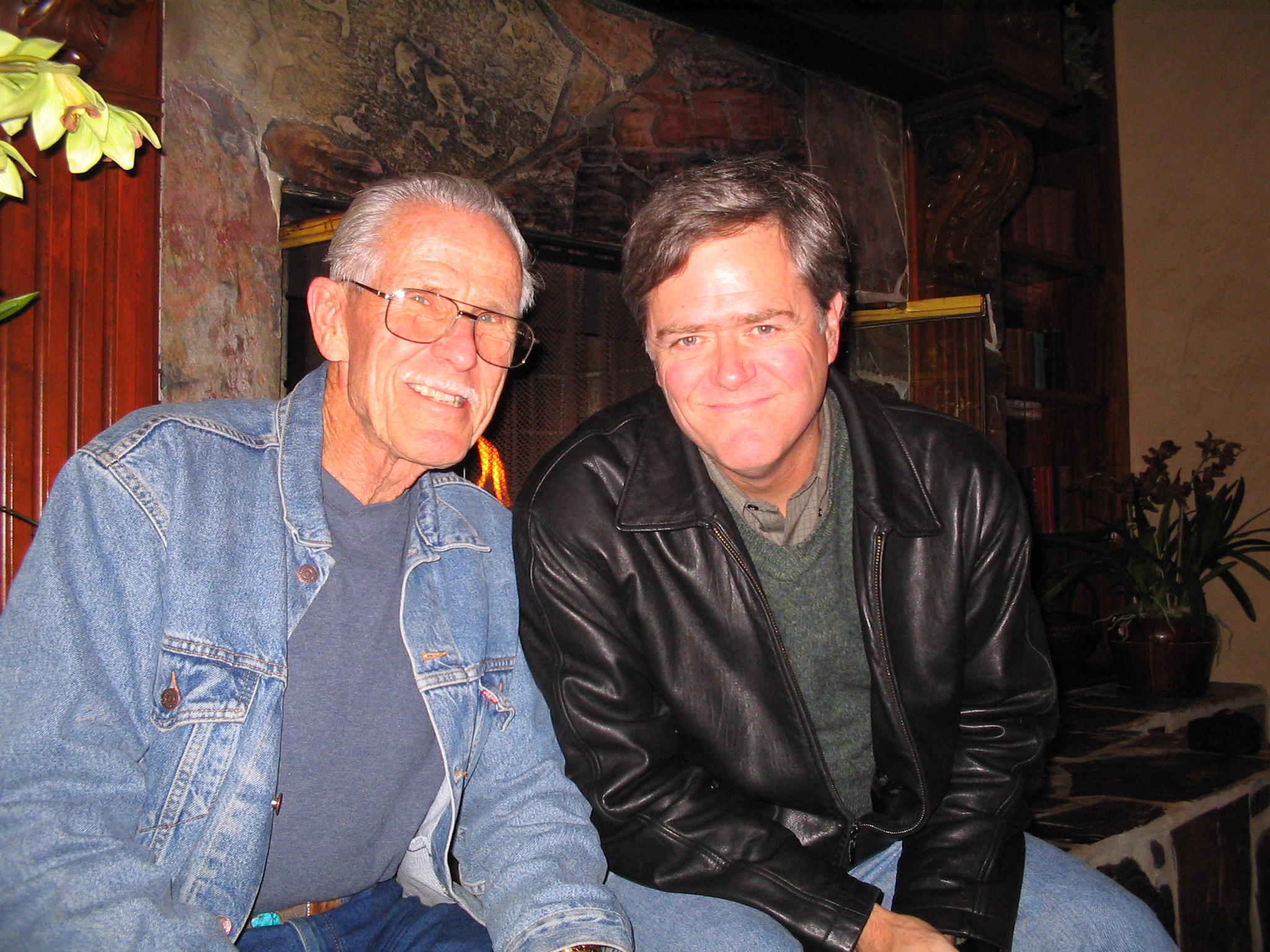
With Earl in San Francisco

With Carlton in Orange County

And I remain forever grateful for their examples, their influence, and their love … which I in turn have passed on to my own children … who will become parents before they know it.

My great kids Ryan and Sarah

Happy Father’s Day!