Feeds:
Posts
Comments

Christians Who Hate

Anyone who hates his brother is a murderer, and you know that no murderer has eternal life in him.  1 John 3:15

There are a lot of Christians who hate other Christians.

I can hear you asking, “Jim, are you sure about that?  Hate?”

Yes.  Hate.

There are Christians who hate certain politicians, like Barack Obama (for his politics) and Mitt Romney (for his faith).

There are Christians who hate institutions, like the government or the IRS or the DMV.

There are Christians who hate a parent, or a sibling, or an ex-spouse, or a turncoat friend.

There are even Christians who hate their pastor.

Several years ago, I was informed that a Christian leader did not like me.  I arranged a meeting with him and we had an awkward discussion.  Toward the end of our time, I asked him, “So what you’re saying is that you’ve hated me all this time?”

This individual admitted as much.

I have reason to believe that hatred went viral.  It certainly decimated our relationship.

I hate being hated.  And I hate hating others.  Richard Nixon once said that all great leaders are great haters, but I don’t know about that.

Let me make three quick observations about Christians and hatred:

First, it’s important to admit that we hate.  I once knew a Christian leader who I felt was angry with me.  Since I valued our relationship, I asked him, “Are you mad at me?”  He replied, “No, I’m mad at sin.”

But he was really angry with me – and I knew it.

But we Christians have a hard time admitting when we hate.  We excuse, rationalize, deny … and even lie to preserve our image as kind, gentle, loving believers.

However, our word selection, tone of voice, facial expressions, and body language give us away.

Say it slowly: “Right now, I hate __________” (a person).  Such an admission doesn’t mean you’re going to hell, but it might shock you into realizing that your soul is ill and needs divine healing.

However, what do we do?  We say, “I hate the lie Joe told about me” when the truth is that we hate Joe for lying about us.

I truly believe that if we Christians could admit that our hurt feelings have degenerated into hatred, we could make more progress in our spiritual lives.  Accumulated hatred becomes bitterness and slows our growth to a crawl.

Second, personal hatred easily becomes contagious.  I recently suffered from sinus problems.  When I went out with a friend for a meal, I greeted him but didn’t shake his hand because, I told him, I didn’t want to pass on any germs.

But our negative feelings about other believers do get passed on to our circle of influence.

There is a Christian author I greatly admire.  I’ve never met him or heard him speak in person, but his books have had a profound impact on my life.

But I have a friend who has spent time with this author, and my friend does not hold this author in high regard.  He has told me that the author’s personal conduct does not match the ideals found in his books.

What do I do with that information?  In my case, I chose to ignore it, and recently read another book by that same author.  But some Christians would allow my friend’s view to become their own without any firsthand experience.

I believe that a lot of conflicts in churches are ignited by personal hatred.  Much of the time, someone hates the pastor on a personal level.  Maybe he didn’t visit their child in the hospital, or they were offended by something he said in a sermon, or the pastor and a parishioner disagree about something … and the parishioner finds a way to turn their personal issue into something official.

The pastor is later charged with all kinds of offenses – and nobody ever discovers that the ensuing conflict really originated with one person’s hatred.

Finally, we need to confess our hatred to the Lord.  When I was nearing college graduation, I was leaving campus one day when a female student called out to me.  We had gone to the same church for a few years and were friends, although I sensed at one time that she wanted to be more than that.

Anyway, she had something to tell me: she had hated me for a long time (because I didn’t want to be more than friends) and wanted to ask my forgiveness.

(I guess a lot of people hate me that I don’t know about.  If you’re in that group, please keep it to yourself.  I would rather assume that you like me.)

I instantly forgave her – for which she was grateful – but can’t remember ever seeing her again.  I felt badly that she’d carried those feelings for so long.

But did I need to know how she felt, especially since we hadn’t had any contact in years?

Some would say yes, others would disagree.

But I do know this: when I hate someone – especially another believer – I need to confess those feelings to Jesus.  He promises to forgive me and free me from my hatred.

But many of us prefer to hold on to our feelings because they make us feel powerful … and self-righteous … and justified.

Let me quote from Don Henley in his brilliant song Heart of the Matter – a song that is thoroughly Christian lyrically:

There are people in your life who’ve come and gone

They let you down, you know they hurt your pride

You better put it all behind you, baby, ’cause life goes on

If you keep carryin’ that anger, it’ll eat you up inside …

That’s good theology … even from an Eagle who had rows with his bandmates.

Be honest.  It’s just you and God right now.

Who do you hate?

What are you going to do about it?

Listen to His Spirit … and lay the hatred aside.

You’ll feel so much better.
Can you remember the day when you first met a good friend?

I recall so many of those days.  Great memories!

But can you also remember the last time you ever saw those friends?  How it hurt to say goodbye?  How you weren’t sure you’d ever see them again?

I’m about to experience that feeling multiplied many times over.

Because for 40 years, books have been my friends.

My wife and I have been reviewing every possession we own to see if we want to (a) keep it, (b) sell it, (c) trash it, or (d) give it away.  I applied for an exemption for my books, but it was denied.

When we moved into our current home, I carefully went through every book I owned, placing the ones I value most on the bookshelves in my study.  Here’s a photo of 60% of them:

Books I'm Keeping

I have so many books that I buy very few anymore, although I do let myself be seduced on occasion.  If I can purchase a volume on Kindle for a lesser rate than a hard copy, I’ll do that.  There just isn’t space anymore for all my friends.

And they are my friends.  I can tell you when I first met most of them.

Some I inherited from my grandfather or father.

Some were purchased for me by my mother or wife or children.

Some were obtained through CBD – Christian Book Discounters, the mail-order group.

Some were bought at bookstores, although those are becoming increasingly extinct.

Some were given to me as gifts by people I treasure – and in most cases, I’m saving those, even if I never plan on using them again.

And some were purchased on Amazon, the website that has curtailed my bookstore visits by 78%.

Many people have asked me, “Jim, have you read all those books?”  My answer is always the same: “No, I’ve read many of them, but I’ve used all of them.”

Some books are signed by people like Nolan Ryan, Rod Carew, John Wooden, Barry Goldwater, Robert Novak, Josh McDowell,  and R. A. Torrey.  Those are definitely keepers.

But other books are dated.  I have a set of small paperbacks from 30 years ago on how to do church ministry.  I devoured those books at the time, but they’re practically worthless today – so maybe someone else can use them.

Then there are sets I acquired when I was in college, like William Hendriksen’s commentaries on the New Testament.  I read his entire commentary on Mark and used all the others, but I haven’t consulted them in years – so off they go.

I found a large bookstore not too far away that buys book collections.  They even come to your house to make you an offer.  How much do you think I can get for 17 boxes’ worth?

Departing Friends

There’s just something about books that I love: the typeset, the layout, sometimes even the smell … it’s all so inviting.

My friends have never rejected me, though they play hide’n’seek at times.  They’re just always there when I need them.

After looking at every one of my companions, I’ve decided to keep the rest of the books in these boxes:

Friends I'm Keeping - for Now

I promised my wife that I’d only keep enough books to fill one more bookshelf.  I get six shelves, she gets two – and one is for DVDs.  So I’m going to have to say goodbye to even more friends in the future.

It’s almost unbearable.

When I’m watching sports … when I’m ready to fall asleep … when I’m meeting with God … when I’m conducting research … when I need some friendly advice … when I just want to curl up on a rainy day … I reach out for a friend.

And my friends have never let me down.

Why Church Membership?

Why should anyone officially join a church anymore?

For years, I had a ready answer: to commit yourself to a specific group of believers at a specific time and place.

But I’ve changed my tune – and am willing to be shown the light.

I grew up in an era when pastors offered altar calls at the end of every service.  While we sang a hymn, the pastor would invite attendees to walk to the front of the church (“the altar”) which signified they were making a spiritual decision.

Sometimes if you walked forward during the first stanza, you were indicating you desired salvation.  Second stanza?  Baptism.  Third stanza?  Rededication.  Final stanza?  Church membership.

Choreography aside, membership was considered so important that (a) you made your desire for membership public, and (b) it became the culmination of the conversion-baptism-rededication sequence.

In one church, a man named Gary walked forward for salvation on Sunday morning.  He was baptized that night and immediately voted into membership.

We never saw him again.

The practice of “instant membership” is still followed in some churches.  I recently visited a church in my area where two women went forward after the sermon and were quickly voted into membership by the worshipers.  (I didn’t vote.)

Although some would disagree, “instant” membership seems like “cheap” membership to me – and cheap membership feels meaningless.

I know a pastor who leads a church without formal membership.  If someone desires membership, they fill out a card and are told, “Now you’re a member.”

This leads me to ask: where does the whole membership idea come from, anyway?

Does it come from Scripture?  I’ve searched the New Testament and can’t find “official membership” anywhere.  The word “member” is used in passages like Romans 12:4-5; 1 Corinthians 12:24; Ephesians 3:6; 4:25; 5:30 – but it metaphorically compares believers to parts of the body, not joining a local church.

So if the New Testament doesn’t command or emphasize official membership – and it doesn’t – then how essential is it for spiritual growth or serving Jesus?

Once upon a time, churches were divided into members and non-members.  If you weren’t a member, you didn’t feel that you belonged.  Some churches even practiced “closed communion” where only members could take the Lord’s Supper.

When you became a member, you were invited to the front of the worship center on a Sunday morning and given the right hand of fellowship by the pastor – an indication that you were now “official.”

And yes, people back then treated members differently than non-members.

Sadly, this kind of thinking still occurs.  I received a phone call several years ago from a man who was in the hospital and near death’s door.  He asked if I would come and pray for him.  I instantly agreed.  He told me that he’d called another minister in town who asked, “Are you a member of our church?”  When he said he wasn’t, the pastor declined to see him.

To me, that’s wrong.  I don’t see a member/non-member distinction in the New Testament.  If we are to pray for and love our enemies, as Jesus commanded, then certainly we are to do the same for non-members.

In fact, the trend for the past 30 years has been to assimilate unchurched people into church life – loving them unconditionally – so they do receive Christ eventually … whether or not they ever formally join the church.

Every church has non-members who attend regularly, serve willingly, and give generously.  And every church has members who attend sporadically, never serve, and rarely give.

Aren’t those in the first group acting more like members – and are more committed – than those in the second group?

In our haste to quanitfy everything, are we making distinctions that neither Jesus nor His apostles ever made?

What are the advantages of membership to a church?

*Bolster congregational statistics (“We have 300 members.”)

*Expect people to attend, serve, and give consistently

*Can discipline members (especially leaders) and hold them accountable

*Can remove the membership of troublemakers

What are the advantages to a member?

*Get to vote on a handful of issues (usually annually)

*Receive a membership certificate

*Receive a church constitution

*Feel like you really belong

When a person first joins a church, they are showered with attention.  But doesn’t that usually fade over time?

Maybe I’m blind, but it seems to me that membership confers few benefits but requires enormous responsibilities.  In fact, the church receives 90% of the benefits without offering much that is unique.

For example, in Ken Sande’s book The Peacemaker, he assumes that Christians in a local church will become members.  Why?  So that church leaders have leverage (“accountability”) when dealing with uncooperative individuals.

So does membership have an inherently strong control component built in?

I haven’t heard one word about membership at the church we’ve been attending the past 16 months.  The church is about three words: WIN, TRAIN, SEND.  More than 1,400 people have come to Christ already this year.

They’re much more missional than institutional.

In fact, I’ve observed that the more missional a church is, the less they emphasize membership, but the more institutional they are, the more they emphasize it.

In other words, if we can’t convert unbelievers into believers, then at least we can convert believers into members.

While I believe that church membership can be meaningful, we need to create a better rationale for the practice than “we’ve always done it that way” or “it means something to me” or “it signifies loyalty to my church.”

When I join Costco, I receive lots of benefits, like bulk packaging, cheap lunches, free samples, and great discounts.  I willingly pay my dues every June for those privileges.

But what do I get for joining a church that I don’t get if I don’t join?

I can still join in worship, hear sermons, sample refreshments, attend classes, join a small group, use my spiritual gifts, ask for prayer … and so much more.

Want to straighten me out?

Two years ago today, my world broke apart.

I attended a meeting and was blindsided by people with whom I had clashing agendas.

Over the ensuing weeks, I experienced the presence of evil like never before.  Diabolical spiritual forces were unleashed with the intent of destroying my family and the church I served.

Through much heartache, I eventually left that situation to preserve my soul, sanity, family – and the church I loved.

It has not been an easy journey, but my wife and I have survived.  We have been told it takes up to three years to heal from such an experience.  We trust that in time, we will thrive once more.

Several times each week, I read the thoughts of a famous British pastor who died in 1892 named Charles Spurgeon.  This is what I read today:

“When you wonder why you are being severely tested, remember that the reason does not lie so much with you but with those to whom God will make you useful.  You are being led along a rough road.  You are being tested and instructed in order to help those whom you will find in some of the earth’s dark regions.”

I believe that God is sovereign.  He can take our mistakes and sins – and those of others – and bring something positive from them, although we only sense chaos and confusion at the time.  As Joseph told his rascally brothers, “You intended to harm me, but God intended it for good to accomplish what is now being done, the saving of many lives” (Genesis 50:20).

Joseph was hated by his brothers, tossed into a pit, and sold into captivity.  His brothers lied to their father Jacob, claiming that Joseph had been killed.  But Joseph was very much alive, and God permitted him to be mistreated – and imprisoned – to save his family, the Egyptians, and everyone who visited Egypt for food.

Only he didn’t know it at the time.

Our pastor has just started a series on the life of Joseph, and I’ve been struck how much his situation parallels mine.

Back in 1997, I was the pastor of a church that experienced a traumatic event.  It wasn’t anybody’s fault – it just happened.  One day, while getting dressed for work, I broke into tears because I knew my time at that church was drawing to a close.

Even though I didn’t confide in anyone but my wife, I began to search for a new ministry.  I felt too weary to pastor again, even though several great opportunities came my way.

So I began to explore the possibility of working in the area of church conflict, specificially pastor-congregational issues.  One day, I made an appointment with a leading Christian conflict expert at his home.  He graciously gave me two hours of his time.

But I wasn’t yet ready experientially, emotionally, intellectually, or spiritually to do such a ministry – until that day two years ago.

I’ve spent the past two years getting ready.

Spurgeon again: “You are being trained as a hardy moutaineer to climb after the Lord’s sheep who are lost in the wild, craggy places.  You are being taught to find your way through the country of depression and despair in order to help lost pilgrims find their way to the celestial city.  They frequently fall into the marshy places of fear and doubt, and you will know how to bring them out, set their feet on the rock, and once again establish their goings.”

Even though my wife and I have endured unimaginable losses since that day two years ago, we have also learned unfathomable lessons we couldn’t have learned any other way.

We are both training for different careers now while trying to establish credentials.  While it’s not an easy process, we see the Lord’s hand at work.

To quote that great theologian Bono from U2’s song Mysterious Ways: “One day you’ll look back and you’ll see where you were held out by this love …”

I see it more clearly today than ever.

Because even when your world falls apart, there is Someone who can put you back together again.

May all praise and glory be His!

Being Real

Who were your heroes growing up?

I had so many.

In baseball, I loved Sandy Koufax, Brooks Robinson, and Willie Mays.

In football, it was Johnny Unitas and Lance Alworth.

And in basketball, it was Jerry West.  Number 44 of the Los Angeles Lakers.  Their All-Star guard who was nicknamed Mr. Clutch.

West could do anything on a basketball floor.

In 1969, a man from my church took my brother and me to 13 Laker games at The Forum, including all four games in the Finals against the hated Boston Celtics.

Jerry West scored 53 points in Game 1, and although plagued by a hamstring problem, he scored 42 in Game 7.  He was named the MVP of the Finals, the only player ever so named from a losing team.

When he came off the court after Game 7, the great John Havlicek of the Celtics told West, “I love you and I just hope you get a championship.  You deserve it as much as anyone who has ever played this game.”

The great Bill Russell – the second greatest player of all time – told West at a night held in his honor two years later, “If I could have one wish granted, it would be that you would always be happy.”

That’s how his opponents felt about the guy.

Last year, I worked my way through Roland Lazenby’s Jerry West: The Life and Legend of a Basketball Icon.

This past Tuesday, West by West: My Charmed, Tormented Life, his psychological autobiography, was released to the public.  I had to have it.

What a book!

It’s a glimpse into the mind and heart of a champion, but also an honest portrayal of why West is such a complex person.

West talks about the beatings he received from his father as a child – for no reason at all.  (West kept a shotgun under his bed and told his father that he’d use it if he had to.)

Because hanging around the house was so unpleasant, West found solace in a variety of solitary outdoor activities, including hiking, fishing – and shooting hoops.

Jerry West worshiped his older brother David.  David planned to study for the ministry and become “a man of God.”

But when David was killed in the Korean War, life in the West household changed forever.

Despite the heartaches, West eventually became one of the greatest athletes in West Virginia history.  He became a first-team All-American, won the gold medal in basketball (along with Oscar Robertson) in the 1960 Olympics in Rome, and went on to establish an incredible 14-year career in the National Basketball Association.

I got his autograph on several occasions.  He once appeared at the Broadway Department store near my home.  Hardly anybody showed up to meet him or obtain his signature (they weren’t worth much then) – so I got signed pictures for many of my friends.

When my wife was pregnant with our first child, we didn’t know what to name him if he was a boy.  (We didn’t want to know the sex.)  One month before his birth, I noticed in the LA Times that Jerry West had named his new son Ryan Andrew.

And that’s what we named our son.

West was so good that his silhouette is on the NBA Logo.  In Bill Simmons’ The Book of Basketball – published in 2009 – Simmons rates West the 8th greatest player of all-time, ahead of immortals like Oscar Robertson and Kobe Bryant.

Jerry West is now 73 years old.  He serves as a consultant with the Golden State Warriors, having left the Lakers after spending four decades with the organization.

And yet with all his accomplishments, West has never truly been happy.

He talks openly in the book about how much he hated losing to the Celtics (6 times in the Finals in the 1960s) and how that led to a divorce, how he’s never learned to swim, how he hates the limelight, how he’s spent years battling depression – and how tough it is being a perfectionist.

I always hoped that Jerry West was a Christ-follower, yet there isn’t any evidence to support my wish.

But I have to admire his honesty.

I’ve been seeing some TV commericals recently featuring happy people who finally say, “I’m So-and-So, and I’m a Mormon.”

Translation: if you become a Mormon, you can become happy like me.

(If I became a Mormon, I’d have to commit intellectual suicide, so that’s not an option.)

Mormons come off to me as image conscious.  In my opinion, they’re not very good at being real.

They’re too busy trying to be perfect.

We Christians are anything but perfect.  We not only have weaknesses, but we sin.  That’s why we need Jesus – and why only Jesus will do.

In fact, sometimes we struggle with sins for years.  And sometimes we struggle with our humanity, too – just like Jerry West.

I resonate with people who are honest, which is why I love West’s book.

I’m drawn to honest people, even if they’re deeply flawed.  It’s why I love the Psalms so much.

I can’t relate to seemingly perfect televangelists who cultivate an antiseptic image so they can keep the donations flowing.

But I definitely connect with people who are real.

Thank you, Jerry, for letting me know I’m not the only person who struggles with certain issues.

I just wish I knew more Christians who are like you.

Healing the Soul

What is the state of your soul today?

Most of us – including Christians – aren’t thinking too much about our souls.  We’re preoccupied with our bodies, emotions, and minds.

I typed the word “soul” into my iTunes search engine to see how the word is used in song/album titles.

The Beatles released an album called Rubber Soul.

Buffalo Springfield did “Mr. Soul.”

The Music Explosion sang “A Little Bit ‘O Soul.”

Sam and Dave did “Soul Man.”

But those are largely references to “soul music,” not the inner, invisible essence of a person.

Abba had a song called “Hole in Your Soul.”

Glenn Frey of the Eagles recorded “Soul Searchin’,” although he was referring to romantic love.

The Yardbirds did “Heart Full of Soul.”

Tracy Chapman performed, “All You Have is Your Soul.”  That’s getting closer.

Christian artist Carolyn Arends sang “I Am a Soul.”

And the Christian Irish band Iona once released a song called “Factory of Magnificent Souls.”

But the great hymns get it right, like “Lover of My Soul” and “Be Still My Soul” and “Arise, My Soul, Arise” and “It is Well with My Soul.”

The reason I bring this up is because of a church service my wife and I attended last month.

There’s a church betweeen our house and the 101 Freeway that I’ve passed scores of times.  One Sunday, we decided to check it out.

It turned out to be a very charismatic church, which made me somewhat uncomfortable.  There were aspects of the service that didn’t reach me … but some did.

One part of the service was reserved for those who needed prayer … for healing, for a job, for family problems … whatever.

If someone wanted prayer, they raised their hand where they were sitting, and others came around them, laid hands on them, and prayed for them.  That part of the service was very meaningful … and so rare in churches today.

At the end of the pastor’s Bible-based message, he admitted that many years ago, he was forced to leave the mission field because of depression.  He talked about his struggles to overcome his pain and how he needed others to help him climb out of his hole.

The service lasted nearly two hours.  Some of it wasn’t my style, but when we left, I told my wife, “That service was about healing people’s souls.”

And it made me wonder: how much emphasis are churches putting on the soul anymore?

David said of the Lord, “He restores my soul” (Psalm 23:2).

The Sons of Korah sang, “As the deer pants for streams of water, so my soul pants for you, O God” (Psalm 42:1).

That same psalm ends with this question: “Why are you downcast, O my soul?”

David wrote, “Bless the Lord, O my soul … praise the Lord, O my soul …” in Psalm 103:1-2.

Jesus asked, “What good is it for a man to gain the whole world, yet forfeit his soul?  Or what can a man give in exchange for his soul?”  (Mark 8:36-37)

And He reminds all of us that the greatest commandment (Deuteronomy 6:4-6) is to “love the Lord your God with all your heart and with all your soul and with all your mind” (Matthew 22:37).

Souls aren’t just for Sundays.

We Christians need to take care of our bodies.

We need to understand and control our emotions.

We need to stimulate our thinking through reading and sermons and discussions.

And churches should be wholistic in their approach.

But most of all, we need to specialize in healing souls.

People can go to fitness centers and health food stores to build up their bodies.

They can visit a psychologist or psychiatrist to address their emotions.

They can enroll in a college course or read a book to feed their minds.

But only a local church can really address the health of the human soul.

How do you think churches are doing at that?  How can they improve?

What is the state of your soul today?

Is there anyone in your life right now with whom you’re experiencing conflict?

A neighbor?  A brother?  A co-worker?  A fellow believer?  A wife?

Peacemaker Ministries was founded 29 years ago to help Christians deal with the conflicts in their lives.  In fact, Peacemakers is one of the few organizations around that is dedicated to helping believers deal with conflict.

You can read more about the organization’s history here:

http://www.peacemaker.net/site/c.aqKFLTOBIpH/b.958339/k.4C8D/Mission_History_and_Organizational_Structure.htm

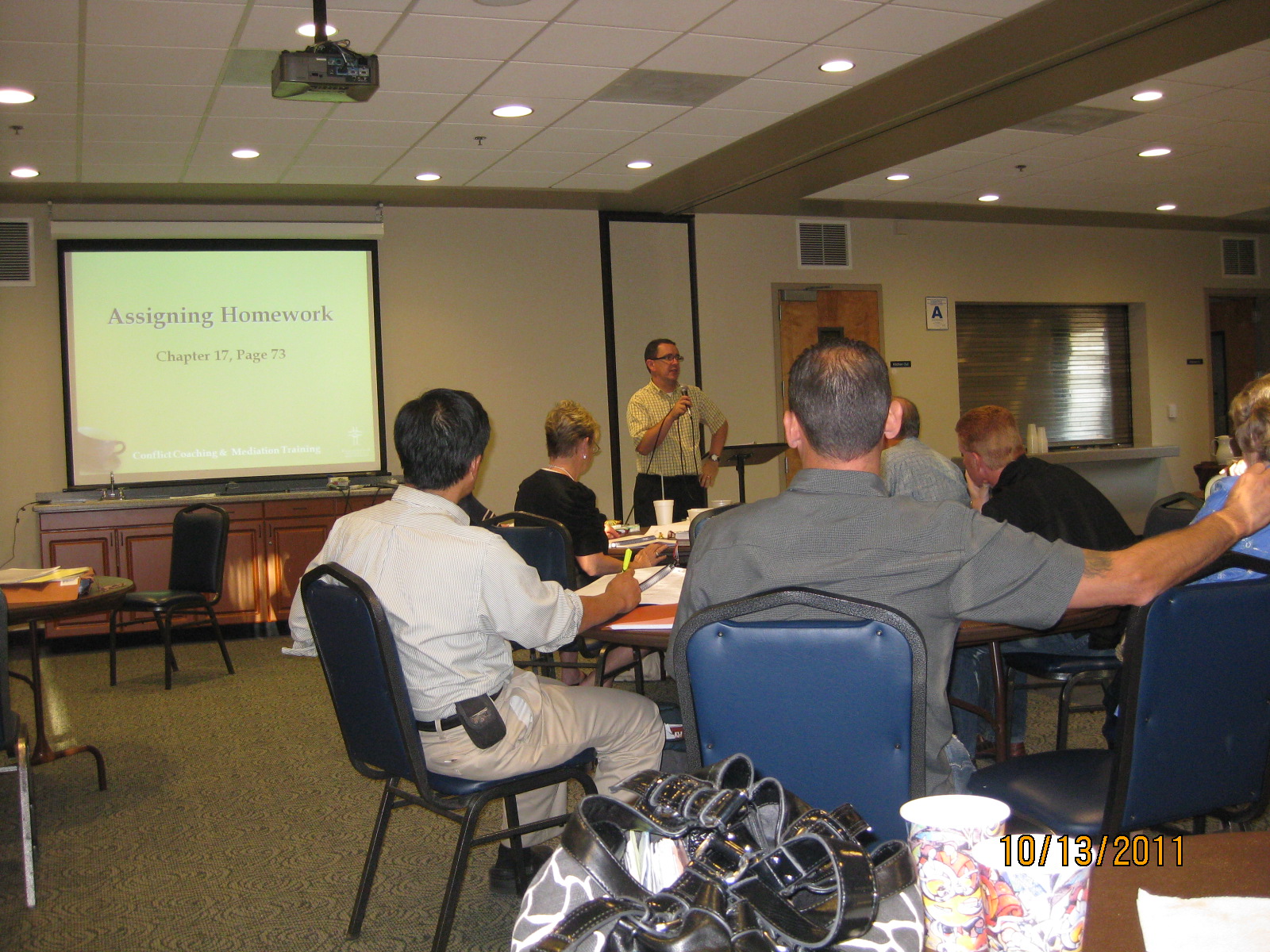
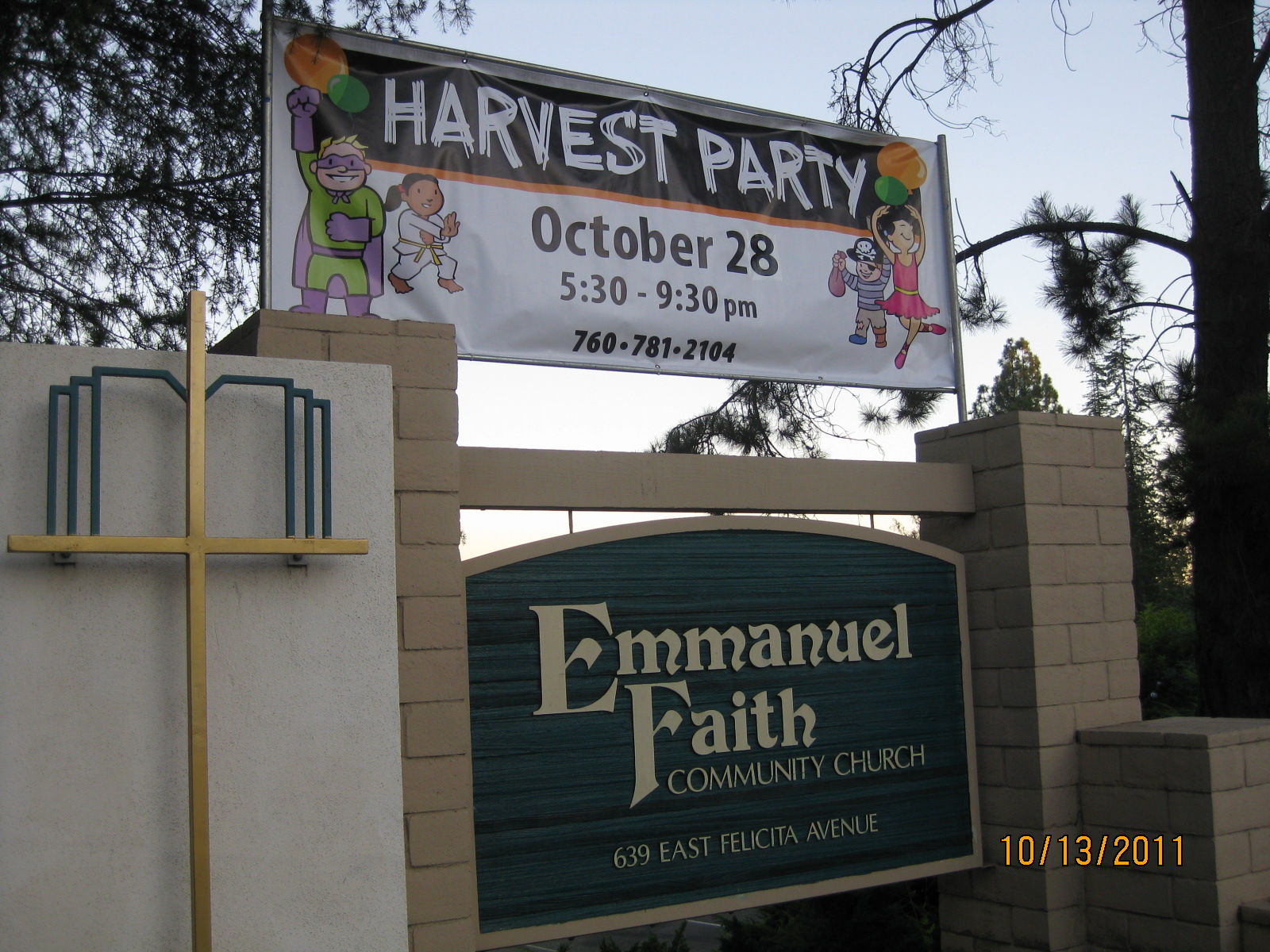
Last Thursday, I attended Peacemakers’ all-day Conflict Coaching event in Escondido, California.  The course was held at Emmanuel Faith Community Church.  My wife attended the church as a little girl.

Emmanuel Faith Sign

I spent a lot of time in preparation for the seminar, reading Ken Sande’s book The Peacemaker and engaging in four hours of prework beforehand.

We had two instructors, one an attorney (whose niece was on the TV show The Bachelor) while the other is a staff member from Peacemakers.

Instructor from Peacemaker Ministries

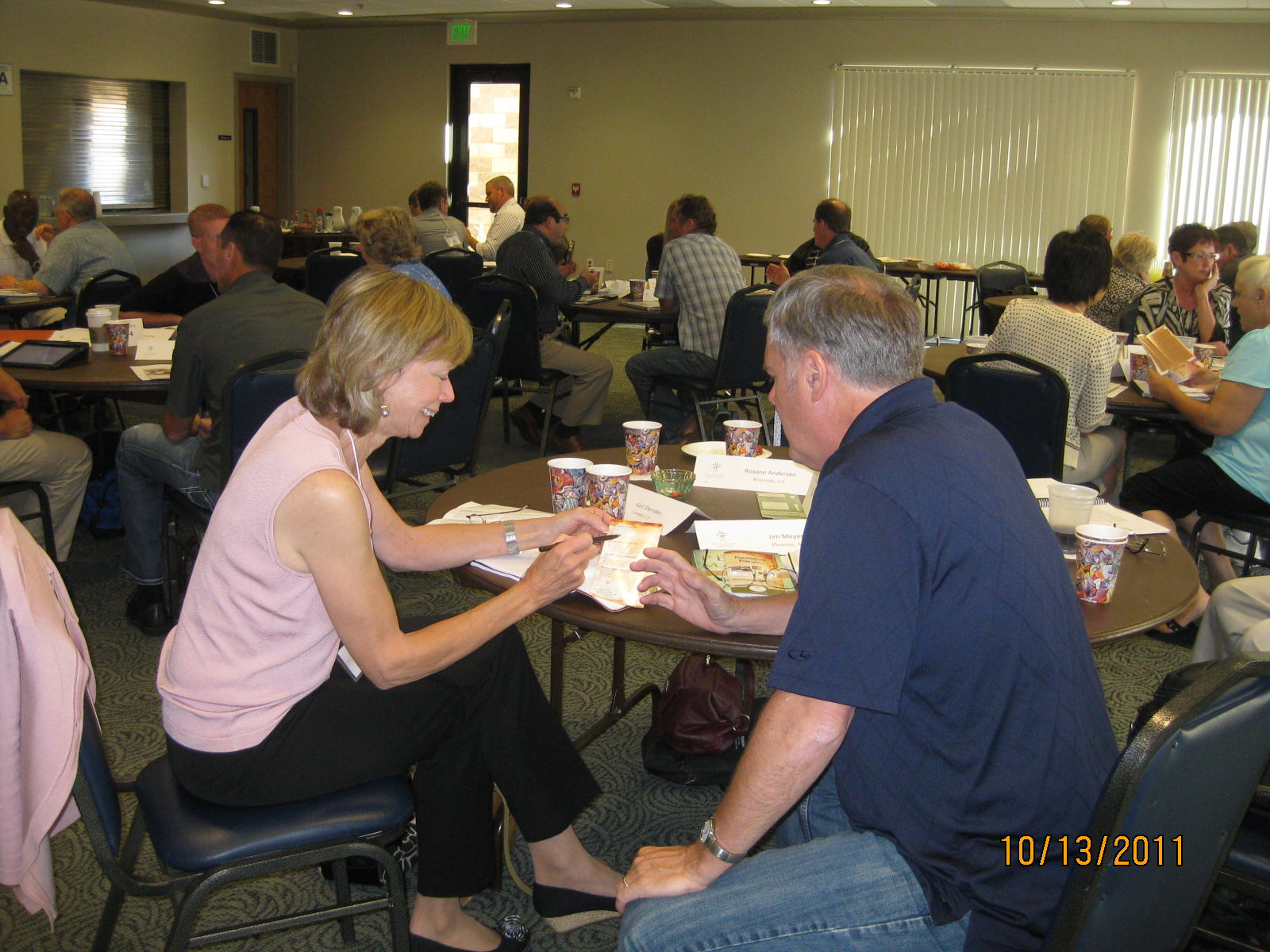
Much of the seminar was devoted to roleplaying.  We participants were given a scenario involving a dispute between two individuals.  We watched our instructors engage in role play, and then we were assigned a partner and practiced using biblical principles for peacemaking at our tables.

Engaging in Role Play

When each role play was over, we critiqued ourselves and then received a critique from our partner.  Personal involvement made the time fly by.

My preparation and attendance at the seminar lead me to four conclusions about conflict:

First, almost all conflict begins with interpersonal tension.  Family squabbles usually start with a rift between two people.  Church conflicts easily proceed from personal to official gripes.  Resolve a dispute with a temporary opponent and the conflict vanishes.  Fail to resolve the dispute and the conflict grows – and your opponent can become permanent.

Second, Christians need to take the initiative in resolving disputes.  Most of us shy away from conflict.  When I’m channel-surfing, if I come across two politicians arguing, I almost always change the channel.  Part of the reason that I’ve pursued conflict studies is because I’m tempted to avoid conflict at all costs.

But as I learned at the Peacemakers’ class, avoiding conflict is an escape mechanism that usually makes conflict worse.

Ken Sande and his organization have put together a way of visualizing possible solutions to conflict in the form of a diagram that summarizes our options when we’re in conflict.  This diagram is called “The Slippery Slope of Conflict.”  I encourage you to take a moment and check it out:

http://www.peacemaker.net/site/c.aqKFLTOBIpH/b.958151/k.5236/The_Slippery_Slope_of_Conflict.htm

I found their Peacemaker Pamphlet to be of great value in summarizing biblical values of peacemaking.  The pamphlet includes the “Slippery Slope” diagram:

http://www.peacemaker.net/site/apps/ka/ec/product.asp?c=aqKFLTOBIpH&b=6598003&en=jkKOK0ONIfIMJ0NSLmLOK2PRLqK1IcOPKeI0JaOSLuIbF&ProductID=923407

I plan to buy a bunch of these pamphlets and use them in my ministry.

Third, peacemaking starts with a pure heart.  While I appreciate the techniques that are advocated by Peacemakers, they don’t work unless a person’s spirit is right before God.  As Colossians 3:15 puts it, “Let the peace of Christ rule in your hearts, since as members of one body you were called to peace.”  However, once a person has practiced these techniques, he or she gains a greater level of confidence in addressing conflict situations.

Finally, every church should put together a Peacemaking Team.  If God ever called me back into pastoral ministry, I would make it a priority to identify a group of at least 3 individuals who could attend Peacemakers’ training and form a Peacemaking Team inside the church.

When I was a pastor, and two people were engaged in a dispute, I encouraged them to work matters out together.  I tried to coach them but tended to abdicate responsibility after that.

But there were times when I could have done more coaching than I did.

In addition, a Peacemaking Team can advise the pastor/staff/board to use biblical principles of peacemaking whenever a major conflict is brewing in a congregation.

Now that I’ve attended this seminar, I know better how to coach others toward conflict resolution in a biblical manner.

Since The Peacemaker book deals mostly with interpersonal conflict, I didn’t use it for my doctrinal studies, which involved antagonism in churches.  In fact, Sande’s book fails to mention much at all about major church conflict, especially conflict that involves the pastor – my primary area of interest.

But that’s not where most people live.  Instead, people want to know how to settle disputes with a spouse, a supervisor, or a sibling.

For those kinds of issues, I strongly recommend the resources and training provided by Peacemaker Ministries.

If you’re interested, please check out their website for training opportunities near you:

http://www.peacemaker.net/site/c.aqKFLTOBIpH/b.3041587/k.C206/Foundational_Skills_Training.htm

You Lost Me

How concerned are you that churches in our country are not reaching young adults?

Last Saturday night, my wife and I attended worship at our home church.  The service theme was, “What is the point of church?”

Our pastor interviewed David Kinnaman, president of the Barna Group, a Christian research organization located in Ventura, California.  Kinnaman’s new book, You Lost Me, was published by Baker Books on October 1.

Here is a link to the book’s Amazon page if you’d like to order it:

http://www.amazon.com/You-Lost-Christians-Church-Rethinking/dp/0801013143/ref=sr_1_1?s=books&ie=UTF8&qid=1318269304&sr=1-1

The theme of our pastor’s questions and Kinnaman’s remarks was that the church in America is losing those who are 18 to 30 years of age.

He gave six reasons why this is the case:

First, the church is overprotective.  You’ve heard of “helicopter parents” who are always hovering over their children?  Kinnaman believes that we have too many “helicopter churches” as well.  He says that young adults want to take risks but that churches tend to be risk-averse.

I saw this in my last church when we tried to take mission trips.  Yes, it can be dangerous to travel to Africa and Eastern Europe, but if God is leading us there, can’t we count on His protection?

Some churches have also become overprotective in ministry because they listen more to attorneys than to God.

Second, the church is shallow.  Young adults claim that churches are boring and that they don’t experience God when they attend.  There’s nothing vibrant happening.  Our pastor mentioned that when he meets with key leaders to plan weekend services, they try to build two or three “Ministry Moments” into the service so people can connect with God.

Too many churches are shallow because pastors have stopped teaching through biblical passages during worship.  The pastor comes to a scriptural text or a topic with preconceived points he wants to make and sidesteps around difficult issues.  I’m always playing mental chess with pastors, asking myself, “But what about this issue?”  In my estimation, only 10% of all pastors in our day are dealing with tough texts or hard issues.  We’ve become a mile wide and an inch deep.

Third, the church is antiscience.  Kinnaman noted that more than half of all Christians are involved in technology, engineering, or health care – fields that all require a scientific bent – but that churches are either silent or antagonistic toward these areas.  He also mentioned how anti-intellectual many Christians are today.

Science was never my best topic, so whenever I discussed it while teaching, I quoted from acknowledged experts.  But if you have a brain, most churches today aren’t going to challenge your thinking too much.  Paul said it best in 1 Corinthians 14:20: “Brothers, stop thinking like children.  In regard to evil be infants, but in your thinking be adults.”  We need more churches that are both intellectually and spiritually credible.

Fourth, the church is repressive.  Young people believe this is especially true when it comes to sexuality.  Kinnaman observed that young adults value their relationships more than anything else, and that they tend to derive morality from their friends, not the church.  When the two clash … they lean toward their friends … because if they side with the church, they may lose their friends.  Kinnaman also noted that although Christians were once viewed as the mainstream in our country, now we’re considered to be the fringe.  He also stated that there are 23 million Christians in America who no longer attend church.

This is a tough one.  While I have always valued friends, I was taught to value following Jesus and standing alone even more.  If the two clashed, I went with Jesus.  Today, when the two clash, young adults are following their friends.

Fifth, the church is exclusive.  Kinnaman noted that people in our country have become skeptical about everything, especially authority structure.  We see this in the lack of confidence that people exhibit in government, academia, business, and the press – and unfortunately, churches are not immune from such skepticism.  And our belief that Jesus is “the way, the truth, and the life” doesn’t mesh with the way most people think today.  It’s too narrow.

If I could pastor again, I would reserve 10-15 minutes at the end of each message for people to ask questions and challenge what I said.  When I visit churches today, if the pastor says something that I don’t agree with, there is no way for me to ask him for clarification or for me to express a viewpoint.  (If I email him, I almost never receive an answer.)  Even in university settings, students are able to ask questions of a professor, but we don’t allow that in our churches.  What are we afraid of?  (Probably missing the kickoff at 1:15.)

Finally, the church is doubtless.  The church feels unfriendly for those who doubt.  Kinnaman says that people do not feel comfortable expressing their mental reservations or emotional issues in a church setting.

I probably identified with this issue the most.  When you’re in pain, and you take a risk and share your feelings with other Christians, the way they respond indicates whether you’ll talk to them again or not.  If they respond with a monologue or condemnation, you’ll go elsewhere to share.  But if they respond with genuine understanding, you can receive real help.

Our pastor ended the session by encouraging our church to be real, relevant, and relational.  (I might add that we need to be rational as well.)

How do you react to these six observations by David Kinnaman?  I’d love to hear your ideas.

What is the most exciting endeavor you’ve ever been involved with as a Christian?

Here’s my Top 5 list:

Number 5: Worshiping God where He’s clearly present.  I remember a midweek service in Santa Clara in the mid-1990s.  We sang worship songs from the depths of our being.  We sang “How Beautiful” before communion – and then we feasted on Jesus during communion.  There’s nothing in the world like worshiping God with your spiritual brothers and sisters when He’s really there.

Know anywhere where you can experience that kind of worship?

Number 4: Seeing a friend come to Christ.  When I was 17, I led a friend named John to the Lord.  We went to a nearby school, where we hit baseballs and threw a football around.  I then told him about Jesus, and John received Him – and 40 years later, he’s still following the Lord.  It’s mindboggling to realize that someone is going to spend eternity with God because the Lord chose to use you.

Know anyone who needs the Lord?  When is the last time you talked with them about Him?

Number 3: Going on a mission trip.  I’ve only been on five – three to northeastern Arizona to minister to Navajo children, and two to the Eastern European country of Moldova.  But a mission trip forces you to call together all you are and know about Jesus.  You are totally dependent upon Him for everything: safe travel, eating food, sleeping accommodations, primitive transportation, language barriers, sharing testimonies … everything.

The Mormons require two years of missionary service for young adults.  I think every Christian should spend at least two weeks sharing Christ in another culture.  Any amens?

Know any church that’s going on a mission trip soon?  Ours is going to Ireland soon … and I’m tempted …

Number 2: Using your spiritual gifts.  When you’re doing what God has called you to do – whether that’s teaching kids, or serving refreshments, or leading a small group, or singing on a worship team – the Lord gives you a sense of contentedness and completeness you can’t find anywhere else.

Every time I got up to preach, I felt like I was doing what God made me to do.

Know what God has called you to do?  Know anywhere you can do it?

Number 1: Starting a new church.  Believe me: there is nothing more exciting, fun, and dangerous than starting a new church!  It’s breathtaking.

When most of us visit a church, it’s already up and going.  The buildings are there, the activities are set, and the staff is in place.  But when you get in on the ground floor … and your ideas can mold a church’s future … it’s awesome!

I’ve only done this once.  My church did it the hard way: we sold our property and used the proceeds to begin a new church with a new name in a new location to reach a new demographic.

While we worked from an overall model, we had no template for much of what we did.  With God’s help, we made it up as we went along.  Talk about revitalizing your spiritual life!

One Thursday night, my brother John came to town.  We stopped by the warehouse where our church met.  More than 25 people were rehearsing for that Sunday’s service.  In one room, someone was working with a computer for a video presentation.  There were people in the sound booth and high up in the video booth.  There was a band on the stage with several vocalists waiting their turn to sing.  There was a drama group rehearsing in another room, waiting to take the stage.

The camraderie was truly amazing.  It was spine-tingling to be a part of it.  And from time-to-time, I hear from people who were in that church, and they tell me that was the best church experience they ever had.

If you hear of a new church starting somewhere near you, see if you can become part of the core group.  It will revitalize you!

If your spiritual life needs some shaking up, try one or more of the activities I’ve mentioned above.

Got one in mind?

I received very good news today – news that I did not expect.

More than a year ago, I visited two attorneys in nearby Tempe who had been recommended to me by a Christian leader.  I needed to obtain 501(c)(3) status with the IRS so that donations to my non-profit ministry could be tax-deductible.

These attorneys told me that it would take 6-8 months for the process to be completed, and that the IRS was horrible to deal with.  They said that if I hired them, I’d have to fill out a bunch of paperwork.  Then we’d send it to them, they’d send it back with questions, then we’d give them more information, and on and on.

And on top of that, the whole process would cost several thousand dollars.

These guys really scared me off.  It sounded like dealing with the IRS was like dealing with the devil.  (You know, the Infernal Revenue Service.)

Then last fall, my wife and I attended a retreat for Christian leaders who work with wounded pastors and their wives.  We attended a seminar where the leader told us that he saved money in obtaining his organization’s 501(c)(3) status by doing all the paperwork himself – but it took many months for his group to be granted tax-exempt status.  (As I recall, it took 8 months.)

This whole scenario was a bit frightening to me, I must confess.  While I wanted to get the paperwork done quickly, I also wanted to get it done right.

Surprisingly, I was able to obtain recognition from my state to operate a non-profit ministry within their boundaries, and I was able to do it without paying anyone else to help me.

But I still had that 501(c)(3) thing hanging over my head.

Finally, I prayed over matters, went online, and found a group in another state that claimed they would obtain the tax-exempt status for a certain fee – one I felt was very reasonable.

I contacted them, sent them my governing documents, answered a few questions on the phone – and then waited.  Several weeks later, they sent me my application to the IRS, asking me just to sign the documents and include a check to Uncle Sam.

And they told me that when the IRS wrote me with questions, my job was to route the questions back to my advocates, and they would take care of matters.

This morning, my advocates informed me that Restoring Kingdom Builders has officially received 501(c)(3) tax-exempt status with the IRS – and the IRS never asked me a single additional question.

And the whole process took less than three months.

This is the final legal step in setting up our ministry – and I’m grateful to God that it’s over!

How many times do we believe that God is calling us to do something, but we’re too afraid to do it?

There are people that I know and love who think I’m crazy to be doing this ministry.  They think I should be doing something else – something more conventional that provides a predictable income.

Maybe they’re right.

But for years, God has been tugging on my heart to be involved in preventing pastoral terminations – and the need is great.

My blog article, “If You Must Terminate a Pastor,” has been viewed nearly three times more than anything else I’ve written.  If you enter “terminate a pastor” in a search engine, my article usually comes up first or second.

There is a great need in Christendom for pastor-church conflicts to be handled in a more biblical and healthy way.

I want to learn, and teach, and consult, and coach, and write, and speak, and make a difference in this field.

Did I ever think I was going to do this?  No, I assumed I would retire as a pastor – and maybe die in the pulpit.  (From a heart attack, not a bullet.)

But God has other plans, and I’m doing my best to walk the path He has for me.

If He clearly leads me to do something else, I will gladly do what He says.

But until then, I am moving down the road at a steady pace.

Thanks for reading my little articles and for your prayers.  They are greatly needed.

And thanks for infusing courage into me when I’ve felt discouraged.  We all need en-courage-ment.

And may I encourage you – don’t be afraid to follow God’s direction, even if you’re afraid.

Because God is bigger than even the IRS.