Feeds:
Posts
Comments

Archive for the ‘Forgiveness and Reconciliation among Christians’ Category

Anyone who hates his brother is a murderer, and you know that no murderer has eternal life in him.  1 John 3:15

There are a lot of Christians who hate other Christians.

I can hear you asking, “Jim, are you sure about that?  Hate?”

Yes.  Hate.

There are Christians who hate certain politicians, like Barack Obama (for his politics) and Mitt Romney (for his faith).

There are Christians who hate institutions, like the government or the IRS or the DMV.

There are Christians who hate a parent, or a sibling, or an ex-spouse, or a turncoat friend.

There are even Christians who hate their pastor.

Several years ago, I was informed that a Christian leader did not like me.  I arranged a meeting with him and we had an awkward discussion.  Toward the end of our time, I asked him, “So what you’re saying is that you’ve hated me all this time?”

This individual admitted as much.

I have reason to believe that hatred went viral.  It certainly decimated our relationship.

I hate being hated.  And I hate hating others.  Richard Nixon once said that all great leaders are great haters, but I don’t know about that.

Let me make three quick observations about Christians and hatred:

First, it’s important to admit that we hate.  I once knew a Christian leader who I felt was angry with me.  Since I valued our relationship, I asked him, “Are you mad at me?”  He replied, “No, I’m mad at sin.”

But he was really angry with me – and I knew it.

But we Christians have a hard time admitting when we hate.  We excuse, rationalize, deny … and even lie to preserve our image as kind, gentle, loving believers.

However, our word selection, tone of voice, facial expressions, and body language give us away.

Say it slowly: “Right now, I hate __________” (a person).  Such an admission doesn’t mean you’re going to hell, but it might shock you into realizing that your soul is ill and needs divine healing.

However, what do we do?  We say, “I hate the lie Joe told about me” when the truth is that we hate Joe for lying about us.

I truly believe that if we Christians could admit that our hurt feelings have degenerated into hatred, we could make more progress in our spiritual lives.  Accumulated hatred becomes bitterness and slows our growth to a crawl.

Second, personal hatred easily becomes contagious.  I recently suffered from sinus problems.  When I went out with a friend for a meal, I greeted him but didn’t shake his hand because, I told him, I didn’t want to pass on any germs.

But our negative feelings about other believers do get passed on to our circle of influence.

There is a Christian author I greatly admire.  I’ve never met him or heard him speak in person, but his books have had a profound impact on my life.

But I have a friend who has spent time with this author, and my friend does not hold this author in high regard.  He has told me that the author’s personal conduct does not match the ideals found in his books.

What do I do with that information?  In my case, I chose to ignore it, and recently read another book by that same author.  But some Christians would allow my friend’s view to become their own without any firsthand experience.

I believe that a lot of conflicts in churches are ignited by personal hatred.  Much of the time, someone hates the pastor on a personal level.  Maybe he didn’t visit their child in the hospital, or they were offended by something he said in a sermon, or the pastor and a parishioner disagree about something … and the parishioner finds a way to turn their personal issue into something official.

The pastor is later charged with all kinds of offenses – and nobody ever discovers that the ensuing conflict really originated with one person’s hatred.

Finally, we need to confess our hatred to the Lord.  When I was nearing college graduation, I was leaving campus one day when a female student called out to me.  We had gone to the same church for a few years and were friends, although I sensed at one time that she wanted to be more than that.

Anyway, she had something to tell me: she had hated me for a long time (because I didn’t want to be more than friends) and wanted to ask my forgiveness.

(I guess a lot of people hate me that I don’t know about.  If you’re in that group, please keep it to yourself.  I would rather assume that you like me.)

I instantly forgave her – for which she was grateful – but can’t remember ever seeing her again.  I felt badly that she’d carried those feelings for so long.

But did I need to know how she felt, especially since we hadn’t had any contact in years?

Some would say yes, others would disagree.

But I do know this: when I hate someone – especially another believer – I need to confess those feelings to Jesus.  He promises to forgive me and free me from my hatred.

But many of us prefer to hold on to our feelings because they make us feel powerful … and self-righteous … and justified.

Let me quote from Don Henley in his brilliant song Heart of the Matter – a song that is thoroughly Christian lyrically:

There are people in your life who’ve come and gone

They let you down, you know they hurt your pride

You better put it all behind you, baby, ’cause life goes on

If you keep carryin’ that anger, it’ll eat you up inside …

That’s good theology … even from an Eagle who had rows with his bandmates.

Be honest.  It’s just you and God right now.

Who do you hate?

What are you going to do about it?

Listen to His Spirit … and lay the hatred aside.

You’ll feel so much better.

Read Full Post »

Is there anyone in your life right now with whom you’re experiencing conflict?

A neighbor?  A brother?  A co-worker?  A fellow believer?  A wife?

Peacemaker Ministries was founded 29 years ago to help Christians deal with the conflicts in their lives.  In fact, Peacemakers is one of the few organizations around that is dedicated to helping believers deal with conflict.

You can read more about the organization’s history here:

http://www.peacemaker.net/site/c.aqKFLTOBIpH/b.958339/k.4C8D/Mission_History_and_Organizational_Structure.htm

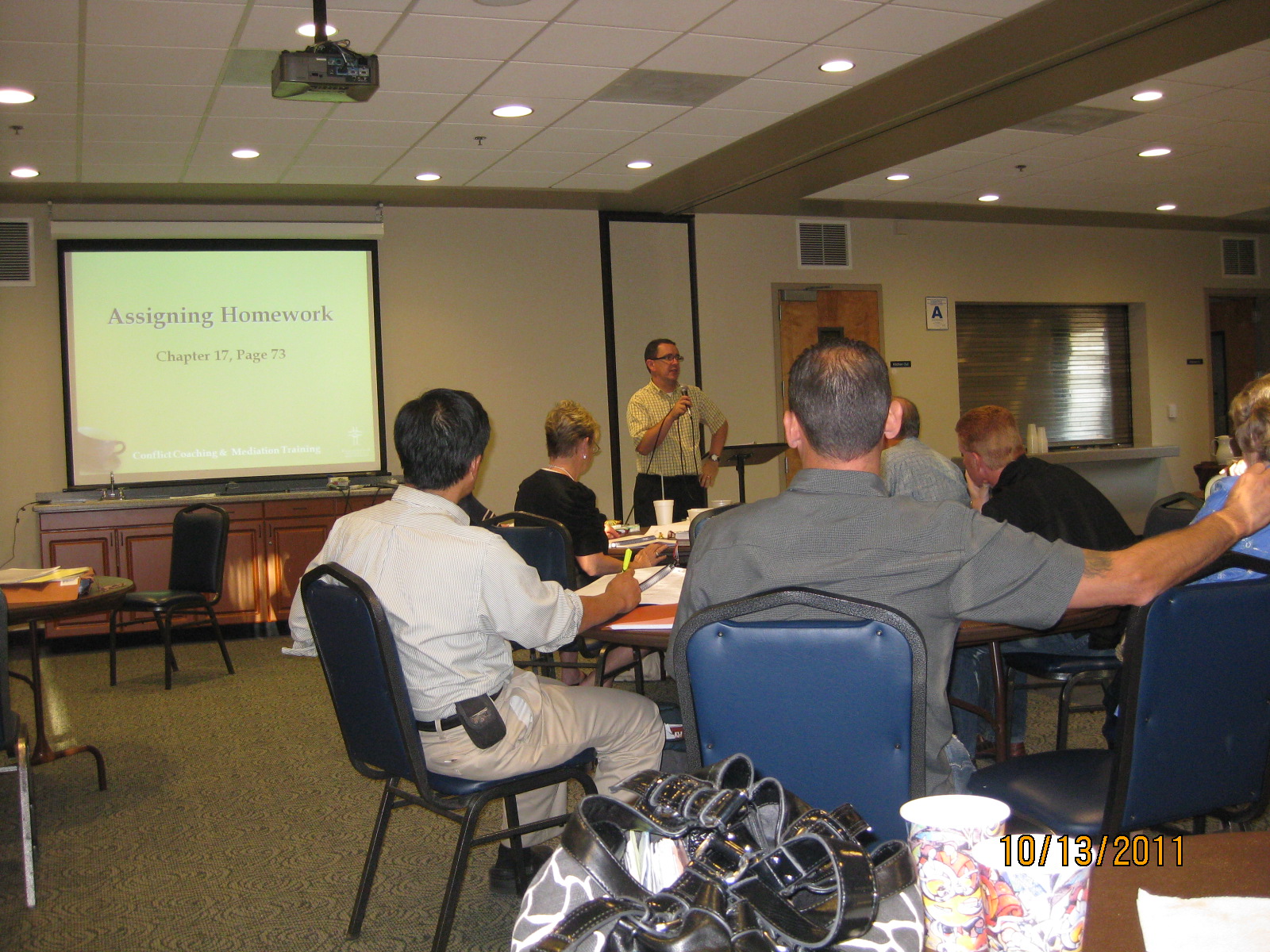
Last Thursday, I attended Peacemakers’ all-day Conflict Coaching event in Escondido, California.  The course was held at Emmanuel Faith Community Church.  My wife attended the church as a little girl.

Emmanuel Faith Sign

I spent a lot of time in preparation for the seminar, reading Ken Sande’s book The Peacemaker and engaging in four hours of prework beforehand.

We had two instructors, one an attorney (whose niece was on the TV show The Bachelor) while the other is a staff member from Peacemakers.

Instructor from Peacemaker Ministries

Much of the seminar was devoted to roleplaying.  We participants were given a scenario involving a dispute between two individuals.  We watched our instructors engage in role play, and then we were assigned a partner and practiced using biblical principles for peacemaking at our tables.

Engaging in Role Play

When each role play was over, we critiqued ourselves and then received a critique from our partner.  Personal involvement made the time fly by.

My preparation and attendance at the seminar lead me to four conclusions about conflict:

First, almost all conflict begins with interpersonal tension.  Family squabbles usually start with a rift between two people.  Church conflicts easily proceed from personal to official gripes.  Resolve a dispute with a temporary opponent and the conflict vanishes.  Fail to resolve the dispute and the conflict grows – and your opponent can become permanent.

Second, Christians need to take the initiative in resolving disputes.  Most of us shy away from conflict.  When I’m channel-surfing, if I come across two politicians arguing, I almost always change the channel.  Part of the reason that I’ve pursued conflict studies is because I’m tempted to avoid conflict at all costs.

But as I learned at the Peacemakers’ class, avoiding conflict is an escape mechanism that usually makes conflict worse.

Ken Sande and his organization have put together a way of visualizing possible solutions to conflict in the form of a diagram that summarizes our options when we’re in conflict.  This diagram is called “The Slippery Slope of Conflict.”  I encourage you to take a moment and check it out:

http://www.peacemaker.net/site/c.aqKFLTOBIpH/b.958151/k.5236/The_Slippery_Slope_of_Conflict.htm

I found their Peacemaker Pamphlet to be of great value in summarizing biblical values of peacemaking.  The pamphlet includes the “Slippery Slope” diagram:

http://www.peacemaker.net/site/apps/ka/ec/product.asp?c=aqKFLTOBIpH&b=6598003&en=jkKOK0ONIfIMJ0NSLmLOK2PRLqK1IcOPKeI0JaOSLuIbF&ProductID=923407

I plan to buy a bunch of these pamphlets and use them in my ministry.

Third, peacemaking starts with a pure heart.  While I appreciate the techniques that are advocated by Peacemakers, they don’t work unless a person’s spirit is right before God.  As Colossians 3:15 puts it, “Let the peace of Christ rule in your hearts, since as members of one body you were called to peace.”  However, once a person has practiced these techniques, he or she gains a greater level of confidence in addressing conflict situations.

Finally, every church should put together a Peacemaking Team.  If God ever called me back into pastoral ministry, I would make it a priority to identify a group of at least 3 individuals who could attend Peacemakers’ training and form a Peacemaking Team inside the church.

When I was a pastor, and two people were engaged in a dispute, I encouraged them to work matters out together.  I tried to coach them but tended to abdicate responsibility after that.

But there were times when I could have done more coaching than I did.

In addition, a Peacemaking Team can advise the pastor/staff/board to use biblical principles of peacemaking whenever a major conflict is brewing in a congregation.

Now that I’ve attended this seminar, I know better how to coach others toward conflict resolution in a biblical manner.

Since The Peacemaker book deals mostly with interpersonal conflict, I didn’t use it for my doctrinal studies, which involved antagonism in churches.  In fact, Sande’s book fails to mention much at all about major church conflict, especially conflict that involves the pastor – my primary area of interest.

But that’s not where most people live.  Instead, people want to know how to settle disputes with a spouse, a supervisor, or a sibling.

For those kinds of issues, I strongly recommend the resources and training provided by Peacemaker Ministries.

If you’re interested, please check out their website for training opportunities near you:

http://www.peacemaker.net/site/c.aqKFLTOBIpH/b.3041587/k.C206/Foundational_Skills_Training.htm

Read Full Post »

You win a contest at your church and become Pastor For A Day.  This means you get to preach a sermon on an upcoming Sunday.  Which topic would you choose?  (Just humor me.)

Let’s say you decided to talk about stealing because of all the looting that’s been going on in London.  Would you slant your message toward warning people not to steal or making things right after they’ve already stolen something?

If you talked about lying, would you present reasons why it’s best to tell the truth in all situations or how to be forgiven after someone has lied?

This is a continual dilemma for those who preach and teach God’s Word.

Because I grew up in more fundamentalist churches, most of the sermons I heard were preventative.  From our youth leaders to the pastor, we heard talks on “how to avoid having premarital sex” and “reasons not to take drugs” and “why you shouldn’t listen to rock music.”  Those who spoke assumed that if they scared us enough, we would never sin.

Of course, public school teachers warned us not to do those things in Jr. High and High School as well – and it worked in some cases.  (I still remember seeing a film featuring Sonny and Cher encouraging us not to take drugs.)

But as time went on, an increasing number of young people did have sex before marriage and did take drugs – and everyone listened to rock music.  So if a high school kid visited a friend’s church and the pastor’s message was on the prevention of sin, that kid couldn’t relate to the message at all.  Heck, he’d already done all those things and a whole lot more.

Revivalist Billy Sunday exemplified the “preaching against sin” attitude when he once said: “I’m against sin.  I’ll kick it as long as I’ve got a foot, and I’ll fight it as long as I’ve got a fist.  I’ll butt it as long as I’ve got a head.  I’ll bite it as long as I’ve got a tooth.  When I’m old and fistless and footless and toothless, I’m gum it till I go home to glory and it goes home to perdition!”

Whenever I taught, I believed that I needed to make a case for the wisdom of what God said in Scripture.  When He said don’t get drunk, the Lord gave good reasons why this isn’t wise (Proverbs 23:29-35).  When He prohibited gossip, He knew how badly the practice wounds people (Proverbs 6:16-19).  The fundamentalists I heard preach kept telling us, “Don’t do this, avoid that, stay away from this, walk around that.”

But what do you do if you’re speaking to people who have already broken every commandment?  The prevention prescription feels like condemnation to them, not liberation.

What did they need instead?  They need to know that even though they’ve sinned, God still loves them.  They need to know the wideness of His mercy and the depth of His grace.  And they need to know that when they confess their sins, God will forgive them – every time.

I don’t remember hearing the message of forgiveness very much growing up.

Many years ago, I had lunch with one of my ministry heroes.  He was an educator, a missionary, and an author.  But this man wrestled with perfectionism and an obsessive-compulsive mentality.  As we compared notes, we both concluded that we struggled with certain issues not because of our parental upbringings, but because of the perfectionistic, nitpicky churches we grew up in.

To counter this thinking, some pastors have stopped warning people about sin and just tell people how they can be forgiven instead.  They continually preach that “God loves you” and “I just want to encourage you” and “Isn’t life with God great?”  They intentionally self-censor any talk about sin, focusing instead on how great God is – and how great we all are as well.

This reminds me of the famous quote by H. Richard Niebuhr who said that modern Christianity was about “a God without wrath who brought men without sin into a kingdom without judgment through the ministrations of a Christ without a cross.”

That quotation perfectly sums up a lot of preaching in our churches today.

When I was a pastor – and I hope to be out speaking again very soon – I tried to maintain a balance between prevention and forgiveness whenever I spoke about sin.

The next time you hear a pastor speak, listen carefully.  If he talks about sin, see if he mentions both prevention and forgiveness.

John 1:17 expresses my philosophy of preaching: “For the law was given through Moses; grace and truth came through Jesus Christ.”

The best preachers utilize both grace and truth.  Liberals emphasize grace (or God’s love); fundamentalists emphasize truth (or God’s holiness).

Biblical preachers emphasize both.

Read Full Post »

Ever work alongside someone with whom you just didn’t get along?

How did things end for you?

The first church that I served as pastor met in a school cafeteria.  The district gave us advance warning that they had sold the property to a developer and that we would have to move by a certain date.

A sister church nearby invited us to merge with them, so after a brief period of negotation, we did just that.

One of the board members from the other church was a man I’ll call Bob.  When the two boards initially met, Bob stood out because he was outspoken and opinionated, even though some of his views didn’t make much sense to me.

I liked Bob personally.  He seemed to be a good husband and father and was warm and kind to our family.  In fact, after I’d been at the church only 18 months, he arranged for me to attend an event at a midwestern seminary and to stay with his son and his family.  Bob even leant me his heavy coat for the meetings.  (The wind chill that week got down to -35 degrees.)

While I was very grateful to Bob for his kindness, I wondered if he had ulterior motives.  Was he trying to buy my favor in some way?

As our church slowly made changes designed to reach younger people, Bob and his wife began to express their dissatisfaction to those in the church’s inner circle.  While most of those people supported me, Bob was becoming increasingly vocal.  Our board held a weekly meeting for spiritual enrichment but Bob was always the odd man out.  His views on everything were vastly different from those of the other board members.

One Sunday, Bob’s wife stopped coming to church.  She couldn’t handle the changes.  A month later, Bob stopped coming as well.  Even though I was suffering from a cold, two board members and I visited Bob and his wife in their home to find out why they were so disgruntled.

They told us they hated the music.  They disagreed strongly with the changes that were being made.  And then Bob’s wife left the room and began to work in the kitchen.

The meeting was essentially over.

In consultation with the board, we decided to move ahead and implement the changes we had already planned on making.  While I heard rumbles from Bob and his wife from time-to-time, they chose to attend another church, for which I was very grateful.

Then a year later, everything changed.

A board member from my first church had been teaching a Bible class for seniors on Sunday mornings.  This man had been a pastor for many years but was now a school teacher, and yet he longed to be in ministry again.  He began to criticize some of the changes that our church had been making.  This may have been his way of feeling important again, but his sentiments began to sabotage our ministry.

Before I knew what was happening, some of the people in this class invited Bob to return to the church and help them.

One Sunday, I was scheduled to speak from Mark 6 where King Herod Antipas beheads John the Baptist.  Bob sat several rows from me with his arms crossed, staring me down the whole time.  When the service was over, Bob told the board chairman that my message was aimed directly at him.  To his credit, the board chairman told Bob, “Look at the bulletin.  We were in Mark 5 last week.  We’re in Mark 6 this week.”  But Bob remained unconvinced.

So Bob and his new followers decided to get organized.  They scheduled a “secret meeting” at someone’s house.  When one of the board members announced his intention to attend the meeting, it was quickly cancelled.

Eventually 17 people met with one goal in mind: to get rid of me as their pastor.

They used every trick in the book to accomplish their mission.  They accused me of being a dictator.  They made charges against my family.  They called up people who had left the church to find dirt on me.  They compiled a list of all my faults.

It wasn’t an easy time to live through.  To be honest, I don’t know how I made it.  The board and I had worked together on all the changes, and we implemented them very slowly – almost too slowly.

In fact, the whole board told me that if I quit, they would all leave the church together, in effect giving the church to Bob and his minions.

Bob then went to the district minister and laid out his case against me.  When the district minister and I spoke on the phone, he recommended that I resign.

I chose to stay and fight instead.  It proved to be the right decision.

It all came to a head when our denomination held their annual meetings in the city where our church was located.  Bob and his group left our church and started a church in a school one mile away.  They had between 20 and 25 people meeting there.  Our church was their only mission field.

Some of our people visited that church because they had friends there.  But in almost every case, they returned to our fellowship.

Anyway, Bob wanted recognition from the district for his new church.  I told the district minister that if they recognized Bob’s church – which was organized not to perpetuate the gospel but to fire missiles at our church – that we would leave the district.

It wasn’t a pretty time.

At the annual meetings, Bob did something unprecedented.  While my wife and I were working with scores of children upstairs, Bob was downstairs passing out literature about his new church – which had not been sanctioned by the district.  And every chance he had, he took verbal shots at me.

I asked our district leaders if they would do something about Bob’s conduct.  They said they didn’t have the authority to do anything.  Finally, a couple pastor friends collected the literature about Bob’s church and threw everything in the trash!

It’s hard for me to believe that I lived through those days.

Bob and I went our separate ways after that.  After a year, his church disbanded.

Without Bob and his crew, our church eagerly looked forward to the future, and several years later, we had tripled our attendance.

I felt terrible for the people who had followed Bob to his new church.  They were now spiritually homeless.  While I had initially assumed they had left our church because they disliked me, I found out that wasn’t the case.

They didn’t dislike me or our church at all – they were seduced by someone who made them feel important.

One night, I was informed that a woman who had left our church for Bob’s church was dying.  She didn’t have long to live.  When I went to visit her in the hospital, who did I run into there?

Bob.

While this woman slept, Bob and I talked across her hospital bed.  Life had changed for both of us.  While Bob wasn’t doing well, life was on the upswing for me.

I don’t remember much about what we said to each other that night, but I do remember that Bob had pegged me all wrong.  He had completely distorted my motives.  He had some issues with authority anyway, and viewed me through the lens of unresolved conflicts from his past.

The fighting was over.

We left the room, went down the elevator together, and spoke with each other outside the hospital before parting amiably.

We had finally reconciled.

And I was glad we had, because several years later, Bob’s best friend – who attended our church – died suddenly.  When Bob and his wife came to pay their respects at their friend’s home, we were all on speaking terms and worked together to bring comfort to the family.

Bob and I never really understood each other.  It was appropriate that we parted ways.  God had given our church a clear mission that Bob couldn’t support, so he needed to find a church whose mission he could get behind.

I truly wish that every conflict story ended with reconciliation.  A few do, while most don’t.

But I try to live by the words of Paul in Romans 12:18: “If it is possible, as far as it depends on you, live at peace with everyone.”

Is there someone that God wants you to reconcile with today?

What is it possible for you to do to make that a reality?

Read Full Post »

Have you ever been accused of doing something that you didn’t do – and someone demanded that you apologize to them?

One time, the church I was pastoring held a service on a major holiday.  After the service, the musicians and vocalists and others involved in the service were milling about and congratulating each other on a job well done – all except for a man who had also participated in the service.  Out of the blue, he told me that he overheard me saying something derogatory about him right after I closed the service.  He was visibly hurt – and angry.  He implied that I better apologize to him – and quickly.

But I didn’t say anything negative about him at all.  In fact, I don’t think I had ever said anything negative about him in my entire life.

When I tried to tell this gentleman that he was somehow mistaken, he insisted that his hearing was excellent and that he had heard me loud and clear.

I had to give him credit for speaking with me directly and swiftly.  He didn’t let it fester and he didn’t spread his discontent to others.  But he was just plain mistaken.  I never said what he claimed I said.

Now what should I have done?  What would you have done?

I apologized – and have regretted it ever since.

Pastors face this problem all the time, as do believers in visible roles like staff members, ministry leaders, vocalists, and musicians.  Well-meaning individuals sometimes misinterpret what we say or do – or accuse us of doing things we never did or saying things we never said.  And when the matter finally comes to our attention, the person who is upset with us demands an apology.  Should we give it?

Many Bible teachers say, “Yes, we should.  It is important for Christians to get along with each other, so if I offend you, and it comes to my attention, then it is my responsibility to apologize to you and make things right with you.”  Jesus’ words in Matthew 5:22-24 are often cited as the text that supports this idea.  (Although I have never been convinced by some of the interpretations of this passage that I’ve heard.)

But incidents from Jesus’ own life make me wonder.

I John 2:6 says that “whoever claims to live in him must walk as Jesus did.”  Although Jesus led a sinless life, He is still our Ultimate Role Model.  Believers are to major in Christlikeness.  WWJD, right?

What do we do with the story in Matthew 15:1-14 then?

On this occasion, the Pharisees and teachers of the Jewish law confronted Jesus about the fact that His disciples didn’t wash their hands ceremonially before eating.  Jesus defended His followers by accusing the Jewish authorities of being hypocritical in the way that they applied Scripture to their lives.

Jesus’ disciples came to Him privately and informed Him, “Do you know that the Pharisees were offended when they heard this?”

Now if Jesus responded to this charge the way that many preachers teach us to, then He would have said, “You know, you guys are right.  I was a little hard on those leaders, wasn’t I?  The next time I see them, I’ll tell them I was sorry and that it won’t happen again.”

What did Jesus say instead?

In Matthew 15:13-14, He said, “Every plant that my heavenly Father has not planted will be pulled up by the roots.  Leave them; they are blind guides.  If a blind man leads a blind man, both will fall into the pit.”

Did you catch that?  Instead of expressing remorse that He had offended the Jewish leaders, Jesus intensified His attack against them by calling them “blind guides.”

Now Jesus clearly offended the Jewish leaders, and if He wanted to get along with them – and set a good example for His closest followers – then He should have apologized to them, correct?  The text seems to imply that’s what they wanted from Him.

But Jesus refused to do it.  Why?  Because He didn’t do anything wrong.  And if He had apologized, it would have been a lie.

And even though Jesus was accused of doing and saying many wrong things during His three-year ministry, He never apologized for anything He said or did.

Had you and I been living during Jesus’ ministry, we probably would have been offended by some of the things He said as well.  For example, we’re told in John 6:60-66 that Jesus made some statements that offended the crowds to the point that most of them deserted Him.  His congregation dwindled significantly.

Faced with an identical set of circumstances, some pastors might have gone on television to explain themselves a little better, or taken out a full-page ad in the newspaper.  Not Jesus.  He let them all go – without apologizing.

This means there will be times when leaders offend people and they need to stand by what they said or did.  But if a leader has done something wrong, he or she does need to apologize for it.

One time, a church leader wanted to meet with me and “clear the air” over some issues.  He brought a whole list of things that I had done to offend him.  (I wish he had kept short accounts and spoken with me about each issue as it arose, however.)  I sincerely apologized for a couple of behaviors where I was wrong, and he said he forgave me – but I staunchly disagreed with some of the other issues he raised, and I did not apologize for those.

Which of the following three leaders would you rather follow?

Leader One never admits he makes any mistakes.  If he gets a date or a name wrong in a sermon, and you mention it to him, he’ll defend himself rather than admit he did anything wrong.  If he falsifies an expense report, and you happen to catch him, then God help you for confronting him.  This kind of leader blames all of his problems on other people.

Leader Two is always apologizing for everything.  She apologizes if she makes a tough decision and someone is hurt by it.  She apologizes if even one person doesn’t like what she says after leading her small group.  She even apologizes for sharing the gospel with a seeker if someone objects to being identified as a sinner.

(I once knew a woman who apologized to the congregation before she sang a solo.  She was sitting near me in the back of the church, and right before she got up to sing, she overheard someone mentioning her name and assumed it was done in a negative fashion.  When the soloist got up to sing, she told the congregation that even though she knew that some people didn’t care for her singing, she would try and do her best for the Lord!  What she never heard – but I did – was that the woman who mentioned her name was looking forward to hearing her sing!)

Leader Three apologizes to the appropriate party when he has done something wrong.  He realizes that as a leader, people will occasionally misinterpret what he says and misunderstand what he does.  When he’s wrong, he quickly admits it – often before anyone confronts him on his offense.  When he’s right, he stands his ground and tries to deal with the hurt feelings that someone might be feeling.

(This whole area of forced apologies gets trickier when a husband and wife have a big argument, so for now, this article applies only to church leaders!)

If Christians are to live in community with each other inside a local church, then we all need to admit that we make mistakes at times, ask people to forgive us for those mistakes, and then grant people forgiveness when they do mess up.  This should be an ongoing part of church life – and it should all be done from the heart.

But when certain people insist that we’ve sinned against them – and we know that we haven’t – then we need to follow Jesus’ example and stand our ground.

Read Full Post »

We were very good friends.

We met every Thursday for breakfast.  We’d tell each other about our weeks, especially about the challenges we faced in our jobs.  We shared our private pains and special joys with one another.

Nothing could harm our friendship.  After all, we were both pastors.

My friend was the associate pastor at his church, filling in while the senior pastor was in the hospital for months.  While he had ideas for his church, he didn’t feel right implementing them while his pastor – and supervisor – was incapacitated.  The months dragged on, but the senior pastor just wasn’t given the green light to return.  The church got into dire straits financially and began to spiral downward.  Some of the governing leaders in my friend’s church wanted him to ignore the pastor’s plight and lead the church ahead, but my friend felt that was a breach of ethics.

A tough, tough situation.

I was pastoring my first church a few miles away, and it was slow going.  I was under thirty, most of the people in the church were over sixty, and there were few people in-between.  I was reaching mostly people my age, and when my generation gained as many people as the over sixty group, power struggles began to emerge.  Since the church had booted their previous pastor, I thought I might be next.

Then one day, my friend called to tell me that a leader from his church proposed that our two churches merge.  There were about 80 people in my friend’s church and about 50 in ours.  Their building was paid for while we met in a school multi-purpose room that was scheduled to be bulldozed down by the school district.  We needed a building.  They needed more people and money.

Merger talks began.

Then the senior pastor from my friend’s church suddenly got well enough to attend a few merger meetings.  Somewhere along the line, he just disappeared.

While the boards from the two churches began merger negotiations, my friend and I continued to share how we felt about everything.  We both agreed that we would look for pastoral positions outside of the proposed merged church.  Neither one of us really wanted to pastor it.  I had read that in many cases, merger math is 1+1=1.  In other words, if you put a church of 80 and a church of 50 together, when the dust settles, you’ll have a church not of 130 but of 80.

So my friend began looking around, and a church in the Northwest expressed interest in having him as pastor.  I too began looking around, but the right situation didn’t open up for me.  I did not want to be the pastor of the new merged church.  I wanted to go elsewhere.

The board from our church gave the board from the other church one condition for merging: I had to become the new senior pastor.  The board from my friend’s church evidently wanted me to be the pastor as well – but I didn’t want the job.

My friend accepted the call to the Northwest church, and I was glad for him.  I still hoped I could find another ministry somewhere else.  But in the end, I didn’t.  On October 2 – the deadline set by the new board – I signed an agreement that made me the senior pastor of the new church.

My friend was convinced that “the fix was in.”  He believed that since he found another ministry, I should have done the same.  And I tried.  I really did.

He never spoke to me again.

I don’t think I’ve ever publicly told this story before even though it happened 28 years ago.  Why not?  Because I lost a friend – a good one – and for a long time, just thinking about it caused me great pain.

And I’m sure it caused my friend pain as well.  It’s hard to lose a close friend like that, no matter what you do for a living.

But how can two pastors – of all people – part ways like that?

There’s a story in Acts that many of us have read.  Paul took Barnabas on his first missionary journey, and they also took along Barnabas’ cousin John Mark (author of Mark’s Gospel).  During that initial adventure, John Mark left the two missionaries and returned to Jerusalem.  When the duo planned their second journey, Barnabas wanted to take along John Mark again, but Paul refused, believing that John Mark would probably desert them again.  Barnabas wanted to give his cousin a second chance and was willing to vouch for him.  Paul was the task-oriented leader, Barnabas the people-centered encourager.

Dr. Luke writes in Acts 15:39, “They had such a sharp disagreement that they parted company.”

How could Paul – writer of half the New Testament, church planter deluxe, the chief proponent of divine reconciliation – sever a friendship with his mentor and colleague?  Shouldn’t they have hung around and tried to settle their differences before doing the Lord’s work?

When Paul returned to the churches he had planted on his first journey, some of the believers undoubtedly asked, “Hey, Paul, where’s your companion Barnabas?”  I doubt if Paul wanted to explain why his friend didn’t come on the trip.  Barnabas probably received similar queries anyplace they knew Paul.

Later in Paul’s ministry, he had positive words for both Barnabas and John Mark, although the latter doesn’t appear until 2 Timothy 4, the last chapter Paul ever wrote.  But thank God, everybody reconciled in the end.  Yet had Paul or Barnabas died first, they might have never have worked things out.

It’s ironic, but church ministry causes pastors to both make and lose friends.  Pastors make friends primarily with those with whom they serve: staff members, board members, key leaders, and ministry team leaders.  Friendships are forged as believers march together toward a common vision.  During such times, it’s natural to think, “We will always be friends.”

But sometimes disagreements surface between the pastor and a leader.  Sometimes the pastor feels he has to talk to a leader about their ministry and that leader becomes upset.  Sometimes the pastor believes he has to intervene in a leader’s life because he sees self-destructive tendencies.  There are even times when a pastor notices that a ministry is repelling people rather than attracting them and he feels the need to intervene.

When a pastor takes any of these actions, he risks his friendship with that leader.  Why?  Because he has to balance that friendship against Christ’s command to make disciples.

I’m writing about this because when a pastor is forcibly terminated, he isn’t sure he has any friends left in a church.  He knows the governing leaders will put their own spin on his departure and that he may end up being portrayed as someone who is incompetent or unspiritual or even evil.  He then has no idea who or how many people will end up believing what is said about him.  Should he try and approach friends in the church, he may be rebuffed or even ostracized.  The only way he really knows those friendships are intact is if his friends contact him and tell him that their friendship is still “on.”

I know about the loss of such friendships firsthand.  During my last church ministry, I lost some good friends, most of them male.  They chose to walk away for reasons of their own.  While I’ve come to accept what they did, the severance of our friendships hurt a lot.  On the whole, women were much more faithful and understanding.  This parallels the sufferings of Jesus when His male disciples fled but His female friends stayed by the cross and tomb.

Being the pastor of a church is a tough job – and it’s getting tougher.  People all come to church with their own expectations and impose them on the pastor, who can’t possibly meet each one.  For this reason, your pastor needs your prayers, encouragement, and support.

And he also needs friends who – come what may – will stand by him, and stand strong with him, and see him for who he really is: a deeply flawed person called to advance the kingdom of God.

I recently had lunch with a man who has remained loyal to his senior pastor for forty years.  Years ago, this man was the only staff member to stand up for his pastor when the rest of the staff banded together to get rid of him.  That pastor and his staff member have provided leadership to their church which now impacts more than 15,000 people every weekend.  Imagine what might have happened had that staff member not stood with his pastor.

Jesus told His disciples in the Upper Room, “You are those who have stood by me in my trials” (Luke 22:28).  It meant the world to Jesus that in His hour of need, eleven of His twelve disciples still considered Him their friend.

Romans 12:18 says, “If it is possible, as far as it depends on you, live at peace with everyone.”

Even your pastor.

Read Full Post »

I’m ten years old and playing baseball with friends at my school on a Saturday.  The field is muddy because of rain, better conditions for football than baseball.  There’s a collision at home plate involving a friend and me.  He comes up swinging.  So do I.  We each land a few blows on the other’s body.  We’re each covered in mud.  Game over.  Score tied 10-10.

My friends are all surprised that I got in a fight: the pastor’s kid.  As we both walk home, my slop-covered friend and I are yelling things at each other.  Crazy things, hurtful things, things we felt for a moment but later denied we really meant.

I valued my friends – all of them, even the guy I collided with.  Sometime later, we met and made up.  It’s funny – we weren’t related, but we both had the same last name.

I abhor conflict.  Most of us do.  As the above story indicates, too many times in our lives, conflict results in emotional damage, verbal volleys, physical pain, and relational distancing.

Why does conflict scare us so much – especially Christians?

For starters, conflict scares us because it’s unpredictable.  Let’s say I have two co-workers who constantly make cutting remarks to me.  I finally work up the courage to confront each person in private.  The first individual quickly admits his wrongdoing and apologizes.  The second person accuses me of “being soft” and “not being adult enough to take it.”  I’ve reconciled with the first co-worker – but now I’m even more distant from the second one.

While I feel I did the right things, I didn’t necessarily obtain the right results.  There is no one-size-fits-all way of handling conflict because it always involves more than one person.

After more than 35 years in church ministry, I don’t miss confrontations at all.  I’d talk to one staff member about an issue, and he’d rebel on me.  I’d talk to another, and she’d fully understand and cooperate.  Mark Twain said he could live a month on one good compliment.  One bad confrontation can ruin an entire month as well.

Conflict scares us because we don’t know how others will react to it.  But …

Second, conflict scares us because we’re afraid of ourselves.  Most of the time, I’m a pretty mild-mannered person.  I know myself well.  Give me nine scenarios involving conflict, and I can predict with accuracy how I’ll handle each one.

But put me behind the wheel of a car, and let another driver nearly run me off the road, and I can become a different person.  (When my kids were teenagers, they used to chide me for the way I reacted to stupid drivers.  When they began driving, they changed their tune.  There are a lot of dangerous drivers out there!  Of course, I’m not one of them.)

If a car approaches me from the rear and tries to run me off the road … if a driver cuts in front of me with no warning … if a vehicle plows through a stop sign without ever applying the brakes … I don’t know what to do with how I feel.  The other driver has initiated conflict with me (not that’s it’s personal) but then speeds away – and even if I tried to follow the car, how would I communicate with the perpetrator?  (I once knew a high school girl who made little signs and would show them to other drivers when the youth went on missions trips.  Is that the answer?)

My point?  When people threaten my life (and my car with 213K miles on it) I’m anything but a happy camper.  In fact, sometimes my reactions scare myself!  (Am I the only one who feels this way?)  While I’ve learned better how to handle these situations over the years (“Lord, send a CHP officer their way”), I’m still amazed at the depths of fear and rage that can reside even inside a present Christian and former pastor.

Many of us instinctively know that we do not handle conflict well.  Paul wrote about his own “conflict on the outside, fears within” (11 Corinthians 7:5).  Over time, we have to learn how to handle conflict better.

Third, conflict scares us because we avoid it so much.  If someone hurts me with words, I resolve not to say a thing.  If a co-worker ignores me, I decide not to do anything to reconcile.  If a pastor says something really stupid from the pulpit, I choose not to challenge him.

But when we go through life practicing conflict avoidance, we never get better at handling conflict.  Because even when we try and dodge it, it still has a way of finding us.  The way to take the fear out of conflict is to practice getting better at it.

On the Myers-Briggs test, my wife and I are exact opposites.  For example, I’m a thinker, she’s a feeler.  She’s intuitive, I need data.  For years in our marriage, when we fought (and I use that word deliberately), we both learned a little more about the other during our post-combat wrap-up.  Instead of assuming that my conflict style was correct, I’d ask my wife, “How could I have handled that situation better?  How would you like me to talk to you about that issue in the future?”  She would tell me how to approach her and I’d try and do that when we had our next conflict.  (Ten years later.)

You can read all the books you want on conflict (and I’ve read scores).  You can take all the seminars available.  You can even write out all the verses applying to conflict in the NT (as I’ve done).  But the best way to become fearless about conflict is to practice getting better at it rather than running away from it.  View every conflict situation as a learning experience.

Finally, conflict scares us because the stakes are high when it gets out of control.  When conflict goes south in the Middle East, innocent people die.  When conflict goes poorly at work, people lose their jobs.  When conflict goes badly at church, pastors quit, staff are fired, and people leave in droves.  A conflict badly handled can negatively impact our lives for a long, long time – and we instinctively know this.

This is why it’s helpful to know the level of a conflict when we’re going through one.  Speed Leas, my number one go-to conflict expert, believes that there are five levels of conflict.  The lower the level, the better chance we can resolve the issue ourselves.  The higher the level, the more essential it is that we obtain outside expertise.  Leas says that:

Level 1 involves predicaments.  Everyone wants to solve the problem and go for a win-win.

Level 2 involves disagreements.  We look for a tradeoff and want to come out looking good.

Level 3 involves a contest.  We want to win and get out our way.  We form coalitions and scapegoat people.

Level 4 involves fight/flight.  We either withdraw or want the other party to withdraw.  We’ve become enemies.

Level 5 involves punishing people.  We try and destroy people’s careers and reputations.

Most of us handle Level 1 conflicts nearly every day.  We’re not as proficient at Level 2, and it’s getting away from us at Level 3.  We’re so out of our league at Levels 4 and 5 that if a conflict gets to this point, we either fight and get bloodied or run far away.

When matters get to Levels 4 and 5, we need to call for outside professional help, like a consultant or a mediator, or we can destroy individuals, families, and organizations.

I’ll write more about Leas’ levels later, but for now, I encourage you to try and keep conflicts at the lowest level possible.  If we can become experts at handling matters at Levels 1 and 2, then hopefully we’ll rarely if ever have to deal with conflict at Levels 4 and 5.

My big concern is for the way Christians handle (or don’t handle) major conflicts, especially as they relate to the pastor.  While pastors can certainly learn better ways of dealing with conflict, when a conflict is about the pastor himself, he almost always has to step to the sidelines and let others manage things.  If those others are prepared, a church can survive and even thrive in such an environment.  If the leaders aren’t ready – and most aren’t – conflict can have disastrous results.

If a church had a major conflict every week, its people would eventually learn how to resolve issues from a biblical perspective or the church would collapse.  But when a major conflict only occurs once every five or ten years, then people either lack the skills to deal with the issues or forget whatever skills they may have learned.  (This is not a justification for creating more conflicts!)  I’d like to share some ideas with you in the future on how we might do a better job in this area.

One of my goals with Restoring Kingdom Builders is to “teach Christians ways to manage these conflicts biblically,” especially issues surrounding the involuntarily termination of pastors and staff members.  I receive statistics on a daily basis as to how many people are viewing the blog, as well as the terms that people are inserting into their search engines to find me.  One of the most common phrases is “how to terminate a pastor.”  I don’t know if pastors, board members, or lay people are ending up here (probably a combination of all three), but I’m gratified to know that God is using me in some way to help others.  There is a dearth of materials and teaching in this area in the Christian community.

Please join me in praying that God will use our new ministry to bring biblical and healing solutions to the hundreds of American churches every month that are considering forcibly removing their pastor.

May you become so proficient at conflict management that the Lord uses you to bring reconciliation to others!

Read Full Post »

Imagine this:

You work as a supervisor at a company that you really like.  You look forward to coming to work each morning, enjoy your co-workers, and find your position utilizes your special gifts and strengths.  Most of all, you believe that you are making a real contribution to your company.  You are always included in management meetings and believe that your ideas make your company better.  You plan on keeping your job for many years to come.

Your company has been undergoing some changes recently, and there’s a lot of anxiety on everyone’s part.  Then one day, you attend an all-company meeting at which the top leaders make a presentation concerning the company’s future and actively solicit feedback from its workers.  You quickly discover that you were excluded from the latest round of meetings and that decisions have been made without your knowledge or approval.

Suddenly, one of your co-workers stands up and accuses you of violating company policy.  You’re taken aback because this is the first time you’ve ever heard of this charge.  You know it isn’t true, and you want to defend yourself, when another co-worker stands up and makes a second charge against you.  You ask yourself, “What in the world is going on here?  Why are they attacking me?”

Before you know it, some other people are making accusations against you as well.  The charges sound like they could be true to others, but you know they are completely false.  After a few minutes, the tide of the meeting has turned so ugly that you just want to crawl in a hole and disappear.

For those of you who work in a company, how likely is the above scenario?

It’s not.  Why not?  Because most companies create policies that protect their workers – and leaders – from being ambushed like that.  If your supervisor believes that you’ve done something wrong, he or she is supposed to sit down with you and talk to you about it face-to-face.  You should never, ever hear negative information about yourself for the first time in a public meeting, and if it did happen, you might very well have legal grounds for taking action against that company.

Then why do all too many churches allow this kind of attack against their pastor?

Jesus, the Founder and CEO of the Christian Church, described the required protocol whenever one worker has a complaint against another worker.  The process is given to us in Matthew 18:15-20.  The steps are simple:

*If I believe that a fellow believer has sinned – especially against me – than I have the responsibility of going to that person directly and confronting him or her with what I have seen or heard.  If they “listen to you” and repent of their actions, then you have restored that person and no further action needs to be taken.

But you don’t first bring up their offenses in a public, all-church meeting.  That’s skipping steps.

*If they refuse to “listen,” Jesus says, then you are to take along one or two other people.  Once again, you repeat the first step but with additional witnesses present.  This elevates the seriousness of the charges.  Once again, the goal is restoration and redemption, not destruction and termination.

But you still don’t go to the church with your charges.  That’s skipping steps.

*Only if the accused individual refuses to change after the first and second encounter should anything be brought up before the church.  Jesus concludes in Matthew 18:17, “If he refuses to listen to them, tell it to the church; and if he refuses to listen even to the church, treat him as you would a pagan or a tax collector” – in other words, as someone who is excluded from the fellowship.

These steps are redemptive and deliberate.  Confronting another believer with sin involves a progressive process, Jesus says, and the steps are crucial.  You must work the steps in the order prescribed without blowing past the first two steps.  If you can’t work step one, then quit.  Don’t jump right to step three.

But in way too many Christian churches, pastors are ambushed in public meetings with charges they have never heard before.  And sadly, most people who attend those meetings let it happen.

Can you imagine how horrible you would feel if you were abused at your workplace in that fashion?  You’d probably reach for the phone and call an attorney right away.

But who can pastors call when this sort of thing happens to them and no one stands up for them?

If I attended a public church meeting, and someone stood up and began making public charges against a pastor, here’s what I would do:

I would grab my Bible and asked to be recognized by the moderator of the meeting as soon as possible.  Then I would read Jesus’ words in Matthew 18:15-20 in a clear, bold voice.  Then I would ask this question of the accuser:

“Have Jesus’ steps in this passage been followed?”

If the answer came back, “I don’t know” or “I’m not sure,” then I would ask the moderator to dismiss the meeting and make sure Jesus’ steps were followed before any charges were ever brought to the congregation again.  If the moderator would not comply, then I would turn on my heel and walk out of the meeting – because Jesus had ceased being the Head of that church.

But I would go further.  (It’s dangerous to have a pastor as a regular church member, is it not?)  I would insist that if the charges made against the pastor turned out to be false that the church exercise discipline on those who made the charges.

What’s the biblical basis for that?

In the Old Testament, what happened to false witnesses?  Moses writes in Deuteronomy 19:16-19: “If a malicious witness takes the stand to accuse a man of a crime, the two men involved in the dispute must stand in the presence of the Lord before the priests and the judges who are in office at the time.  The judges must make a thorough investigation, and if the witness proves to be a liar, giving false testimony against his brother, then do to him as he intended to do to his brother.  You must purge the evil from among you.”

Did you catch the second-to-the-last phrase?  “If the witness proves to be a liar, giving false testimony against his brother, then do to him as he intended to do to his brother.”  If the witness hoped his charges resulted in the stoning of the accused – and the charges proved to be false – then the witness should be stoned, Moses says.

The result?  One less malicious liar in Israel – and all the other gossips and haters are put on notice that their crap won’t be tolerated.

You say, “But that’s the Old Testament.  You won’t find anything like that in the New.”

But we do in Titus 3:10-11, where Paul writes, “Warn a divisive person once, and then warn him a second time.  After that, have nothing to do with him.  You may be sure that such a man is warped and sinful; he is self-condemned.”

Paul advocates turning the tables on divisive individuals, working the steps in Matthew 18 in an attempt to get them to repent of their body-fracturing behavior.  While many of us would prefer just to boot them out of the church with a “don’t let the door hit you on the way out” sentiment, once again, the steps cannot be skipped: they must be worked.

Even though these verses are in Scripture, how often are they carried out in our churches?  And if not, why not?  I’d like to hear your thoughts.

Read Full Post »

Have you ever had this happen to you?

Someone you know and love is heading in the wrong direction.  Maybe they’re drinking too much, or blowing money sky high, or are on the wrong career path.  You really want them to know how you feel, but you’re not quite sure you should get involved.

So you wait.  And you pray about it.  And you muster up your courage.  And you pray about it some more.  Then you wait for just the right time, all the while mentally rehearsing the words you’re going to use.

Then the moment presents itself … and you chicken out.  You let the opportunity pass.  You begin to second guess yourself, wondering if you’re just too critical.  But that good friend continues to make poor decisions, and you know you just have to say something.  So you do … and it all goes horribly wrong.

Your friend is hurt by what you said, so hurt that you fear you’ve risked your friendship for good.  You try phoning your friend, but she won’t call back.  You email her – zilch.  You text her, but she doesn’t respond.

You go over what you said again in your mind.  You tried your best to use the right words in a caring fashion.  You monitored your tone during the minute that you spoke and believe you showed genuine concern.  You honestly don’t feel that you did anything wrong, but your friend obviously doesn’t agree, and a cold war has broken out between the two of you.

It’s no wonder that people run from conflict like they’re fleeing from a rattlesnake on their front porch (a unique Arizona experience).

I hate confronting people.  Who am I to tell someone that they’re messing up their life?  Maybe I’m not the best person for the job.  Don’t I have enough dysfunctionality in my own life to work on without intervening in other people’s lives?  (The answer is “Yes,” so no need to comment!)  Why should I take on the responsibility for how someone else lives?

The average person doesn’t have to worry about engaging in too many confrontations.  Wives sometimes must confront their husbands.  Dads occasionally need to confront their sons.  Bosses periodically must confront those they supervise.  But most of us are adept at dodging confrontations because we’re just not very good at them.

But when you’re a pastor … confrontation is part of your job.  Staff members mess up.  Volunteers don’t show up.  Families nearly blow up.  While you’d prefer not to deal with matters, one of the jobs of a pastor is to intercept entropy.  If things are sliding downhill fast, you have to say something or else people will hit bottom and implode.

With staff members, you walk down the hall and have a little chat.  Most of the time, it goes well.  Occasionally, you have to call a staff member into your office so they know you’re serious.  Some of the staff take correction well, while others never do.  In fact, the source of a lot of conflict between pastors and staff members occurs right after the pastor engages in a confrontation, because from that moment on, many staff start viewing the pastor as their personal enemy.  While the pastor may not be conscious of this fact, that staff member will probably tell his network how much the pastor hurt him, and how unfair he is, and how he doesn’t know if he can work for the pastor anymore – and some in the network will side with their friend, which can keep the staff member from trying to change.

When the pastor confronts a volunteer, some listen and comply with the pastor’s concerns, while others ignore the pastor’s wishes, complain to their network, or eventually quit.

No one ever puts “confrontation” into a pastoral job description, but it’s a necessary part of a pastor’s calling.  Very few pastors are good at it, either by technique or by results.

Speed Leas is, in my judgment, the greatest living Christian consultant on conflict management.  He takes a biblical yet realistic approach to the whole issue.  I have read everything that he’s written on the topic that is currently in print, as well as his out-of-print manual Managing Your Church through Conflict, the single greatest resource on conflict I have ever read.

In the book he co-authored titled Mastering Conflict & Controversy, Leas wrote:

“I’ve always struggled with conflict in my life.  Conflict has been hard for me.  I haven’t understood it, and I haven’t understood myself when I’ve been in conflict.  My work is partly a quest to understand what happens to me when I get in a conflict, so I can do better.”

I struggle with conflict, too.  As a pastor, I never liked it and usually tried to avoid it, but there were times when I was forced to engage in it or else (a) a person might be destroyed, (b) a family might be destroyed, (c) the church might be destroyed, or (d) I might be destroyed.  Knowing that confrontations can easily backfire, whenever a pastor senses God leading him to do it, that confrontation must be considered a loving act.

Paul put it this way in Galatians 6:1: “Brothers, if someone is caught in a sin, you who are spiritual should restore him gently.  But watch yourself, or you also may be tempted.”  Translation: only spiritual individuals (not just leaders) should confront others, but they should do it gently and with humility.  Most of us are pretty fragile inside, no matter how we appear externally, and we rebel against harsh, arrogant attempts at correction.  Most people – including children – only respond positively to demonstratable love.

I have found that I can usually control a lot of elements when it comes to confrontation: the place, the time, the seating, my tone of voice, my language, my facial expressions.  But what I cannot control is how another person will respond to my correction attempt.  That’s what makes confrontation so … adventuresome … and troublesome … at the same time.

Although I can’t locate the exact book in which he said it (half of my books are in boxes in the garage), I recall reading something Charles Swindoll once wrote.  He said that about half the time that he had to confront someone, things turned out well, but the other half, things turned out poorly.  Same confronter, different confrontees, varying results.

Maybe the primary reason we’re uncomfortable confronting people is because we can’t predict with certainty how our friend will respond – or if we’ll still be friends afterwards.  But followers of Jesus need to obey their Lord, and Matthew 18:15-20 is still in The Book: “If your brother sins against you, go and show him his fault, just between the two of you.  If he listens to you, you have won your brother.”

If that one verse was obeyed by all parties, friends would nearly always stay friends, pastors would almost never be forced out of churches, and churches would never split.

Although I’m not very good at confrontation – and admit it, you aren’t, either – we need to learn to do better.  When confrontation works, people are transformed, families are saved, and churches become healthier.

With God’s help, it’s worth it.

Read Full Post »

Have you ever looked back on your life and wished you had taken a different path than the one you chose?

Humanly speaking, I should have turned down the first invitation I received to become a pastor.  After graduating from seminary, I was ordained by my home church.  A few months later, I was invited to speak at a small church in Silicon Valley.  I was in my late twenties and the church was mostly composed of seniors – not exactly a recipe for church growth!

In the five years that church had been in existence, I was their fourth pastor.  The previous pastor was forcibly terminated after he became angry at a church bowling party.  If I had to do it all over again, I would have contacted him and asked him directly why he had been fired.  At least I would have gotten both sides of the story.

But I didn’t contact him, the church called me as pastor, and I accepted.  Before long, my family of three left Orange County for Santa Clara Valley.

Those were the days when a pastor was still expected to do home visitation, so every Thursday night, one of the deacons and I visited people from the church- only there weren’t many people in the church.  So the deacon suggested that we visit the people who left the church when the previous pastor was fired.  Not a good idea.

Sometimes we’d set up an appointment, other times we’d make cold calls.  The people we visited tried their best to be polite, especially when the deacon introduced “our new pastor” to them, but the whole exercise was a colossal waste of time.  We’d stay for an hour or so, but it was obvious that none of the people we visited ever intended to return to the church.

Why not?  Because they liked the previous pastor and the church board had fired him.

Those poor people looked lost.  They didn’t sound very enthusiastic about their faith (if they ever did) and they weren’t very excited about going to church (if they were going anywhere at all).  When the board fired the pastor, they ended up damaging a lot of people who viewed the pastor as someone special in their life.  And while this may sound borderline heretical, that pastor represented God to them.

Yes, some pastors are too incompetent to be in the ministry, and yes, some eventually disqualify themselves by their sinful lifestyles and harmful actions.  But if a pastor must be released from ministry, the way he’s released will indicate whether (a) he and his family, (b) his church friends, (c) new believers, and (d) new members continue to follow Christ and/or continue attending any local church in the future.

Last Saturday down in Tucson, a lone gunman tried to assassinate a member of the United States House of Representatives.  While she is still clinging to life (and we pray for her complete recovery), we sadly realize that his actions did not just damage his target, but harmed many innocent bystanders, entire families, and even our whole nation.  The assassin may not have intended to harm others but he did so all the same.

I beg you: if you are ever involved in the termination of a pastor or staff member – either as a board member or a church member – make sure the process is done biblically, graciously, slowly, and redemptively.

That’s why I’m starting our new ministry Restoring Kingdom Builders.  One of my goals is to educate as many Christians as I can about the devastating effects of forced exits on pastors, their families, and the congregations they leave behind.  We as Christians can handle these situations so much better than we do.

I would appreciate your prayers for our new ministry.  And if I can answer any questions for you about church conflict or the forced termination of pastors, I would be happy to do so.  May the Lord richly bless you!

Read Full Post »

« Newer Posts - Older Posts »