Feeds:
Posts
Comments

Of making many books there is no end … Ecclesiastes 12:13

Several years ago, a few days after leaving my last pastoral ministry, I spoke on the phone with a Christian attorney who was assisting me with some documentation.

During our conversation, I mentioned to him that I planned to write a book about the events surrounding my departure from the church.

He offered one short phrase in counsel: “Just make sure you tell the truth.”

With my recently-published book Church Coup, I did my best to tell the truth from my perspective.

Let me ask and answer three questions about the writing of the book:

1.  How did people react when you told them you were writing a book?

I received so many different reactions:

*Skepticism.  Most of us have a hard time believing that anyone we know would become a published author, so some people said, “That’s nice” or “Send me a copy when you’re done” – but they weren’t sure I’d ever finish.

However, because anyone can self-publish nowadays, that book can be published … you just have to pay for the privilege.

*Discouragement.  One Christian leader – whom I greatly admire – told me candidly that if I wrote a book on the forced termination of pastors, it wouldn’t sell.

To verify that, a Christian literary agent told me that a major Christian publisher turned down an offer by a bestselling Christian author to write a similar book years ago.  He also told me my book was too long.  (So I cut it from 450 pages to 290.)

*Competitiveness.  I told one Christian leader that I was writing a book … and he proceeded to tell me about a book he had written that sells 5,000 copies every year.

I liked the attitude of another leader better.  When I told him about my book, he told me about a book he had written about an issue in his family … and offered to give me one from the trunk of his car.

*Encouragement.  One Sunday morning at Christ’s Church of the Valley in Peoria, Arizona, my wife and I stopped after the service to chat with Dr. Mark Moore, who had just become the church’s teaching pastor.  When I told Dr. Moore about the book, he asked me to send him a copy when it was finished.  I felt inspired after talking with him.

But the greatest encouragement I’ve received came ten years ago from Dr. Archibald Hart from Fuller Seminary – one of my very few Christian heroes.  (I keep a framed copy of the comments he made on the post-seminar paper I submitted for his class.)  When I wrote in that paper that I felt compelled by God to write, he jotted down, “I’ll be praying that God will not release you from these commitments!”

What’s interesting to me is that many people from my previous church knew that I was writing a book – I announced it repeatedly for months  and even released a few excerpts on this blog – but no one ever asked me not to write anything.

2.  Why did you write on the forced termination of pastors?

*Because I felt compelled by God to write it.  Paul spent three years in the Arabian desert (Galatians 1:17-18).  I’m not sure what he did there or how he lived, but God used that time to prepare Paul for greater ministry.

In the same way, Church Coup was written almost exclusively in several desert locations.  The Lord gave me time to pray, reflect, and work in relative solitude.  I could not have written any book if I was still pastoring.

*Because I wanted to bring meaning to my father’s death.  There is a sense in which a particular church killed my father, who resigned his position as pastor in June 1965.  He died on February 9, 1967 – more than 46 years ago – after several months of suffering from pancreatic cancer.  He went through such a horrendous conflict in that church for two years that I believe the stress compromised his immune system.

My wife never met her father-in-law.  My kids never met their grandfather.  My sister barely remembers her own dad.  But I will never forget him … and I want what happened to him to help others, which is why Chapter 12 begins with his story.

*Because I’ve cared deeply about the forced termination of pastors for decades.  35 years ago, I served as youth pastor in a church in SoCal that voted their pastor out of office.  Although I was not integrally involved in the conflict, I was lobbied by both sides, and I watched in disbelief as Christians acted like the world they were supposedly trying to convert.

Since then, I’ve collected books on the topic, spent countless hours discussing the problem with pastoral colleagues (and anyone who would listen), and thought long and hard about how pastor-board/congregation impasses should be handled.  In fact, 25 years ago, a Christian attorney and I began writing an article on how these situations could be addressed in an optimal way.  While I still have the article, we never published it.

*Because I did my doctoral work on church antagonism.  I had already read scores of books and articles for my dissertation, so why not build on what I had already done?

*Because I wanted to give meaning to a conflict I experienced firsthand.  With my background and passion for the issue of forced termination, how could I not write about it when I went through the experience myself?  Through the years, God has uniquely prepared me to write about this single issue.  If I died today, at least I’ve left behind something that might help Christian leaders and churches in the future.

I’ve asked myself, “What have I learned by going through this crisis?  How can I help other pastors, governing leaders, and congregations?  How can we handle these tragedies in a more biblical manner?”

3.  What kind of reactions do you hope the book inspires?

Some people have already read the book and shared with me their feelings of anger, sadness, empathy, and horror.  I dare not try and program people’s responses, but my prayer is that readers might sense:

*Humility.  During a conflict, it’s okay to disagree with others.  It’s okay to hold firmly to a position.  But too many people in a conflict quickly demonize those who disagree with them … and that attitude leads to destruction.

Humility means there’s a possibility that I’m wrong … or that I may have exaggerated wrongdoing in others … or that I may have overreacted to protect my image or my feelings.

And more than anything, humility may mean that I need to break from the party line and admit, “I crossed some spiritual and moral lines during this conflict.  Please forgive me.”

I pray that all of us – including me – can say to the Lord, “Search me, O God, and know my heart; test me and know my anxious thoughts.  See if there is any offensive way in me, and lead me in the everlasting way” (Psalm 139:23-24).

*Change.  In the book, I try and challenge some of the conventional wisdom about conflicts in churches when it doesn’t square with Scripture.

The old paradigm said that if a few people charged a pastor with wrongdoing – especially members of the church board – then the pastor should automatically resign to keep the church united.

But then I read that Jesus was accused of wrongdoing all the time, but He didn’t resign as Messiah.  And Paul was incessantly criticized by the church in Corinth, but he kept on serving faithfully.

In fact, while reading the Bible, I discovered that Moses, Jesus and Paul constantly responded to their critics and stayed in their positions rather than walking away from God’s call.

Of course, there is a time when a pastor should leave a church – and it’s not always when the pastor wants to go.  But if and when that ever happens, it must be handled in a Christian manner – with grace, truth, humility – and especially redemption.

And when people attempt to push out their pastor, they may not be doing the work of God.

*Wisdom.  I subtitled the book A Cautionary Tale so that the reader can learn from both the wise and foolish decisions that were made during the conflict.  And I quoted multiple times from the best congregational conflict experts possible.  Since there’s little in print on the issue of forced termination, I wanted to make a small contribution to the literature on the subject.

I’ve preached hundreds of sermons, many of them on cassettes that I’ve stuffed into boxes in my garage.  Nobody has ever asked to listen to even one of them.

But maybe through this book, the church of Jesus Christ can make some small headway in combatting this plague of forced termination in our churches.

Let us therefore make every effort to do what leads to peace and to mutual edification.  Romans 14:19

Out of the 269 articles I’ve posted on this blog, a few stand out in my mind because they challenge conventional wisdom.  That’s certainly true of this article from nearly two years ago:

(The following post is meant to be interactive.  Along the way, I have included some questions that I’d like you to answer for your own benefit.  Compare your responses to what actually happened in the story.  Thanks!)

Yesterday I read a true story about a church that faced a terrible situation.  The story comes from congregational consultant Peter Steinke’s book Congregational Leadership in Anxious Times.  I do not wish for anyone to be upset by this story, so please know ahead of time that the story turns out favorably for all.

Here’s what happened:

A young girl in a church accused her pastor of molestation.  Two leaders, Tom and Diane, met privately with the pastor to notify him of the charge.  By state law, they had to report the charge to a governmental agency.

The pastor shook his head and quietly responded, “I have never touched her.  Never.”

1.  Which option would you recommend for the pastor if you were Tom or Diane?

  • Stay and fight the charge.
  • Take a leave of absence.
  • Resign immediately.
  • Hire an attorney.

Which option did you select?

Tom and Diane recommended that the pastor take a leave of absence.

However, the pastor eventually decided against that option because he felt it indicated guilt.  He told the leaders, “I need to clear my name, but I don’t want to drag the church through this for months.”

Tom and Diane knew they had to inform the congregation of the charge, and when they did, a group of members thought the pastor should resign.  The leaders of the church were warned that most cases like this one are based in fact.

2.  What should the leaders do now?

  • Insist that the pastor stay and fight.
  • Encourage him to take a leave of absence.
  • Recommend that the pastor resign.
  • Let the process play itself out.

Which option did you select?

The leaders decided to let the process of justice go forward and stand behind their pastor until the legal system made the next move.

The leaders also decided that they would meet every week for prayer followed by a sharing time where they would openly discuss what they were thinking.

Tom shared that he believed the pastor was innocent.

Diane wondered how stable the girl was based upon the fact that her parents had gone through a terrible divorce two years earlier but had now jointly hired a lawyer.

Another admitted that she was being pressured by other members to withdraw her support for the pastor.

The pastor told the leaders that he would hold no resentment if anyone felt compelled to withdraw their support from him.

One leader chose to resign.

Marie, another leader, stood solidly behind the pastor because she had been falsely accused of something at her own workplace.

A few anxious leaders turned against the pastor and condemned him.

3.  If you attended those weekly meetings, what would you as a leader do now?

  • Insist the pastor stay and fight.
  • Encourage him to take a leave of absence.
  • Recommend that he resign.
  • Let the justice process run its course.

Which option would you select at this point?

The leaders chose the last option once again.

Fourteen weeks later, the charges against the pastor were suddenly dropped.

4.  What should Tom and Diane do now?

  • Verbally berate every person who doubted the pastor’s innocence.
  • Encourage all the doubters to return to the church.
  • Shame those who didn’t stand with the pastor.
  • Just turn the page and move on.

Which option did the leaders select?

They decided to personally contact anyone who doubted the pastor (or the leaders) and welcome them to return to the church – no questions asked.

5.  What did the leaders of this church do that was so unique?

  • They stood behind their pastor whether he was innocent or guilty.
  • They ignored almost everything the congregation told them.
  • They waited for the truth to come out before making a judgment.
  • They took the easy way out.

Which option did you go with?

The third statement best reflects the mindset of this church’s leaders: they chose to let the justice system take its course before deciding the pastor’s future.

According to Steinke, many people facing these conditions become what psychologists call “cognitive misers.”  They instinctively draw either/or conclusions: either the pastor is innocent or he’s guilty.  Either the pastor is good or he is bad.

But the leaders of this church are to be commended for not letting anxiety make decisions for them.  When certain people were calling for the pastor’s resignation – and even staying home from services until he left – the leaders stuck to their original decision and let the legal system do its work.

The pastor’s job, career, and reputation were all saved.

The church’s reputation and future were preserved.

The decision of the leaders was vindicated.

Why?  Because the leaders chose to make their decision based on truth rather than (a) unity, (b) politics, (c) groupthink, or (d) anxiety.

Let me quote Steinke on this issue fully:

“Nowhere in the Bible is tranquillity preferred to truth or harmony to justice.  Certainly reconciliation is the goal of the gospel, yet seldom is reconciliation an immediate result.  If people believe the Holy Spirit is directing the congregation into the truth, wouldn’t this alone encourage Christians who have differing notions to grapple with issues respectfully, lovingly, and responsively?  If potent issues are avoided because they might divide the community, what type of witness is the congregation to the pursuit of truth?”

In other words, the church of Jesus Christ does not crucify its leaders just because someone makes an accusation against them.

Think with me: if unity is more important than truth, then Jesus deserved to be crucified, didn’t He?

The accusations against Jesus caused great distress for Pilate, resulting in turmoil for his wife and animosity between Pilate and the Passover mob.

The Jewish authorities had to resort to loud and vociferous accusations against Jesus to force Pilate to act.

The women around the cross wept uncontrollably.

The disciples of Jesus all ran off and deserted Him in His hour of need (except John).

Jesus’ countrymen engaged in mocking and taunting while witnessing His execution.

Who caused Pilate, the Jewish authorities, the women, the disciples, and the Jewish people to become angry and upset and depressed?

It was JESUS!  And since He disrupted the unity of His nation, He needed to go, right?

This is the prevailing view among many denominational leaders today.  If a pastor is accused of wrongdoing, and some people in the church become upset, then the pastor is usually advised to resign to preserve church unity, even before people fully know the truth – and even if the pastor is totally innocent.

In fact, there are forces at work in such situations that don’t want the truth to come out.

That is … if unity is more important than truth.

But if the charges against Jesus – blasphemy against the Jewish law and sedition against the Roman law – were false and trumped up, then Jesus should have gone free even if His release caused disunity in Jerusalem.

The point of Steinke’s story is that leaders – including pastors – need to remain calm during turbulent times in a church.  There are always anxious people who push the leaders to overreact to relieve them of their own anxiety.

If Pilate hadn’t overreacted … if the mob hadn’t … if Jesus’ disciples hadn’t … would Jesus still have been crucified?

Divinely speaking: yes.  It was the only way He could pay for our sins.

Humanly speaking: no.  What a travesty of justice!

20 centuries later, Jesus’ followers can do a better job of handling difficult accusations against Christian leaders – especially pastors.

Instead of becoming anxious, they can pray for a calm and peaceful spirit.

Instead of making quick decisions, they can make deliberate ones.

Instead of aiming for destruction, they can aim for redemption.

Instead of holding up unity as the church’s primary value, truth should be viewed that way.

If the pastor in this story had been guilty of a crime, then the leaders needed to choose a different course of action.  Sadly, these things do happen in our day, even in churches.

But in this case, the leaders stood strong and did not let the anxiety of others – or their own – determine the destiny of their pastor and church.

They opted for truth instead.

And the truth will set you – and everyone else – free.

Here is the second half of the introduction to my recently-published book Church Coup: A Cautionary Tale of Congregational Conflict.  I sign all the books that are ordered from my website at www.restoringkingdombuilders.org   You can also purchase the book from Amazon and other retailers.

__________

While there are fascinating studies on the forced termination of pastors, Christians need to hear more stories about this tragedy that happens behind closed doors.  Yet pastors are afraid that if they tell their stories publicly, they will look foolish, rehearse their pain, sully their reputations, and damage their chances for future employment. So except for rare forays into the light, the involuntary dismissal of hundreds of pastors every month has escaped the notice of most Christians.  Because most books on conflict are aimed at pastors and church leaders, my hope is to enlighten and empower lay people as well to ensure that conflicts involving pastors or staffers are handled in a just, deliberate, and biblical manner.

I may be violating some unwritten rule that says, “What happens in church stays in church.”  Wouldn’t it be better for our careers and mental health if my wife and I refused to look back, learned from our mistakes, kept our mouths shut, and advanced full-speed ahead?  But I believe it’s a greater evil to remain silent.  What kind of a New Testament would we have if Paul had been mute about the problems in Rome, Corinth, Galatia, Ephesus, Philippi, Thessalonica, Ephesus, and Crete?  We have learned so much from those churches and their blunders.

Part of me wants to travel back in time and prevent my father’s forced exit.  If I could help him with that situation, would he still be alive today?  Although that notion may be unrealistic, I have sensed God calling me for years to do something to limit (and even eliminate) the unchristian practices that are inherent in forcing an innocent pastor to leave a church.  Wouldn’t it advance the kingdom to prevent this tragedy from happening to other pastors and churches?

Let’s acknowledge that troubled pastors do exist. Some have character disorders or a narcissistic bent.  Others are control freaks.  A few are lazy.  Some can even be tyrants.  There are pastors who should be terminated – and even leave pastoral ministry altogether.  But Alan Klaas, who investigated the causes of pastoral ousters in different Christian denominations, concluded that in 45 percent of the cases, a minority faction caused the pastor to leave, while “only seven percent of the time was the cause the personal misconduct of the minister.”[iii]

I have written this book with three purposes in mind.  First, I want to share my side of a conflict as forthrightly as I can.  Several weeks after the conflict surfaced, I sat in two public meetings and did not respond to any of the charges leveled against me.  Three years later, I am able to articulate my responses with greater perspective.  Others have differing views as to what happened, and that’s fine.  This is not the final version of what happened in 2009, but my version as I experienced it.  While the conflict occurred, I took careful notes, generated and received scores of emails, interacted with key players, and interviewed congregational experts.

Next, I want to seek redemption for what we’ve experienced.  Rick Warren says that our greatest ministries emerge from our greatest sufferings:

“God intentionally allows you to go through painful experiences to equip you for ministry to others . . . . The very experiences that you have resented or regretted most in life – the ones you’ve wanted to hide and forget – are the experiences God wants to use to help others.  They are your ministry!  For God to use your painful experiences, you must be willing to share them.  You have to stop covering them up, and you must honestly admit your faults, failures, and fears.  Doing this will probably be your most effective ministry.”[iv]

While my wife and I are unimportant in the larger Christian community, maybe our willingness to share honestly about a painful experience will turn out to be our “most effective ministry.”

Finally, I want to prevent these kinds of conflicts from happening altogether.  My prayer is that by reducing the fifty-day conflict to slow motion, God’s people will be able to identify key junctures and learn from both the wise – and foolish – decisions that were made.  I also pray that believers will institute safeguards so that a similar conflict won’t invade their churches.

It is not my intent to seek revenge on those who hurt us.  Although it took time, my wife and I have forgiven them and wish them God’s best in the days ahead.  But for this story to help others, it must be reported with authenticity and emotion.  My goal is to let believers know how quickly a conflict can spiral out of control and to recommend ways to handle matters that go against our feelings but are consistent with Scripture.

Because I come from a tradition where mostly men are considered for ordination, I will use terms that reflect that reality, although I greatly value the contributions women make in ministry.

Except for members of my immediate family, I have used aliases throughout this book to protect the identity of the individuals involved. I have also avoided naming my former community or church – but all the events related in this story are real to my knowledge.

May God use this book to help his people treat pastors and staff members with greater dignity and respect so they can serve him passionately and productively until Christ returns.

Over the course of many months, I’ve posted a few excerpts on the blog from my new book Church Coup: A Cautionary Tale of Congregational Conflict.

Since the book has now been published, I thought I’d post a few more excerpts.  The following is from the book’s introduction (with the formatting altered).

____________________

Did you know that hundreds of pastors are forced to leave their churches every month?

Christians rightly lament the persecution of believers worldwide, but they are being terrorized by secular authorities or religious extremists.  But in far too many cases, pastors and their families are being mistreated in local assemblies by their spiritual brothers and sisters – and the toll keeps escalating.

If a group in a church attacks their pastor and he is forced to resign, the consequences are tragic for everyone involved. The pastor may leave church ministry for good. That church’s reputation will be sullied.  Some believers will flee their church.  Friendships will end.  Outreach will stop cold.  And the evil one will dance.  I’ve seen it all my life.

When I was a boy, my father felt pressured to resign as pastor from a church he founded, even though he was innocent of any major offense.  He died twenty months later at age thirty-eight, leaving behind a homemaker wife who didn’t drive, two sons (ages thirteen and ten), and a five-year-old daughter who has only vague recollections of the father she lost.

During the ensuing years, the pastors of the churches I attended were subjected to similar pressures.  In my early teens, one pastor abruptly resigned in the middle of a church meeting.  My next pastor was forced to resign after five years of ministry.  In my second staff position, the pastor was voted out of office in another contentious public meeting.  And in my next staff position, the pastor was verbally threatened until he lost the will to serve.

When I became a rookie pastor, I learned that my predecessor had been forced from office after just one year of ministry.  When our church merged with a sister church two years later, the other church’s pastor was forced to leave.  Five years after the merger, a disgruntled churchgoer formed an alliance with a faction inside that church and pressured me to resign – but the board stood by me and that group left to form their own church nearby.

The next decade went so well that I hoped that I’d finally outlasted any ecclesiastical opponents. And after becoming the pastor of an impactful church entering the millennium, I entered the Doctor of Ministry program at Fuller Seminary and wrote my dissertation on dealing with church antagonists using a biblical model informed by family systems theory. After studying how powerbrokers operate in a church, I thought I had finally come to a place where peace and understanding reigned.  But sadly, I was mistaken.

In the autumn of 2009, after my wife and I returned from a mission trip to Eastern Europe, our church’s governing leaders stunned us by making drastic decisions.  Seven weeks later, I resigned as pastor because too many people believed a litany of false allegations.  We were not guilty of heresies, immoralities, illegalities, or any major offenses.  While we both had made minor mistakes in our ministries, we were treated like we had committed ecclesiastical felonies.

As I have related our story to family, friends, and colleagues, I have learned how frequently this kind of situation is replicated in local churches.  While there are unique features to our story, the template for forcing pastors from their positions has remained the same for decades, if not centuries.  Forced exits have become so common in American churches that Rediger writes:

“Abuse of pastors by congregations and the breakdown of pastors due to inadequate support are now tragic realities. This worst-case scenario for the church, one that is increasing in epidemic proportions, is not a misinterpretation by a few discontented clergy.  Rather, it is a phenomenon that is verified by both research and experience.”[i]

Guy Greenfield, who was forced out of his position as pastor in his early sixties, comments:

“This problem is a growing phenomenon. Numerous publications of observations and research indicate that it is in fact a major problem approaching crisis proportions.  Talk to any group of ministers, and you will hear stories of tragedy and heartache. In recent years I have interviewed a considerable number of former ministers, now in secular work, and nearly everyone I talked with told me a similar story that resulted in forced termination. Many of them are now cynical, bitter, angry, and discouraged. Most tell me they will never return to a full-time paid church position.  Their wounds continue to be painful.”[ii]

While pastors have always faced the possibility of forced termination, the problem has been growing steadily worse, which is why wounded pastors are flocking to specialized ministries that offer professional assessments, intensive counseling, and peaceful retreats.

For the past three years, my wife and I have been living hundreds of miles from the church we once joyfully served.  We’ve asked ourselves, “How did we get here?  Why did we lose so many friends so quickly?  What did we do to contribute to our exile?”  What’s ironic is that I possess a good-sized library on managing and resolving church conflict, and I think I understand the field fairly well.  Yet part of me continues to engage in self-reproach because I didn’t see the conflict coming – and neither did our church family.  The whole experience still seems surreal.

___________________

I’ll share the other half of the introduction next time.  If you’d like to purchase the book, you can obtain a signed copy from my website at www.restoringkingdombuilders.org or you can spend a little less and secure the paperback or e-book at Amazon’s website at http://www.amazon.com/Church-Coup-Jim-Meyer/dp/1624199321/ref=dp_wl_cart1?ie=UTF8&colid=EWNKS64TGXCT&coliid=IN8XJYN9467QW

Thank you!


[i] G. Lloyd Rediger, Clergy Killers: Guidance for Pastors and Congregations under Attack (Louisville, KY: Westminster John Knox Press, 1997), 1.

[ii] Guy Greenfield, The Wounded Minister: Healing from and Preventing Personal Attacks (Grand Rapids, MI: Baker Books, 2001), 15.

Why I Wrote a Book

Over the past 3 years, I’ve been writing a book on a devastating 50-day conflict that my wife and I experienced in our last church ministry.

The book has now been published by Xulon Press and is titled Church Coup: A Cautionary Tale of Congregational Conflict.

The book is 291 pages long, contains 14 chapters, and has more than 150 endnotes.

Why did it take 3 years?

*Because I wrote 450 pages and had to pare it down.  (You can’t share everything that happened or the book would become unreadable.)

*Because I chose to edit the book myself … and that took twice as long as writing it.

*Because this may be my only shot at writing a book … and I wanted to get it right.

*Because I hoped that the longer I waited, the less painful the recounting of the story would be for everyone involved.

While the first nine chapters are a narrative describing the conflict, the last five chapters analyze what happened and place it in its larger context in the Christian community.

There are models for books like this, such as The Wounded Minister by Guy Greenfield, Too Great a Temptation by Joel Gregory, Why I Stayed by Gayle Haggard, Crying on Sunday by Elaine Onley, as well as the classic Clergy Killers by the late G. Lloyd Rediger.

When I wrote my doctoral dissertation on church antagonism informed by family systems theory, my professional editor could not believe that these kinds of conflicts happen in churches.  Pastors know they occur, as do denominational executives and parachurch leaders, but the average Christian remains unaware of how conflicts begin and are perpetuated.

While pastors and governing boards will profit from the book, I wrote it primarily for lay people, which is why I chose to tell a story.  In fact, I believe that lay people hold the key to preventing and resolving these kinds of conflicts, even when they occur behind closed doors.

Let me make four observations about the book:

It’s personal.  The book is my attempt to share what a pastor goes through when a small minority targets him for removal.  I’m in a unique position to do this because I’ve seen pastors treated this way all my life, starting with my father, who died less than two years after he was forced to resign due to a major conflict in a church he planted.

It’s not possible to lead a large volunteer organization without making occasional missteps, which is why I wrote a chapter called, “Mistakes I Made.”  But I contend that any errors I made were minor and resolvable.  I was not guilty of any major offense and should have been protected against the accusations made against me.

However, some people collected several minor offenses, embellished them, exaggerated their importance, and then accused me of all kinds of wrongdoing.  They chose to elevate their personal agenda over the desires of 95% of the congregation . . . the epitome of selfishness.

While I answer some charges in the book, most could easily have been cleared up if people had simply spoken with me in person.

It’s emotional.  From the beginning, I intended to write a raw book, but after letting some professionals review it, I made modifications.

Because the book rehearses how the conflict affected my wife and me emotionally, there’s a lot of pain involved, which several endorsers noted.  Maybe someday the pain will subside, but from what I understand, it probably never will . . . and not just for us.

That’s why I’ve subtitled the book A Cautionary Tale.  There are lessons we can learn from pain that can’t be learned any other way.

At the eleventh hour, I felt like scrubbing the whole project, but my family cheered me forward.  Why put all that effort into a book and then discard it?  Because I truly don’t wish to hurt anyone or reopen any old wounds.

But if you write about the crucifixion, you have to talk about Pilate, and Caiaphas, and the Sanhedrin, and Peter’s denials, and Judas’ betrayal.  There’s no way around it.

So I tried to put as much distance between me and those who attacked me as possible.  I don’t name the church or its community, and I give aliases to those who were integrally involved in the conflict.  Whenever I could advance the narrative without mentioning people by name, I did, and as often as possible, I attribute actions and decisions to groups rather than individuals.

In addition, I purposely tried not to attack anyone either personally or professionally.  While I vehemently disagreed with many decisions that were made, I try to express myself with grace.

A major conflict surfaces a range of feelings that you can’t conceal.  Before and during Jesus’ crucifixion, He experienced sorrow, depression, agony, abandonment, betrayal, and shock.

In the same way – but to a far lesser degree – there is no way to tell this story without relating strong emotions, especially outrage.  Since I’m a thinker more than a feeler, my account is usually restrained – but not always.

It’s prescriptive.  At the end of each of the first 11 chapters, I offer suggestions as to how to prevent these kinds of conflicts from happening in churches.  I offer counsel to pastors, governing leaders, and lay people alike.  The book is not so much a “look how much I suffered” lament as it is an attempt to point out mistakes that were made to help Christian leaders and churches handle these situations better in the future.

Paul wrote letters to 7 churches and 2 ministry leaders in the New Testament.  His letters to Timothy and Titus were for their eyes only.  But books like Romans and 1 and 2 Corinthians and Ephesians and Colossians were written to congregations and intended to be read aloud to affect the behavior of entire assemblies . . . and Paul often instructs them concerning how to handle the conflicts in their midst.

There’s so little in print on dealing with these challenges.  So the book’s last chapter deals with the problem of pastoral termination.  I offer prescriptions for eradicating this plague that causes at least 1,500 pastors per month to leave church ministry . . . often for good.

It’s redemptive.  While God did not cause this conflict, He did permit it.  After Joseph encountered his brothers in Egypt, he told them, “You meant it for evil, but God meant it for good.”

Much of my ministry in the days to come will be focused on helping congregations prevent these kinds of conflicts.  They are inherently destructive to churches, pastors, boards, and churchgoers alike.  (In fact, there isn’t one instance in the New Testament where churchgoers try to destroy one of their leaders.)

In my introduction, I quote Rick Warren – who is going through his own period of suffering right now – from his bestseller The Purpose Driven Life:

“God intentionally allows you to go through painful experiences to equip you for ministry to others . . . . The very experiences that you have resented or regretted most in life – the ones you’ve wanted to hide and forget – are the experiences God wants to use to help others. They are your ministry! For God to use your painful experiences, you must be willing to share them. You have to stop covering them up, and you must honestly admit your faults, failures, and fears. Doing this will probably be your most effective ministry.”

This book is my attempt to carry out Rick’s words.  In fact, I felt that God was compelling me to write it.

If you’d like to buy Church Coup, you can order it at our website at www.restoringkingdombuilders.org

And if you find the book helpful, I’d appreciate it if you would tell others about it.

May God richly bless you, and remember the wisdom of Romans 12:18:

“If it is possible, as far as it depends on you, live at peace with everyone.”

There’s an unbiblical notion about pastors that has been circulating for years.  It goes like this:

Churchgoers can publicly attack their pastor … accuse him of anything they want … without any corroboration … and the pastor is expected to absorb the hits without fighting back.

We’re told that Jesus refused to defend Himself against false accusations and that His leaders need to do the same.

There’s just one thing wrong with this idea.

It wasn’t true of Moses, or Joshua, or David … or even Jesus Himself, who defended Himself and His message at every turn (read John 5-9, for example) until His God-appointed execution.

Here’s a specific example: how Moses behaved in Numbers 16.

While Israel wandered in the wilderness, 4 men arose to challenge Moses’ leadership: Korah, Dathan, Abiram, and On.

And just in case Moses didn’t get the message, the foursome formed an additional alliance with 250 community leaders against Moses’ leadership.

This group thought that Moses shouldn’t be their leader … that they should be priests … and implied that Israel should return to Egypt.

In other words, they didn’t like their leader nor the direction he was taking them, so they tried to help God out by staging a coup.

In my last post, I mentioned two lessons about spiritual leadership that emerge from this passage:

First, God chooses who He wants to lead His people.

Second, God’s leaders can expect to be challenged periodically.

Here’s a third lesson:

Next, God’s leaders are permitted to defend themselves against public accusations.

I know pastors who have been trashed in public by a single individual or a small group in their congregation.

The majority of those pastors made a beeline for the exit and immediately resigned.

In one case, a woman sent a letter to every home in the congregation claiming that her pastor did not believe several essential Christian doctrines.  Her claims were completely false, but rather than defending himself, the pastor quickly split.

Although Moses wasn’t a pastor, he was a spiritual leader, and when his leadership was challenged publicly, he fell on his face in prayer (Numbers 16:4) … and then stood strong against his accusers.

Why did the humblest man on the face of the earth (12:3) resist rather than wilt?

*Because God had called him to lead His people.

*Because Moses was God’s spokesman to Israel.

*Because God had never commanded Moses to quit.

*Because Moses knew he hadn’t done anything wrong (16:15).

I wish more pastors would stand strong against false accusations.

I once met with a prominent pastor who told me a similar story.  During a pivotal time in his church’s history, four staff members began making accusations against their boss.

The pastor was devastated by their charges, even though they weren’t true.

The pastor knew that if he resigned because of their claims, they would end up in charge of the church by default … and that would be disastrous for everyone involved.

So the pastor called a public meeting of the congregation … and when he did, 3 of the 4 staff members instantly resigned, fearing that their mutiny would be exposed.

At the meeting, the pastor calmly but passionately answered the charges the staff had made against him.

The pastor stayed … the rebellious staff members all left … and that church became a congregation of great impact.

That’s how Moses handled this situation as well.

Finally, God aligns Himself with the leader He called.

Was Moses imperfect?  Yes.

Had he made mistakes as a leader?  Undoubtedly.

Did Korah and his 3 buddies and the 250 community leaders make any valid points about Moses?  Possibly.

But in spite of all this, the Lord sided with Moses 100%.

Moses indicted the rebels “because of all their sins” (16:26) while the Lord mentioned “the men who sinned at the cost of their lives” (16:38).

The Lord never said, “Moses, they’re right … you can be overbearing at times … and a bit too sensitive … and you lose your temper too often.  I’m replacing you with Joshua.”

No, the Lord backed Moses to the hilt.  In fact, He told Moses to get out of the way so He could “put an end to them [the rebels] at once”  (16:20-21).

God couldn’t have made His feelings any clearer when He opened up the earth and sent all the rebels to Sheol … and then sent fire that consumed the 250 community leaders.

True to form, the following day, the whole community in Israel blamed Moses and Aaron for killing the 254+ rebels when God was responsible … even though Moses interceded for their salvation (16:22).

And when Israel “gathered in opposition” to the two leaders, the Lord threatened to wipe them out a second time … only to have Moses plead for their salvation again … even though a plague took out 14,700 people “in addition to those who had died because of Korah” (16:42-49).

In my last article, I mentioned that I recently had a conversation with a man who had been a pastor for 50 years.  In his first church, there was a woman who had run out the previous 3 pastors.

When she tried the same approach with the new pastor, he ran her out instead.

When he told me that, I shook his hand and commended him for his courage.

That pastor knew that God had called him to that church, and that nobody was going to run him out prematurely.

That pastor stayed 23 years and enjoyed a glorious ministry … all because he had the guts to fight back against unreasonable opposition.

Last weekend, I led a seminar at a Christian leadership convention titled, “Dealing with Church Antagonists.”

When I was done, one veteran pastor told me, “I wish I’d heard that 30 years ago.”  Others echoed similar thoughts.

But I’ll never forget one tiny, quiet woman who wouldn’t let go of my hand and repeatedly told me, “Thank you.  Thank you.”

My basic message?  Spiritual leaders – especially pastors – have a biblical right to fight back against congregational antagonists.

Yes, I know such battles can be bloody.  I have the wounds to prove it.

Moses said to his opponents in Numbers 16:7: “No, I’m not the one who has gone too far … you’re the ones who have gone too far!”

Do you have the courage to say that?

While reading through the Old Testament Book of Numbers recently, I slowly stopped to read the 16th chapter.

Up to this point, Moses had been continually and mercilessly attacked in the harsh wilderness.

The people complained because they wanted to return to Egypt where they enjoyed a more varied diet (Numbers 11).

Moses’ siblings Aaron and Miriam complained that their brother had a special relationship with the Lord that they did not enjoy (Numbers 12).

The people complained again after 10 of the 12 spies issued a report stating that Israel could not survive an invasion of the Promised Land (Numbers 13).

And after the report, the people emphatically stated their preference for new leaders that would return them to Egypt, even talking of stoning Moses and Aaron (Numbers 14).

But the biggest rebellion of all happened two chapters later (Numbers 16).

When I was a kid, our family owned an illustrated Bible story book, and the drawing accompanying this story always frightened me.

In fact, this story is meant to scare us.

Korah (a Levite) and Dathan, Abiram and On (all from the tribe of Reuben) “became insolent and rose up against Moses.”  They allied themselves with 250 “well-known community leaders” (16:1-2).

Their complaint is expressed to Moses in 16:3: “You have gone too far!”

Why had Moses gone too far?  Because, in their eyes, he had set himself “above the Lord’s assembly” (16:3).

These men had been talking among themselves and became convinced that if Moses was special, then they were all equally special as well.

After humbling himself before the Lord, Moses proposed a showdown for the following morning (16:4), ending his challenge with these words in 16:7: “You Levites have gone too far!”

We all know how the story ends: the leaders of the rebellion – along with their families – “went down alive into the grave, with everything they owned; the earth closed over them, and they perished and were gone from the community” (16:33).

Let me share four lessons about spiritual leadership from this pivotal passage (two this time, two next time):

First, God chooses who He wants to lead His people.

God could have chosen Aaron or Miriam, but He didn’t.

He could have chosen Korah or Dathan, but He didn’t.

He could have chosen Caleb or Joshua, but Joshua’s time hadn’t yet come.

Moses didn’t apply for the job, and even after God made it clear that Moses was His choice, Moses still didn’t want to lead Israel.

So many of us who have been in Christian leadership can relate to this story.

Nearly 15 years ago, I was contentedly living in Arizona with my family.  We had purchased our initial house, and for the first time in our lives, we lived near members of my family.

I didn’t plan on going anywhere.

But I was asked by the leaders of two churches if I would consider leaving Arizona and come to work for them.

One church was in the Midwest, while another was on the West Coast.

My wife and I walked the streets of our community that Christmastime and we both agreed: we wanted to stay put.

But six months later, we sold our house in Arizona and moved to a new community.

I didn’t call myself to that church.  I didn’t want to go there.

Instead, God called me.

And that’s how Moses felt, too.

Second, God’s leaders can expect to be challenged periodically.

When Moses watched sheep from ages 40 through 80, my guess is that they rarely if ever caused him problems.

But after age 80, Moses’ leadership was continually challenged: by Pharaoh, by the tired-of-quail crowd, by the Amalekites, and by the 10 spies, among others.

But Korah and his gang represented the greatest challenge of all.

Korah allied himself with 3 other prominent leaders as well as 250 community leaders.  Percentage wise, it was just a sliver of 2 million people, but 254 against 1 looks very intimidating.

When I was a pastor, I didn’t mind it when churchgoers disagreed with me.  And while I didn’t like it when someone was critical of me personally, I deserved it on rare occasions.

But when someone said, “He shouldn’t be our leader anymore,” that really upset me … just like it made Moses angry, too (16:15).

And when Moses was publicly challenged, God became angry as well (16:22).  In fact, Moses later noted that “wrath has come out from the Lord” in the form of a destructive plague upon Israel (16:46).

This past weekend, I had the privilege of speaking with a man who had been a pastor for 50 years.

He told me about his first pastorate.  When he came to the church, a woman in the church had run out the previous three pastors.  When these men did something she didn’t like, she got on the telephone, told people what to think and say, and they’d comply with her wishes by calling a meeting and removing the pastor from office.

Who did God call to lead that church?  The pastor or that woman?

Then why in the world did people follow someone whom God had not called as their leader?

Former pastor and author Charles Wickman told me on several occasions, “Every church needs to celebrate the anniversary of their pastor’s call to ministry on an annual basis.”  Charles believed that some in a congregation attacked their pastor simply because they forgot that God had called him to their church.

And when people challenge their pastor’s leadership, aren’t they challenging God’s leadership of their church as well?

Here’s what Moses said in 16:11 to Korah: “It is against the Lord that you and all your followers have banded together.”

Look, leaders called by God make mistakes at times.  God only uses imperfect leaders.

But way too many church leaders – and rebellious factions – decide they’ll lend God a hand and get rid of their pastor prematurely.

In fact, they come to believe that God has called them to dispose of their leader even though the great majority of their congregation wants him to stay.

Isn’t this what Korah and his cohorts did?  They took their own desire to usurp Moses’ leadership and imposed their wishes on the rest of the congregation.

In other words, they staged a coup.

But rather than backing the coup, God responded differently.

That will be our topic next time.

When I was ten years old, my friend Steve invited me to spend a Friday night at his house.  It was an experience I’ve never forgotten.

We flipped baseball cards … slept in the living room in separate sleeping bags … and ate toast with an egg in the middle for breakfast.

I had never flipped cards before … slept somewhere in total darkness … or had anything other than pancakes for breakfast on a Saturday.

For the first time I could recall, I realized that the way someone’s family did things was vastly different than mine.

Families not only have systems … families are systems … and family systems theory teaches that every group or organization operates like a family.

Let me make several observations about family systems:

First, the way our family of origin operated seems normal to us.

I grew up without color TV.  To me, watching a black-and-white television was normal.

But when I watched television at someone else’s house, they invariably did have a color set.

In fact, it’s only when we visit the homes of friends that we discover that everyone is not like us … but it’s not easy to shake family culture.

Remember the old TV show The Munsters?  Whenever Marilyn Munster brought home a guy to meet her family, he’d scream and run away.

The Munsters assumed that they were normal and that Marilyn’s boyfriend was the weird one.

And yet to those outside the family … including TV viewers … Marilyn was the only normal member of the family.  It was the rest of the Munsters who were weird.

This same dynamic happens in our churches as well.

After a while, we become so accustomed to the way things are done that we just accept things rather than try and change things.

My wife and I recently visited a church where the music was really bad.  It was obvious to us … but not to church leaders.

They accepted it because it had gone on for so long that it became normal … and yet the music was killing their attendance.

What they needed was for someone from the outside to help them see the problem … if they had the courage to solicit help.  However:

Second, families search for scapegoats when things go wrong.

My wife and I once lived in a place that shared a wall with a family.  We got along fine with them, but on occasion, we could hear blood-curdling screams coming through the wall.

The screams came from a female teenager who had seemed to have some serious life issues that disrupted her family’s tranquility.

Several times, this girl’s parents sent her away for various forms of rehabilitation.  Each time, she thrived in her new surroundings, and was deemed well enough to return home.

But each time she came back, she slipped into her former behavior.

The simplest way to deal with this situation was for the other family members to blame the girl entirely for the way she was disrupting their family.  After all, the screaming stopped when she wasn’t around.

In fact, this is the way that many families handle matters when one family member’s behavior seems intractable: the others blame every family issue on the one who’s acting out.

In our quick-fix culture, organizations … which all operate like families … have a tendency to blame problems on just one person.

*If a sports team isn’t winning, the general manager fires the coach … but some teams fire coach after coach and never improve.

*If a company’s profits are down, the board cans the CEO … but sometimes the entire organization is 20 years behind the curve.

*If donations are down, some churches remove the pastor … only to find giving continuing to slide under the next pastor.

Sometimes in our anxiety, even Christians forget that Jesus was crucified, not because He had done anything wrong … but because the system of His day demanded a scapegoat.  And yet:

Finally, it’s far more productive to treat the whole family system when things get unhealthy.

When the girl in the above story was away from her family, she did well … but when she was with her family, she regressed.

Most likely, the problems in that family weren’t due entirely to her … they were due to her family system.

So instead of sending just her to counseling, the entire family needed to go … but first, they needed to become convinced that they were part of the problem … and pride makes that a tough sell.

In the language of family systems theory, this girl had become the identified patient, or the family scapegoat.

By blaming her for the family’s problems, the others didn’t have to think about making changes in the family system … or in their own lives.

Many churches do the same thing.  They hire a pastor … and then fire him.  They hire another … and soon afterward let him go … time after time.

Most pastors can readily tell that a church suffers from a serious pathology.  But every time he attempts to point out problems and resolve issues, he becomes a threat to the current system … so he has to go.

The church at Corinth was like that … as was the church in Galatia.

So when Paul wrote his letters to those churches, he didn’t address the pastor or lay leaders … he intended that his epistles be read to the entire congregation.

Let me be blunt: there are many churches in this world where the problem isn’t the pastor … it’s several individuals or a group that doesn’t want the church to change.

Because as long as the church maintains the status quo, they maintain their level of power.

But if the church did change, these powerbrokers would be forced to reflect on their own lives, confess their sins, and get right with God … and quit blaming all their church’s problems on their pastor.

When Israel continually rebelled against Moses in the wilderness, the people demanded new leadership on multiple occasions.

But God didn’t immediately fire Moses and replace him with Joshua.

No, God stuck with Moses.  In fact, it wasn’t Moses whose heart needed to change … it was the heart of the people.  God had to kill off an entire generation before he could let Israel into the Promised Land.

Let me summarize this post by posing three sets of questions:

*How healthy is your family of origin?  Your church?

*How often do people at home or at church blame others for problems rather than look at themselves?

*What might be the best way to help your family or your congregation become healthier?


I love to visit graveyards.

More specifically, I enjoy visiting cemeteries where famous people are buried.

In fact, it’s become a bit of a hobby.

My interest began many years ago when I visited London and bought a small booklet in the Westminster Abbey bookstore on where famous people were buried.

Then I purchased a copy of Tod Benoit’s outstanding book Where Are They Buried?

And then I ran across the website Seeing Stars, which has tons of information about Hollywood celebrities, including the location of their final resting places.

Why would anyone be interested in locating the graves of famous people?

First, it’s fascinating to compare where people have been laid to rest.

For example, here’s the memorial for the famous singer Al Jolson:

Al Jolson's Memorial @ Hillside Memorial Park, Culver City, California

Al Jolson’s Memorial @ Hillside Memorial Park, Culver City, California

Then there’s this bronze memorial for actor Don Knotts:

Grave of Don Knotts @ Westwood Memorial Park in California

Grave of Don Knotts @ Westwood Memorial Park in California

And here’s the crypt for the greatest basketball coach of all time, UCLA’s John Wooden:

Crypt of John Wooden @ Forest Lawn, Hollywood Hills

Crypt of John Wooden @ Forest Lawn, Hollywood Hills

Why are the memorials for Jolson and Knotts so elaborate while Wooden’s is so simple?

Does it have to do with the finances of these men’s survivors?  To what degree do these graves reflect their personalities and final wishes?

You can enjoy a whole evening of conversation on that topic!

Second, it’s fun to find people’s graves.

My father died when I was 13, and during the ensuing few years, our family visited his gravesite quite often.

Sometimes my cousins would come along, and while the grownups talked, we’d play “Find the Grave.”

One of us would walk around, notice someone’s name on a gravestone, and then tell the others, “Find Joe Shlabotnik.”  The first one who found Joe’s grave would take the next turn.

Well, last November, my wife and daughter joined me in walking from downtown Cambridge, Massachusetts to the famous Mount Auburn Cemetery … a walk of about two miles.

Mount Auburn Cemetery, Cambridge, Massachusetts

Mount Auburn Cemetery, Cambridge, Massachusetts

There were 7 or 8 famous people buried there, and we wanted to see their graves.  We immediately found the grave of Phillips Brooks, a well-known preacher from the 19th century … best known as the writer of “O Little Town of Bethlehem.”

Tombstone of Phillips Brooks, Cambridge, Massachusetts

Tombstone of Phillips Brooks, Cambridge, Massachusetts

Then we went looking for the grave of behaviorist B.F. Skinner … but all we found was encroaching darkness:

Graves at Dusk at Mount Auburn Cemetery

Graves at Dusk at Mount Auburn Cemetery

Fortunately, we didn’t give up, returning to Mount Auburn two days later.  With the aid of afternoon light, we finally located Skinner’s final resting place:

Grave of B.F. Skinner and his wife, Mount Auburn Cemetery

Grave of B.F. Skinner and his wife, Mount Auburn Cemetery

Even with a map, it can be a challenge to find the graves of certain well-known people … not because they’re hidden, but because they’re buried alongside thousands of others.

Third, I feel a connection with famous people when I visit their graves.

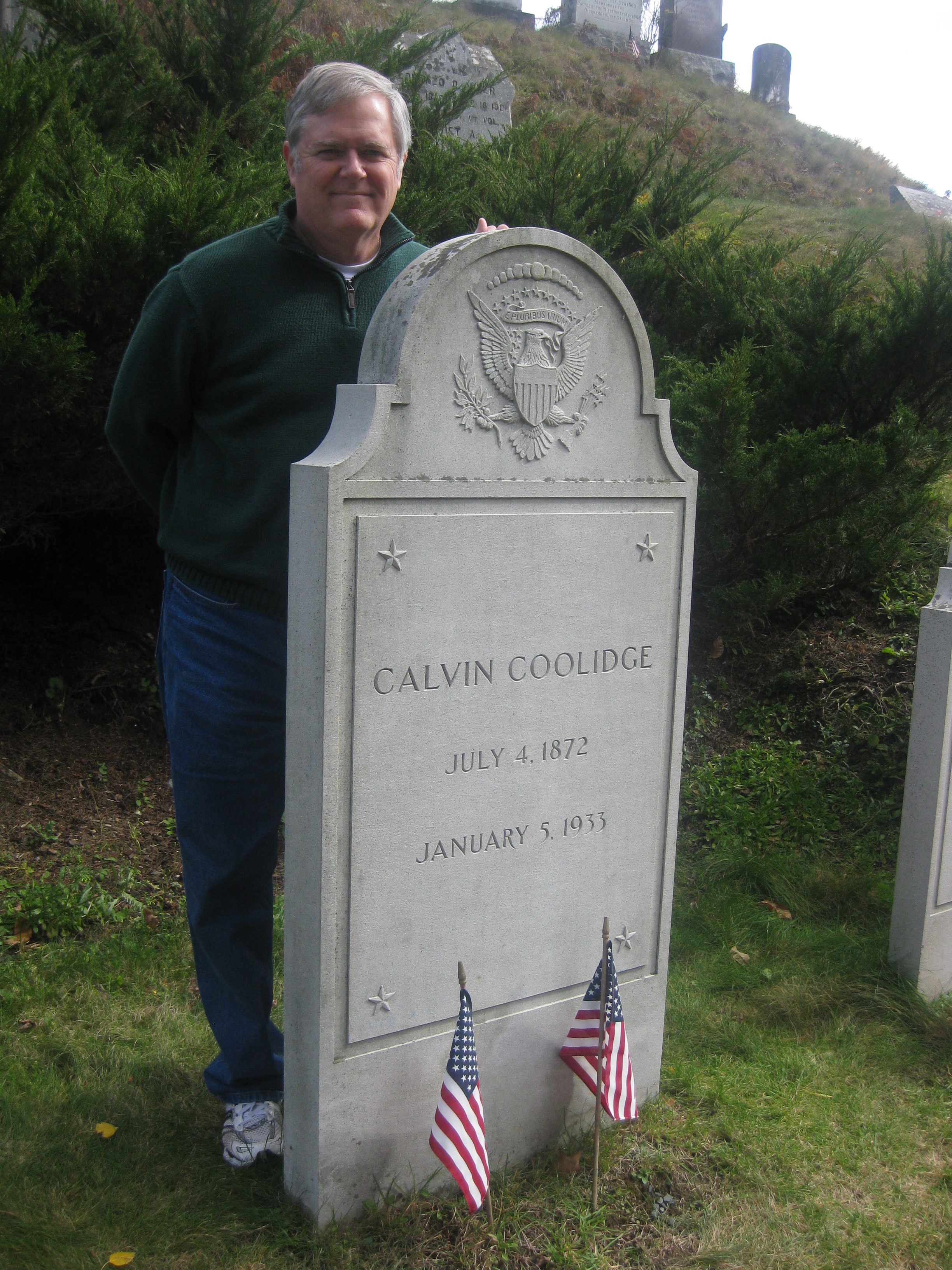
I’ve never met Calvin Coolidge, or Napoleon, or John Bunyan, but when I visited their final resting places, I felt like I somehow knew them:

Grave of former US President Calvin Coolidge in Vermont

Grave of former US President Calvin Coolidge in Vermont

If I’d seen these men in real life, they might have had Secret Service protection, or been kept at a distance from the public, or avoided crowds of commoners.

But death is the great equalizer.  I could walk right up to the graves of these people … think about their impact in my life … and even pose for a photo (in most cases).

Although there are a few celebrity graves that the public cannot visit … like those of Michael Jackson and Lady Diana … the average person can visit 95% of them.

And most of the time, you can linger and reflect … like the day I visited the grave of Winston Churchill … with nobody around.

Fourth, visiting graveyards is free.

Every cemetery I’ve visited does not have an admission charge.  I did pay $5 for a map of the grounds at Hollywood Forever, but it was well worth it.

While I hesitate to say that they’re entertaining, they’re certainly sobering … and even spooky at times:

Twilight at Mount Auburn Cemetery

Twilight at Mount Auburn Cemetery

While most cemeteries lack any kind of amusement factor, some cemeteries do offer “entertainment.”

For example, Hollywood Forever shows old movies on its grounds at night on a regular basis.

By the way, Westwood Memorial Park is the best cemetery I’ve visited as far as value.  Dozens of famous people (Will and Ariel Durant, for example) are buried there, but it takes the average person less than two minutes to walk across the whole place in either direction:

Westwood Memorial Park

Westwood Memorial Park

Finally, graveyards tend to be places of peace and rest.

My wife and I currently live in a 55+ community where it’s perpetually quiet, but we’re moving to a neighborhood full of shouting kids and screeching brakes.

It’s nice to know that in the midst of a noise-filled life, there are some places one can visit where it’s usually serene.

Many cemeteries feature manicured green lawns … gentle rolling hills … beautiful statues … and lovely landscaping.  For example, here’s a photo of Forest Lawn, Hollywood Hills:

IMG_2859

I’ve got quite a list of cemeteries I’d still like to visit, especially Forest Lawn in Glendale, California.

One grave I’d like to see is that of Babe Ruth, who is buried north of New York City.  (So is Lou Gehrig, but they’re in different cemeteries.)  My wife and I searched for it last fall, but came up empty.  Next time!

I’d also like to visit more of the graves of US Presidents, as well as members of the Baseball Hall of Fame.

From time-to-time, I’ll write more about this topic.  But for now, let me share with you a picture of one of my favorite tombstones:

Grave of American TV talk show host Merv Griffin

Grave of American TV talk show host Merv Griffin

My wife and I attended a terrific Easter service yesterday at the Orange County Fairgrounds in Costa Mesa, California.

Thousands of people attended.  We sang praise songs to the risen Christ … witnessed a multi-sensory video/dance presentation … heard a biblical message on the resurrection followed by a moving testimony … and witnessed baptisms when the service ended.

Because most churches expect they’ll have a larger-than-normal crowd on Easter, everyone goes all out.  There’s an organized clean-up day on Saturday … people bring Easter lilies on Sunday … the worship team plans a special song … the pastor spends extra time on his message … and the congregation leaves feeling upbeat and hopeful.

But ironically, the following Sunday is one of the worst-attended services of the year … presumably because many people have now accomplished half of their annual Easter/Christmas assignment.

But what if a church acted like every Sunday was Easter?

Theologically, most of us know that the early Christians changed their day of worship from the last day of the week to the first day because Jesus rose from the dead on a Sunday.

But too many churches – as I have witnessed during recent visits – put little effort into planning their regular services.

It’s 3 praise/worship songs for 15 minutes … followed by a greeting time/announcements/the offering … followed by the pastor’s message and a final song/benediction.

This is the basic order of service in about 75% of the churches I’ve visited over the past 40 months.

On Easter … Christians pull out all the stops.  On the other 51 Sundays, it’s business as usual … with the possible exception of a special service around December 25.

No wonder some people only come to church on Easter and Christmas!  Those are the only occasions the average church tries to do anything out of the ordinary.

How can a church make every Sunday Easter?

Let me make four quick recommendations:

First, the pastor has to become integrally involved in the planning of every service.

A pastor can’t delegate worship planning to someone else … and he can’t plan a worship service by himself, either.

There was a time 25+ years ago when I planned all the services at my church unilaterally … then I led the entire service myself, including the singing, testimony time, prayers, and sermons.

I was too lazy or busy to consult with others about the service week-after-week.  But I would work with others on Easter Sunday … and those were always the best services.

Hmmm.

The pastor may be a trained “professional,” but he needs input from others to offer services that will reach both men and women … young and old … and believers and unbelievers.

And he has to learn to value people who think differently than he does.

While pastors need to have the final say on every element in a service … and the congregation expects that he will …  this kind of planning requires getting key leaders together several times a month … and it’s essential if a church wants to make every Sunday Easter.

Second, the service has to be rehearsed.

No, a church service isn’t a show … but Jesus Christ deserves our best efforts … and that means working out the bugs before going prime time.

For the first 1/3 of my pastoral ministry, the churches I served didn’t rehearse any of their services.  If someone was going to sing a solo, they’d meet with their accompanist privately, but no provision was made for handling transitions (where to sit, when to come to the stage, how to hold the microphone, where to walk off).  Consequently, many service elements ended up being handled awkwardly … causing the congregation to cringe.

I remember the day it all changed for me.

I met with the leader of our worship band to plan the Easter service.  He had great ideas.  Then a few days before Easter, the entire service was rehearsed … from beginning to end.

After my message that Easter, three people prayed to receive Christ … an unusual event at the time.

Afterwards, a young teenager came up to me and said: “That was the best church service I’ve ever attended!  If I lived around here, I would go to this church.”

Bingo!  I realized that we needed to take our services up about five levels … and the best way to do that was to plan and rehearse every service.

That will make every Sunday Easter.

Third, the topics have to relate to people’s everyday lives.

I know a church where they offer a traditional service and a contemporary service.

The traditional service is aimed at seniors … and the place is fairly full.

The contemporary service is aimed at younger people … and the place is largely empty.

Why?  Because the pastor preaches through entire books of the Bible … and he doesn’t do it well enough to capture the interest of people under 40.

Many pastors … and I include myself … were trained to be expository preachers.  We delight in preaching through Deuteronomy or Ezra or Ephesians or Hebrews.

In fact, the more challenging text, the better!

During the week, we study the text … gather our commentaries … scratch out an outline … and put together our message.  On Sunday, we stand up to preach.

But let’s be honest … very few pastors are great expositors.

I once preached through 2 Chronicles.  I found it fascinating … and emptied out half the church in the process.

I have a pastor friend who can take a Bible chapter, a single verse, or any topic and hold your attention for a solid hour … but he’s a rarity.

In my view, most pastors should speak topically … just like Jesus did.  While Jesus gave biblically-based messages, most of his sermons were topical … like the Sermon on the Mount.  He dealt with contemporary issues in the culture and the religious sphere – holding the attention of His hearers – and constantly brought them back to Old Testament texts.

And Jesus constantly told stories … and yet my guess is that about 1/3 of the pastors I’ve heard preach recently didn’t tell one story.

There’s a time to go through books of the Bible – maybe in a small group, or at a midweek study – but fewer people than ever are going to church in this country.

Maybe we need to change the way we teach before they’ll even consider coming … just like we do on Easter.

Finally, we need to speak in a language our culture can understand.

My wife and I attended a Good Friday service last week.  While the pastor conducted the service, he didn’t preach.  Instead, the “message” was a monologue presented by the centurion who stood by the cross when Jesus was crucified.

While I would have preferred at least a dialogue … the centurion could have been interviewed on a first-century talk show, for example … I give that church an “A” for understanding how to speak to our culture.

Most churches in our day have a band … and the pastor uses PowerPoint in some form … but we can do so much more with our services to draw lost people toward Jesus.

In my view:

*We need more testimonies (in person or on video).  These can be done as monologues or as interviews.

*We need more presentation songs.  I can’t understand the aversion that churches have to asking gifted vocalists to sing solos.  Yes, it’s a lot of work … but it’s worth it.  (Our home church in Arizona still does 1-2 presentation songs every weekend.)

*We need more creative Scripture reading and more meaningful times of prayer (don’t we believe in the priesthood of all believers?).

*We need to produce more in-house videos.  I know a church full of seniors where they’re more advanced in using video technology than most churches filled with GenXers!

*We need to move people both spiritually and emotionally.  (I cried my way through “Don’t You Hear the Mountains Tremble” at yesterday’s Easter service because it’s the first time I’ve ever heard that song done in a worship service.)

And friends, let’s be honest: strong left-brained pastors … and I include myself … aren’t very good at moving people emotionally.

This is why pastors need to work with more creative right-brained people.

Reaching people for Jesus starts with presenting Christ in a creative, authentic, relevant, and excellent fashion.

But too often, we’re just talking to ourselves … and not making a dent in fulfilling the Great Commission.

But if we’ll make the effort, we can turn every Sunday into Easter.

And people will come.  People most certainly will come.

And they will find Jesus Christ … who can make every day of our lives Easter.